
Knee Surgery Recovery: Arthroscopy to Ligament Reconstruction, Milestones, and Rehabilitation in India
In short
Recovering from knee surgery requires structured, milestone-based rehabilitation. Discover graft healing biology, swelling management, quad reactivation, and clinical physio.
In this guide (5 sections)
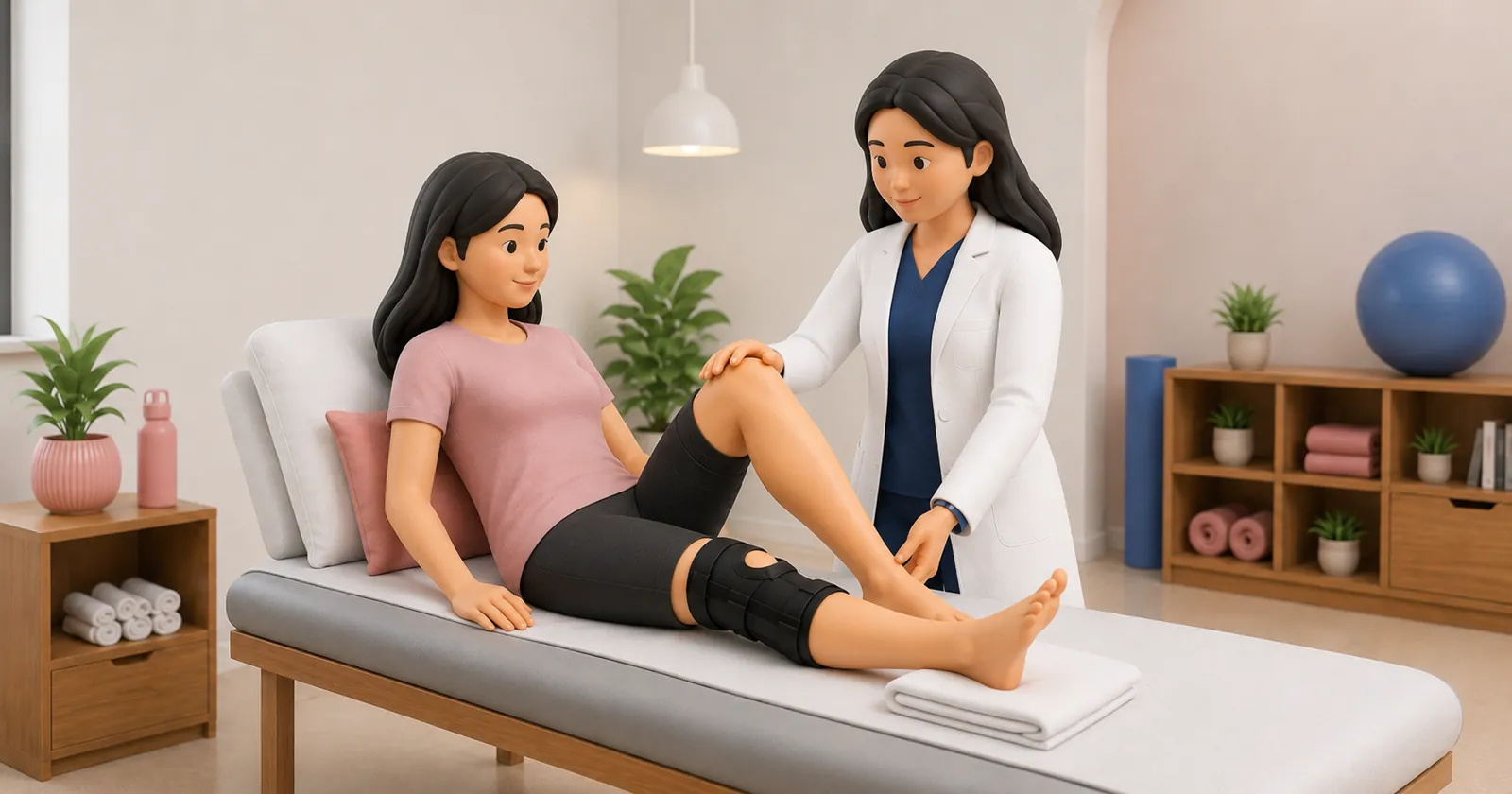
Undergoing knee surgery: whether an arthroscopic meniscal repair, partial meniscectomy, chondral debridement, or anterior cruciate ligament (ACL) reconstruction: represents only the first step in reclaiming pain-free joint function. While the orthopaedic surgeon skillfully repairs or reconstructs anatomical structures, the biological success of the procedure is determined almost entirely by the quality, consistency, and precision of postoperative rehabilitation.
In India, thousands of active adults and athletes undergo knee arthroscopy each month. A frequent pitfall is assuming that modern minimally invasive 'keyhole' surgery requires minimal physical rehabilitation. In reality, arthroscopic joint distension and surgical trauma provoke immediate arthrogenic muscle inhibition (AMI): a neural shutdown of the quadriceps muscle mediated by the spinal cord. Without prompt, structured physiotherapy to eliminate swelling and reactivate the vastus medialis, patients risk permanent muscle atrophy, altered gait mechanics, and premature osteoarthritic degeneration.
1. Surgical Procedures: Meniscal Repair vs Meniscectomy vs ACL Reconstruction
Postoperative physiotherapy guidelines differ fundamentally based on whether joint tissue was excised, repaired, or reconstructed with a biological graft.
| Clinical Parameter | Partial Meniscectomy | Meniscal Repair (Sutured) | ACL Reconstruction (Bone-Patellar/Hamstring) |
|---|---|---|---|
| Weight-Bearing Status | Immediate weight-bearing as tolerated with crutches for 3 to 7 days | Strict non-weight bearing or partial weight bearing for 4 to 6 weeks | Protected weight bearing with crutches and hinged knee brace for 2 to 4 weeks |
| Flexion Range Restrictions | Early full active range of motion as swelling permits | Flexion strictly restricted to 90 degrees for first 4 weeks to protect sutures | Immediate passive terminal extension (0 degrees); gradual flexion to 90 by week 2 |
| Graft / Tissue Biology | Zero healing tissue; focus is on rapid swelling clearance and quad reactivation | Biological fibrocartilage healing in vascular red-red zone; vulnerable to shear | Ligamentisation of graft: weakest between weeks 6 and 12 during revascularisation |
| Return to High-Impact Sport | 6 to 8 weeks following functional strength testing | 4 to 6 months to ensure complete meniscal scar consolidation | 9 to 12 months minimum based on strict Limb Symmetry Index (>90%) |
2. Arthrogenic Muscle Inhibition (AMI) and Swelling Control
Arthrogenic Muscle Inhibition is an involuntary, reflex neural inhibition of the quadriceps musculature triggered by intra-articular effusion (fluid) and joint nociception. Even as little as 20 to 30 millilitres of joint fluid: barely enough to cause visible swelling: triggers inhibitory reflex signals from joint mechanoreceptors to the spinal cord, suppressing the motor neuron pool of the vastus medialis oblique (VMO).
Until this swelling is aggressively cleared, traditional strengthening exercises remain ineffective because the brain cannot recruit the muscle. Postoperative physiotherapy prioritizes the PRICE protocol (Protection, Rest, Ice, Compression, Elevation), active ankle pumps to stimulate the calf venous pump, and neuromuscular electrical stimulation (NMES) to bypass spinal inhibition and re-educate the quadriceps.
3. Three-Phase Milestone-Driven Knee Rehabilitation Protocol
Progression must be governed by biological tissue healing criteria and functional physical milestones rather than arbitrary calendar dates.
Phase 1: Isometric Quadriceps Setting and Terminal Extension
Objective: Eliminate quadriceps lag and restore mandatory zero-degree terminal knee extension.
- 1Sit or lie supine with your legs straight out in front of you on a firm bed or mat.
- 2Place a small rolled hand towel directly beneath your heel, elevating your knee slightly off the mat.
- 3Actively tighten the front of your thigh, pressing the back of your knee firmly downward toward the bed.
- 4Ensure your kneecap glides superiorly (upward toward your hip) as the vastus medialis contracts.
- 5Hold the contraction for 5 seconds while breathing smoothly, feeling the knee lock out straight at 0 degrees, then relax.
Phase 2: Straight Leg Raise (SLR) Without Extension Lag
Objective: Build multi-joint hip flexor and quadriceps strength while protecting healing articular cartilage.
- 1Lie on your back with your unaffected knee bent at 90 degrees with foot flat on the mat for spinal support.
- 2Completely lock your surgical knee straight into full extension by engaging your quadriceps.
- 3Maintaining a rigid, locked knee, slowly lift your entire leg 20 to 30 centimetres off the bed.
- 4Ensure the knee does not sag or bend into flexion during the lift (zero extensor lag).
- 5Hold for 2 seconds at the peak, then lower slowly under control over 3 seconds.
Phase 3: Closed-Chain Mini-Squats and Proprioceptive Balancing
Objective: Restore functional axial joint loading, hamstring-quadriceps co-contraction, and balance.
- 1Stand tall with feet shoulder-width apart, holding onto a sturdy kitchen counter or table for security.
- 2Distribute your body weight symmetrically across both feet.
- 3Slowly hinge at your hips and bend your knees to a comfortable 45-degree angle, keeping your chest upright and knees aligned over your toes.
- 4Pause at the bottom for 2 seconds, then drive through your heels to return to standing.
- 5Progress to single-leg balancing on a firm surface once comfortable.
Reduced mobility and surgical trauma significantly increase the risk of deep vein thrombosis in the lower limb. Seek emergency medical evaluation immediately if you experience: sudden persistent throbbing pain or severe cramping in the calf muscle, localized calf swelling, erythema (redness), or unusual warmth compared to the other leg. Sudden shortness of breath, chest pain, or coughing up blood indicates a life-threatening pulmonary embolism requiring an ambulance.
4. Treatment Settings and Transparent Fee Benchmarks in India
During the first 2 to 4 weeks following knee surgery, home-visit physiotherapy is essential. Navigating flights of stairs, crowded vehicular transit, and clinic waiting rooms with fresh surgical incisions, crutches, and a bulky brace is physically hazardous. A home-visit physiotherapist monitors wound healing, measures passive knee range of motion with a goniometer, guides safe bed and bathroom transfers, and safely progresses weight bearing.
Once functional walking is established, transitioning to an outpatient clinic provides access to stationary exercise bikes, leg press machines, and agility equipment. Standard outpatient clinic fees in Indian urban centres range from ₹400 to ₹1,500 per session. In-home physiotherapy sessions range from ₹600 to ₹2,000 depending on clinical expertise and travel distance. Transparent direct payments ensure clinical trust.
5. Frequently Asked Questions Regarding Knee Surgery Rehabilitation
Why is restoring 0 degrees of knee extension more important than bending early on?
Restoring full terminal knee extension (0 degrees: completely flat) is the single most critical early milestone after knee surgery. While bending (flexion) can be reclaimed gradually over weeks, failure to achieve full extension within the first 2 to 4 weeks often leads to permanent arthrofibrosis (scar tissue scarring in the anterior notch). Even a tiny 5-degree extension deficit forces you to walk with a permanent bent-knee limp, dramatically increases patellofemoral joint stress, and causes chronic quadriceps fatigue.
When can I stop using crutches after my knee surgery?
You can safely discontinue crutches only when three objective criteria are met: you can perform a straight leg raise with zero knee lag (the knee remains completely locked), you have achieved full knee extension, and you can walk on flat ground without a limp. Discontinuing crutches prematurely while limping reinforces abnormal gait mechanics and places destructive shear stresses across healing surgical tissues.
Is it normal for my knee to click or pop after surgery?
Occasional painless clicking, popping, or soft crepitus is extraordinarily common during the first 3 to 6 months after knee surgery. This is typically caused by resolving joint swelling, temporary patellar maltracking due to vastus medialis weakness, or minor scar tissue remodeling. As quadriceps strength normalizes and joint effusion completely resolves, these sounds usually diminish. However, if clicking is accompanied by sharp pain, catching, or the knee giving way, consult your surgeon.
How long should I continue applying ice to my knee after surgery?
Cryotherapy (icing) should be used regularly (15 to 20 minutes, 3 to 4 times daily) during the acute phase (the first 2 to 3 weeks) to control post-surgical inflammation and provide natural analgesia. Beyond the acute phase, continue applying ice for 15 minutes after performing your rehabilitation exercises or after strenuous walking as long as post-activity swelling or warmth persists.
When is it safe to drive after knee surgery in India?
For left knee surgery in an automatic transmission car, driving may resume within 2 to 4 weeks once you are no longer taking sedating pain medications and can comfortably enter and exit the vehicle. For right knee surgery or driving a manual vehicle (requiring rapid clutch and brake foot transitions), driving is typically prohibited for 6 to 8 weeks until your emergency brake reaction time and lower limb motor control return to normal baseline levels.
Related condition guides


BookPhysio.in Editorial Team
The BookPhysio.in editorial team writes and maintains this content, checking it against reliable clinical sources. Content follows our medical review policy: general information only, and no page claims a clinical review until a named registered physiotherapist has signed it off.
Read our medical review policy