
Physiotherapy and pain medication: how their roles differ
In short
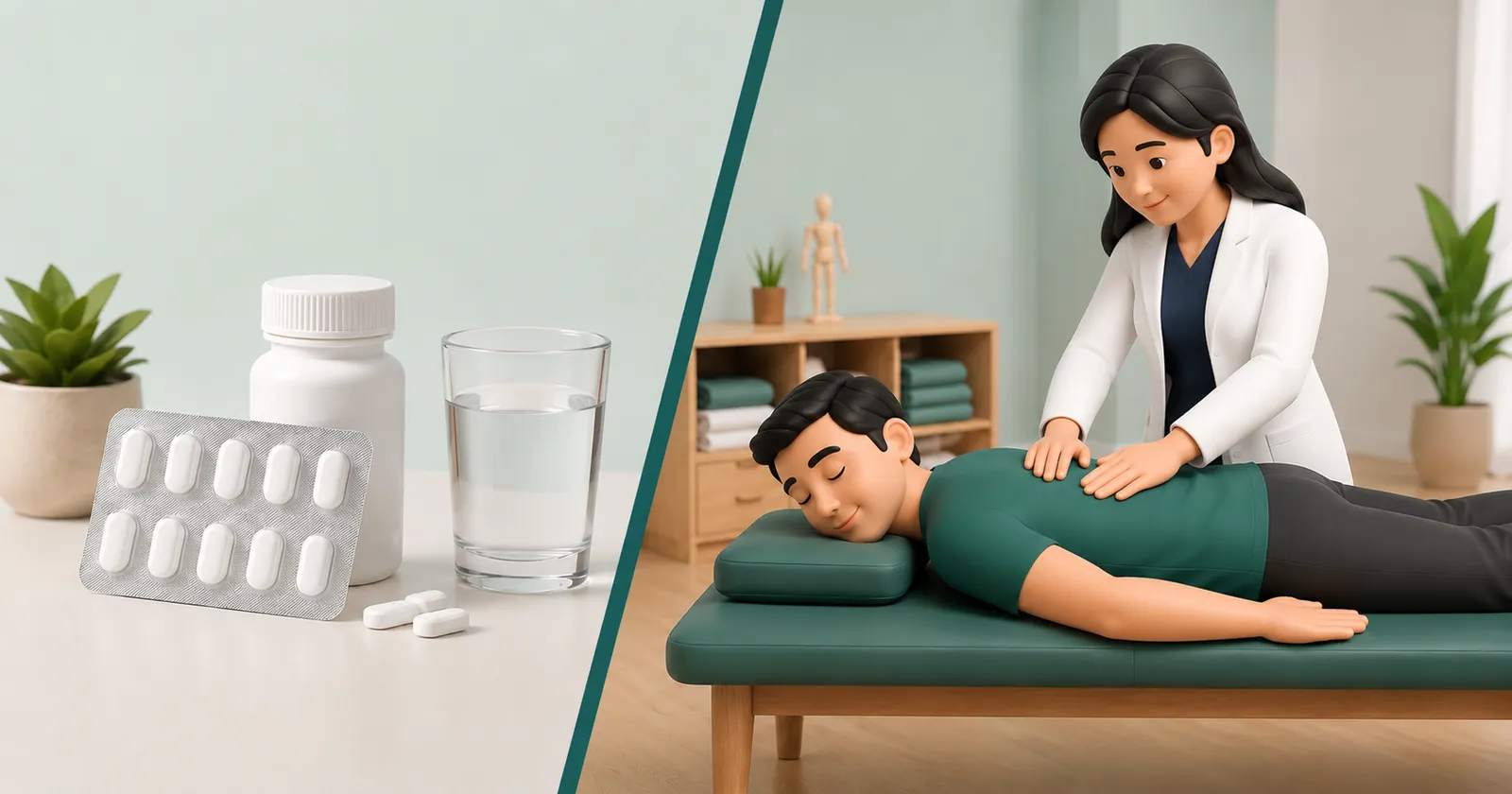
Pain medication and physiotherapy can have different roles and may sometimes be used together. Medication decisions belong with a doctor or pharmacist. Physiotherapy may focus on assessment, movement, function, activity, and rehabilitation. Neither should be presented as universally better for every type of pain.
In this guide (6 sections)
When acute musculoskeletal pain strikes: whether from lifting a domestic LPG cylinder, an acute ankle sprain, or severe neck stiffness from prolonged laptop work: patients in India frequently face a dilemma: should they rely on pharmaceutical painkillers or pursue active physiotherapy? Understanding how pharmacological interventions and physical rehabilitation interact: rather than viewing them as competing alternatives: is essential for achieving safe, long-lasting recovery while avoiding drug toxicity.
Pharmacological Pain Relief: Chemical Symptom Suppression
Analgesics, non-steroidal anti-inflammatory drugs (NSAIDs such as aceclofenac, diclofenac, or naproxen), muscle relaxants (such as thiocolchicoside or chlorzoxazone), and neuropathic agents (like pregabalin or gabapentin) operate chemically. They inhibit cyclooxygenase (COX) enzymes, decrease prostaglandin synthesis, or suppress ascending nociceptive pain signals along the spinal cord dorsal horn.
Prescribed medication provides a valuable clinical window of symptom relief during severe inflammatory flare-ups. However, pharmaceuticals do not correct faulty movement mechanics, strengthen atrophied stabilizing muscles, restore joint proprioception, or decompress a mechanically impinged spinal nerve root. When pain medication wears off, the underlying mechanical vulnerability remains entirely unaddressed.
Physiotherapy: Mechanical Restoration and Neuromuscular Adaptation
Physiotherapy treats musculoskeletal disorders through biomechanical and neurophysiological pathways. By performing targeted joint mobilisations, progressive resistance exercises, motor control re-education, and neural tissue mobilisation, a physiotherapist directly addresses the root mechanical drivers of tissue overload.
Through mechanotransduction, controlled mechanical loading stimulates cellular fibroblasts to synthesize new type I collagen fibers in injured tendons and ligaments, enhances proteoglycan synthesis in articular cartilage, and restores muscular tensile strength. Concurrently, graded active movement desensitizes an overactive central nervous system, reducing chronic pain hyperalgesia and kinesiophobia (fear of movement).
| Clinical Parameter | Physiotherapy Rehabilitation | Pharmacological Analgesia (NSAIDs / Painkillers) | |
|---|---|---|---|
| Primary Mechanism | Biomechanical loading, tissue remodeling, motor control, and joint kinematics | Biochemical inhibition of inflammatory mediators (COX enzymes) and neural signals | |
| Speed of Relief | Gradual progression over days to weeks; builds cumulative structural resilience | Rapid onset within 30 to 90 minutes; temporary symptomatic masking | |
| Long-Term Durability | High: strengthens supporting muscles, reduces recurrence rates by 60% to 80% | Low: pain returns immediately upon discontinuation if root mechanics are unchanged | |
| Side Effect Profile | Mild transient delayed onset muscle soreness (DOMS); zero systemic organ toxicity | Risk of gastric ulceration, renal toxicity, hepatic strain, and dependency over time | |
| Role in Chronic Pain | First-line gold standard for osteoarthritis, chronic low back pain, and tendinopathy | Secondary, short-term adjunctive use; guideline-discouraged for prolonged monotherapy |
Neuropathic Pain vs Nociceptive Pain: Why Strategy Must Differ
A major clinical distinction often overlooked by patients is the difference between nociceptive tissue pain and neuropathic nerve pain. Nociceptive pain originates from inflamed joints, torn ligaments, or strained muscles, producing a localized, dull ache that responds moderately to short courses of NSAIDs and active physical loading. Neuropathic pain arises from mechanical compression or chemical irritation of neural tissue: such as sciatica from an L5-S1 disc herniation or cervical radiculopathy.
Neuropathic pain presents as burning, electric shocks, tingling, and numbness radiating down the extremity. Standard NSAIDs are notoriously ineffective for true neuropathic pain, often leading physicians to prescribe neuromodulators like pregabalin. Physiotherapy approaches neuropathic pain through specialized neurodynamic mobilisations (nerve glides), spinal opening techniques, and McKenzie directional preference exercises that physically relieve nerve root compression rather than just muting sensory pathways.
The Synergistic Window: How Medication and Physiotherapy Cooperate
In clinical practice, the most effective strategy is rarely an "either/or" choice. In acute high-irritability presentations: such as an acute lumbar disc extrusion with severe radiating sciatic pain, or acute frozen shoulder in the freezing phase: pain intensity may be so excruciating that the patient cannot tolerate active physical assessment or therapeutic exercise.
Here, a short, medically supervised course of anti-inflammatory analgesics prescribed by a physician or orthopaedic surgeon lowers nociceptive input. This biochemical "window of opportunity" allows the physiotherapist to introduce gentle neural glides, pain-free directional preference movements, and isometric stabilizing contractions. As mechanical stability improves and pain recedes, medication is systematically tapered under medical guidance.
In persistent musculoskeletal syndromes such as fibromyalgia, chronic myofascial pain syndrome, or failed back surgery syndrome, reliance on long-term opioids or non-steroidal analgesics carries severe addiction and organ failure risks. Contemporary clinical practice guidelines from the World Health Organization and the Indian Council of Medical Research emphasize non-pharmacological modalities: including graded motor imagery, pain neuroscience education, aerobic reconditioning, and progressive resistance training: as the foundational management strategy. Physical rehabilitation targets the neurobiological drivers of central sensitization, fostering durable self-efficacy rather than passive chemical symptom suppression. Collaborative multidisciplinary care combining medical pain control with targeted physical rehabilitation produces optimal long-term functional recovery.
Risks of Long-Term Self-Medication in the Indian Context
In India, over-the-counter availability of potent NSAID combinations (often paired with paracetamol and serratiopeptidase) leads millions of citizens to self-medicate chronic joint and back pain for months. Prolonged NSAID consumption is a leading cause of drug-induced peptic ulcers, gastrointestinal bleeding, and accelerated nephrotoxicity, particularly in patients with hypertension or type 2 diabetes.
Masking pain signals with chronic analgesics while continuing to subject degenerated joints to faulty biomechanical loads accelerates cartilage breakdown. Patients often present to orthopaedic clinics with bone-on-bone knee osteoarthritis that could have been preserved with early quadriceps strengthening and gait correction five years earlier.
Screening for Red Flags Requiring Immediate Medical Intervention
Neither physiotherapy nor standard analgesics are appropriate when musculoskeletal pain masks serious systemic pathology. Immediate specialist medical consultation is imperative if you experience: unremitting night pain that worsens when lying flat, pain accompanied by unexplained weight loss, night sweats, or low-grade fever (indicative of spinal tuberculosis / Pott spine or neoplastic disease), sudden severe motor paralysis (drop foot or knee giving way), or bowel/bladder sphincter incontinence.
Should I take my painkiller before going to my physiotherapy appointment?
Generally, no. Your physiotherapist needs an accurate baseline assessment of your natural symptom response, pain provocation patterns, and movement thresholds. Masking pain with a strong analgesic immediately before the session may lead to unintentional tissue over-stretching during manual testing. Consult your treating clinician for individual guidance on timing.
Can physiotherapy completely replace painkillers for severe arthritis?
In mild to moderate osteoarthritis, structured physiotherapy: focusing on quadriceps and hip abductor strengthening, weight management, and joint offloading: often reduces pain sufficiently to eliminate daily NSAID dependency. In advanced severe cases, physiotherapy reduces the dosage and frequency of medication required to maintain functional mobility comfortably.
Is it dangerous to stop prescribed pain medication abruptly to start physiotherapy?
Never stop prescribed pharmaceuticals: especially neuropathic medications like pregabalin, or chronic steroids: abruptly without consulting your prescribing physician. Any medication tapering should occur gradually in coordination with your doctor as physiotherapy restores mechanical function and tissue load capacity.
Why does my back pain return as soon as my medication course finishes?
Medication only suppresses the biochemical sensation of pain; it does not correct the muscle imbalances, deep core weakness, disc mechanical pressure, or prolonged sitting postures that caused the strain. Without active physiotherapy to rebuild structural support, symptoms inevitably recur once the drug clears your bloodstream.
How long does physiotherapy take to provide noticeable pain relief?
Most patients experience meaningful pain reduction and mobility gains within 3 to 6 active sessions over two weeks. Long-term structural adaptations: such as tendon collagen remodeling, core muscle hypertrophy, and motor pattern re-education: typically require 6 to 12 weeks of consistent rehabilitation to consolidate permanent resilience.
- The Lancet (2021): Management of Chronic Musculoskeletal Pain - Guideline Comparisons: https://thelancet.com
- American College of Rheumatology (ACR) Guidelines for Osteoarthritis: Non-Pharmacological Interventions: https://rheumatology.org
- Indian Council of Medical Research (ICMR): Clinical Practice Guidelines for Management of Low Back Pain: https://icmr.nic.in
- British Journal of Sports Medicine (BJSM): Mechanotransduction and Active Loading in Tendinopathy: https://bjsm.bmj.com
Related condition guides
BookPhysio.in Editorial Team
The BookPhysio.in editorial team writes and maintains this content, checking it against reliable clinical sources. Content follows our medical review policy: general information only, and no page claims a clinical review until a named registered physiotherapist has signed it off.
Read our medical review policy