
Frozen Shoulder (Adhesive Capsulitis): Clinical Signs, Capsular Patterns, and Physiotherapy Recovery in India
In short
Frozen shoulder severely limits arm elevation and external rotation. Learn why the capsule tightens, how clinical staging dictates treatment, and evidence-based physiotherapy.
In this guide (5 sections)
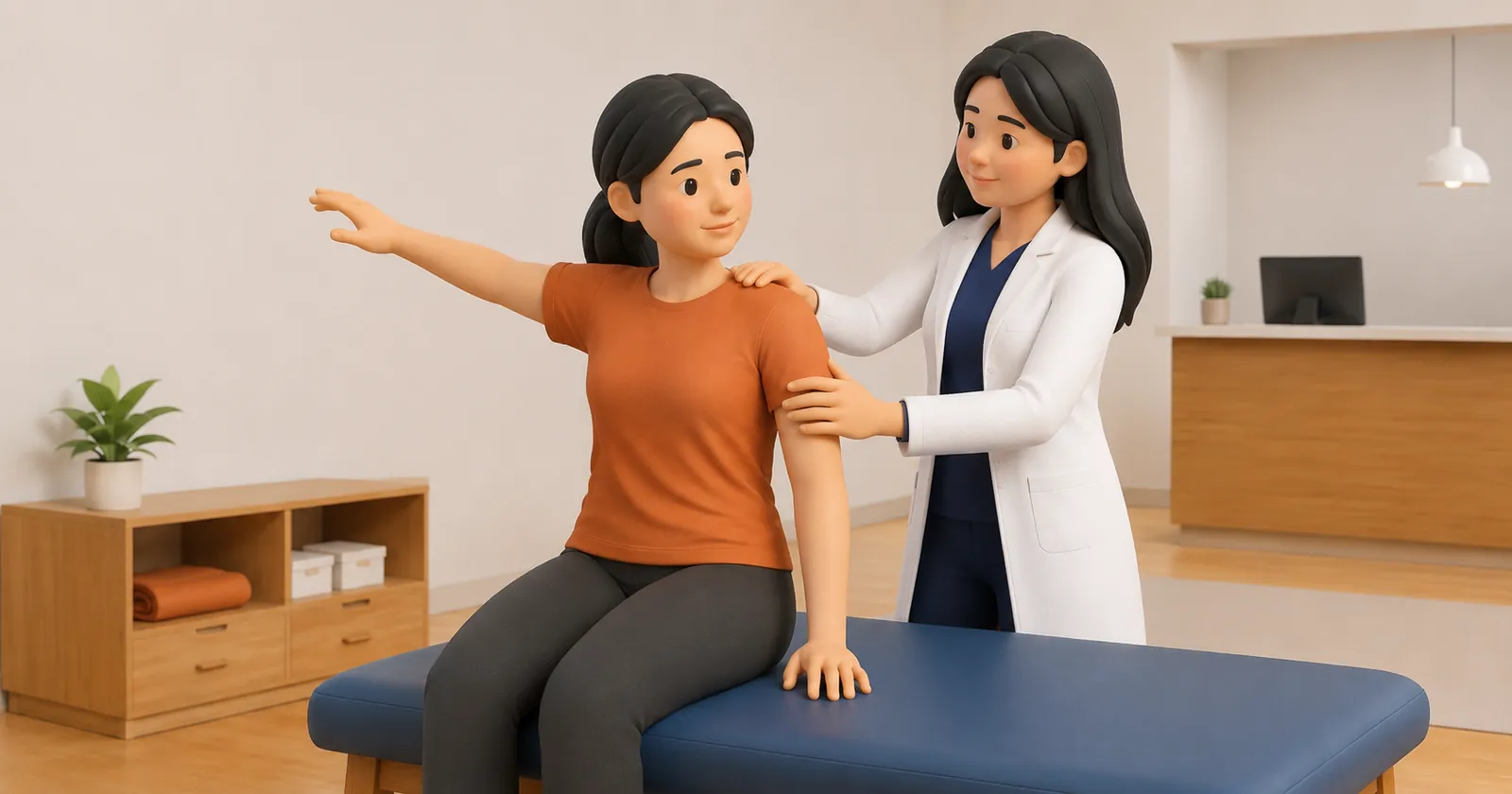
Frozen shoulder: clinically termed primary adhesive capsulitis: is an excruciating and notoriously disabling disorder of the glenohumeral joint. It is characterized by spontaneous onset of severe shoulder pain accompanied by progressive, profound global restriction of both active and passive glenohumeral range of motion. Unlike a localized tendon tear or bursitis where passive motion is preserved, adhesive capsulitis physically 'shrink-wraps' the entire joint capsule, creating a firm, mechanical block that halts arm elevation and external rotation.
In India, frozen shoulder predominantly affects adults between 40 and 65 years of age, with a disproportionate prevalence among women and individuals with metabolic disorders like type 2 diabetes or hypothyroidism. A major clinical pitfall is late presentation: patients frequently dismiss early freezing symptoms as a minor muscular sprain or 'sleeping wrong', seeking help only when reaching for an overhead shelf, combing their hair, or fastening a bra behind their back becomes impossible. Early, staged physiotherapy prevents intractable joint contracture.
1. The Capsular Pattern: Cyriax Rules of Glenohumeral Restriction
Orthopaedic medicine pioneer Dr. James Cyriax established that when the entire capsule of a synovial joint is inflamed or fibrotic, motion is lost in a predictable, fixed proportional pattern known as the capsular pattern. For the glenohumeral joint, the capsular pattern is defined as: External rotation is most severely limited, followed closely by abduction, and lastly by internal rotation.
| Clinical Feature | Adhesive Capsulitis (Frozen Shoulder) | Rotator Cuff Tendinopathy / Tear |
|---|---|---|
| Passive External Rotation | Profoundly restricted with firm, leathery capsular end-feel (<30 degrees) | Normal or near-normal passive range; restricted primarily by pain |
| Active vs Passive Motion | Both active AND passive movements equally blocked in capsular pattern | Active movement painful/weak; passive motion substantially preserved |
| Night Pain Characteristics | Severe, unremitting, throbbing ache disrupting sleep; cannot lie on side | Intermittent nocturnal ache; exacerbated mainly when rolling directly onto arm |
| Scapulothoracic Mechanics | Immediate compensatory scapular hiking (shrug) on initiating arm elevation | Painful arc between 60 and 120 degrees; normal initial scapular rhythm |
2. Staged Natural History and Clinical Presentation
Adhesive capsulitis evolves through three distinct biological phases. Stage 1 (Freezing / Inflammatory, 2 to 9 months) is dominated by hypervascular synovitis and severe unremitting night pain. Stage 2 (Frozen / Fibrotic, 4 to 12 months) sees a subsidence of resting pain into a dull ache, replaced by dense collagenous contracture and mechanical joint stiffness. Stage 3 (Thawing, 6 to 18 months) features gradual spontaneous remodeling of the capsule and progressive return of functional reach.
Physiotherapy interventions must be rigorously matched to the patient's biological stage. In the freezing stage, aggressive stretching is contraindicated because it provokes intense inflammatory flare-ups. Management focuses on pain modulation, pendulum swings, and gentle scapular setting. In the frozen stage, Maitland Grade III and IV oscillatory joint mobilisations and end-range capsular stretches are indicated to mechanically elongate fibrotic tissues.
3. Three-Phase Structured Shoulder Mobilisation Protocol
The following staged exercises restore synovial fluid circulation and progressively expand capsular boundaries.
Phase 1: Codman Pendulum Swings (Passive Joint Decompression)
Objective: Distract the humeral head from the glenoid fossa and stimulate synovial fluid flow without muscular effort.
- 1Stand beside a sturdy table or kitchen counter. Bend forward at the waist at a 90-degree angle, supporting your unaffected arm on the table.
- 2Allow your symptomatic arm to dangle completely limp toward the floor like a relaxed pendulum.
- 3Initiate motion by swaying your entire torso in gentle circles; do not actively use your shoulder muscles to swing the arm.
- 4Let the weight of your arm create passive traction in the glenohumeral joint, allowing momentum to create circles 20 to 30 centimetres wide.
- 5Repeat in counter-clockwise circles and back-and-forth directions. This provides immediate soothing relief.
Phase 2: Supine Wand External Rotation Stretch
Objective: Elongate the contracted anterior capsule and coracohumeral ligament using the non-painful arm as an assist.
- 1Lie flat on your back on a bed or mat with a rolled hand towel under your elbow to keep the upper arm level with your torso.
- 2Bend both elbows to 90 degrees, holding a light wooden walking stick or broom handle horizontally across your abdomen.
- 3Keeping the elbow of your stiff shoulder tucked close to your flank, use your healthy arm to push the stick outward.
- 4This rotates the forearm of your stiff shoulder outward away from your body into external rotation.
- 5Push until you feel a firm, tolerable stretching sensation: never sharp, stabbing pain. Hold for 10 seconds, then return to centre.
Phase 3: Standing Overhead Pulley or Wall Crawls
Objective: Reclaim terminal active-assisted forward flexion and break inferior axillary pouch adhesions.
- 1Stand facing a smooth wall at an arm's distance, with feet staggered.
- 2Place the fingertips of your affected hand on the wall at waist height.
- 3Slowly walk your fingers upward like a spider, stepping closer to the wall as your arm elevates.
- 4At the highest comfortable point where you feel a firm stretch in your armpit, hold the position for 5 seconds.
- 5Do not shrug your shoulder up to your ear; actively keep your shoulder blade relaxed and depressed as your arm climbs.
- 6Slide your hand down smoothly, step back, and rest.
Severe shoulder pain accompanied by localized joint warmth, erythema (redness), high fever, or chills warrants emergency medical evaluation for septic arthritis: a rapid bacterial infection that destroys joint cartilage within days. Similarly, unremitting severe night pain accompanied by unexplained weight loss or a prior history of breast or lung cancer requires immediate oncological imaging to rule out bony metastasis or apical lung (Pancoast) tumors.
4. Clinical Settings, Manual Therapy, and Fee Transparency in India
Outpatient clinic physiotherapy provides access to specialized shoulder pulleys, Maitland mobilisation plinths, and functional resistance equipment. For patients in the hyperalgesic freezing stage where sitting in a vehicle or bumping over road potholes triggers excruciating joint spasms, home-visit physiotherapy provides essential bedside manual therapy and guidance on pain-free sleeping positioning.
Standard physiotherapy fees across Indian clinics range from ₹400 to ₹1,500 per session. In-home physiotherapy sessions range from ₹600 to ₹2,000 depending on city tier and practitioner clinical credentials. Patients pay directly per session, avoiding lock-in contracts.
5. Frequently Asked Questions Regarding Frozen Shoulder Physiotherapy
How long does frozen shoulder typically take to resolve fully?
Without treatment, frozen shoulder is a self-limiting condition that often runs an agonizing 18 to 36-month course. With structured, stage-appropriate physiotherapy, recovery can be substantially accelerated, with most patients reclaiming 80 to 95 percent of functional range within 6 to 12 months. Diligence with daily home stretching exercises and avoidance of aggressive early manipulation are the primary keys to a rapid, uncomplicated recovery.
Can an injection help before starting physiotherapy for frozen shoulder?
Yes. In the early inflammatory 'freezing' stage, an ultrasound-guided intra-articular corticosteroid injection administered by an orthopaedic specialist can dramatically diminish synovial inflammation and night pain. This creates a valuable therapeutic window of 4 to 8 weeks during which physiotherapy can mobilise the joint capsule far more comfortably and effectively. In chronic fibrotic cases, hydrodilatation (injecting sterile saline to physically distend the capsule) is another evidence-backed option.
Should my physiotherapist forcefully push through severe pain to break adhesions?
No. Forceful, aggressive manipulation through severe pain is an outdated, harmful practice. Aggressive force tears the fragile inflamed capsule, triggering massive secondary inflammatory cascades, reactive muscular spasm, and additional scar tissue formation. Modern evidence-based physiotherapy utilizes Maitland Grade I to IV gentle rhythmic oscillations and sustained low-load end-range stretching that stimulates physiological creep and collagen remodeling without causing tissue trauma.
What is the best way to sleep when you have frozen shoulder?
Avoid sleeping directly on the symptomatic shoulder. The ideal position is sleeping on your unaffected side or on your back. If lying on your unaffected side, place a firm pillow in front of your chest to support your symptomatic arm: this prevents the painful shoulder from dangling forward into adduction and internal rotation, which compresses the anterior capsule. If sleeping on your back, place a folded pillow beneath your elbow and forearm to keep the shoulder slightly flexed.
Will I develop frozen shoulder in my other arm as well?
Approximately 20 to 30 percent of individuals who experience frozen shoulder in one arm eventually develop it in the contralateral (opposite) shoulder, typically within 2 to 5 years. This risk is considerably higher (up to 40 percent) in patients with poorly controlled diabetes mellitus or thyroid disease. Interestingly, frozen shoulder almost never recurs in the same shoulder once the condition has completely resolved.
Related condition guides

BookPhysio.in Editorial Team
The BookPhysio.in editorial team writes and maintains this content, checking it against reliable clinical sources. Content follows our medical review policy: general information only, and no page claims a clinical review until a named registered physiotherapist has signed it off.
Read our medical review policy