
Rotator Cuff Related Shoulder Pain: Tendon Biomechanics, Load Management, and Physiotherapy in India
In short
Rotator cuff related shoulder pain affects overhead reach, lifting, and sleep. Discover why tendons break down, why rest fails, and evidence-based loading exercises.
In this guide (5 sections)
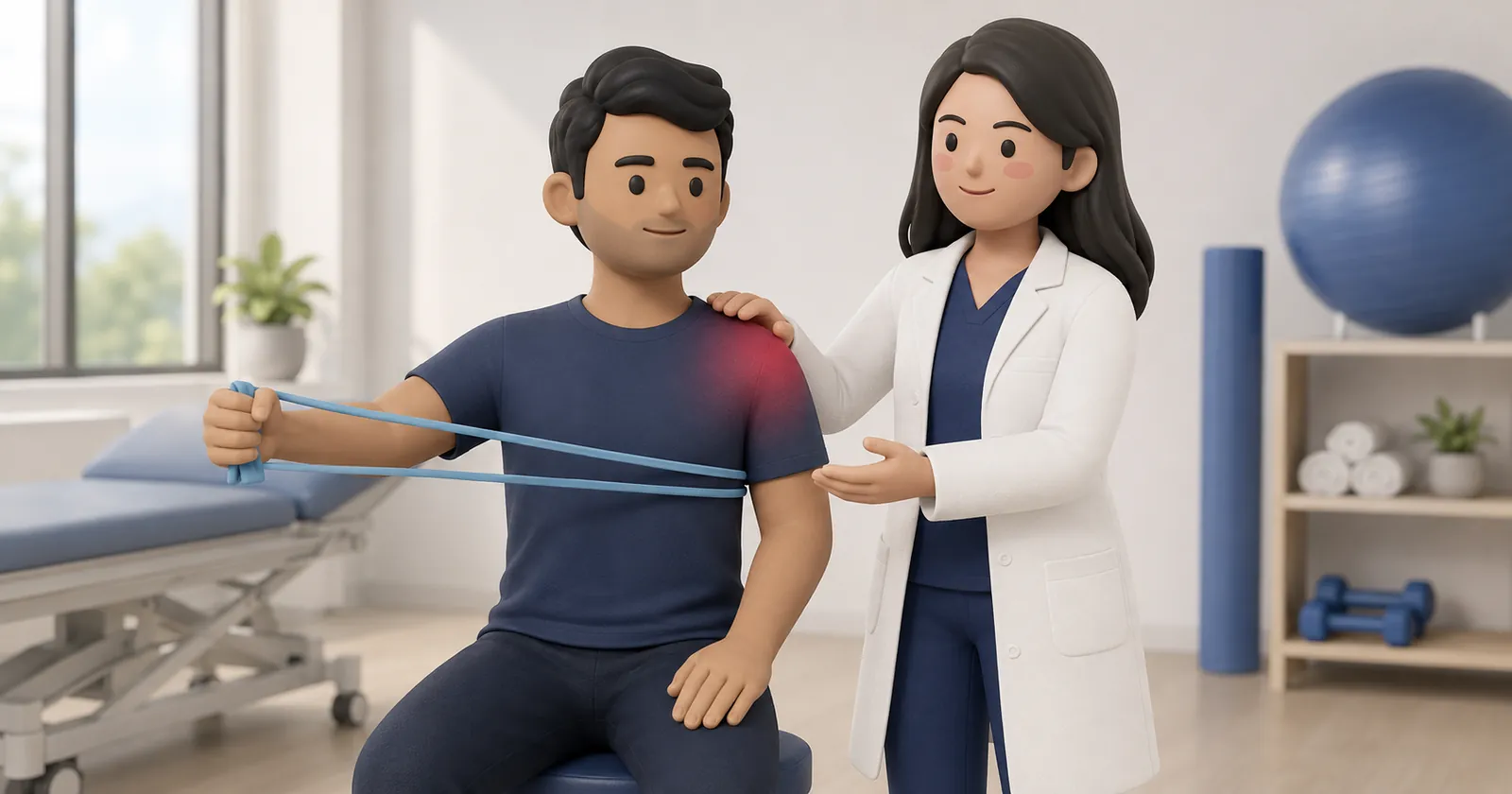
Rotator Cuff Related Shoulder Pain (RCRSP): an umbrella clinical term encompassing subacromial impingement syndrome, supraspinatus tendinopathy, subacromial bursitis, and partial-thickness rotator cuff tears: accounts for more than 70 percent of all shoulder complaints evaluated in clinical practice. The rotator cuff comprises four dynamic muscular units: the supraspinatus, infraspinatus, teres minor, and subscapularis: that originate on the scapula and converge into a confluent tendon sheath inserting onto the humeral head. Rather than acting primarily as prime movers, these muscles serve as dynamic stabilizers, centring the humeral head within the shallow glenoid fossa during arm movement.
In India, rotator cuff pain affects diverse demographics: young gym enthusiasts performing heavy bench presses, overhead athletes (cricket fast bowlers, badminton and tennis players), and middle-aged adults navigating overhead household storage and daily chores. A widespread clinical error is prescribing prolonged immobilisation in an arm sling. Tendon biology dictates that tendons require mechanical loading to heal; prolonged rest leads to collagen disorganization, tendon catabolism, and persistent vulnerability.
1. Tendon Pathophysiology: Cook and Purdam's Tendinopathy Continuum
Leading tendon researchers Jill Cook and Craig Purdam revolutionized our understanding of tendon pain by replacing the outdated concept of 'tendinitis' (implying active inflammatory cells) with the Tendinopathy Continuum model. Rotator cuff pathology progresses through three distinct phases: Reactive Tendinopathy, Tendon Disrepair, and Degenerative Tendinopathy.
| Continuum Stage | Underlying Biological Pathology | Typical Clinical Triggers | Physiotherapy Management Strategy |
|---|---|---|---|
| 1. Reactive Tendinopathy | Non-inflammatory proliferative response in tendon matrix; cellular swelling and water retention | Acute unaccustomed loading: sudden heavy gym workout, vigorous house painting, sudden sports burst | Load reduction; isometrics to reduce cortical inhibition; avoid compressive tendon stretches |
| 2. Tendon Disrepair | Matrix breakdown; collagen fascicles become disorganized; ingrowth of micro-vessels and sensory nerves | Repeated loading without adequate rest over several weeks or months; persistent dull shoulder ache | Progressive isotonic resistance training; eccentric-concentric strengthening; load pacing |
| 3. Degenerative Tendinopathy | Areas of cell death and acellularity; extensive matrix collapse; potential partial or full-thickness tear | Longstanding chronic shoulder pain in older adults (>50 years); recurrent weakness upon lifting | Long-term kinetic chain conditioning; periscapular strengthening; functional movement adaptation |
2. Biomechanics: The Painful Arc and Subacromial Compression
The classic hallmark of rotator cuff tendinopathy is the 'Painful Arc' sign: pain experienced between 60 and 120 degrees of active arm abduction, with relative comfort below 60 degrees and above 120 degrees. In this middle range, the subacromial space narrows to its anatomical minimum (typically 6 to 10 millimetres), compressing the supraspinatus tendon and subacromial bursa against the anteroinferior acromion.
However, modern biomechanics proves that compression alone rarely tears a healthy tendon. Subacromial pain is fundamentally a capacity problem: the rotator cuff musculature lacks the strength and endurance to depress the humeral head against the upward pull of the powerful deltoid muscle. When the deltoid contracts unopposed, the humeral head rides upward, pinching the underlying tendon. Physiotherapy restores humeral head depression and scapulothoracic upward rotation.
3. Three-Phase Progressive Loading Protocol
A progressive loading prescription transitions from isometric analgesic drills to heavy slow resistance training.
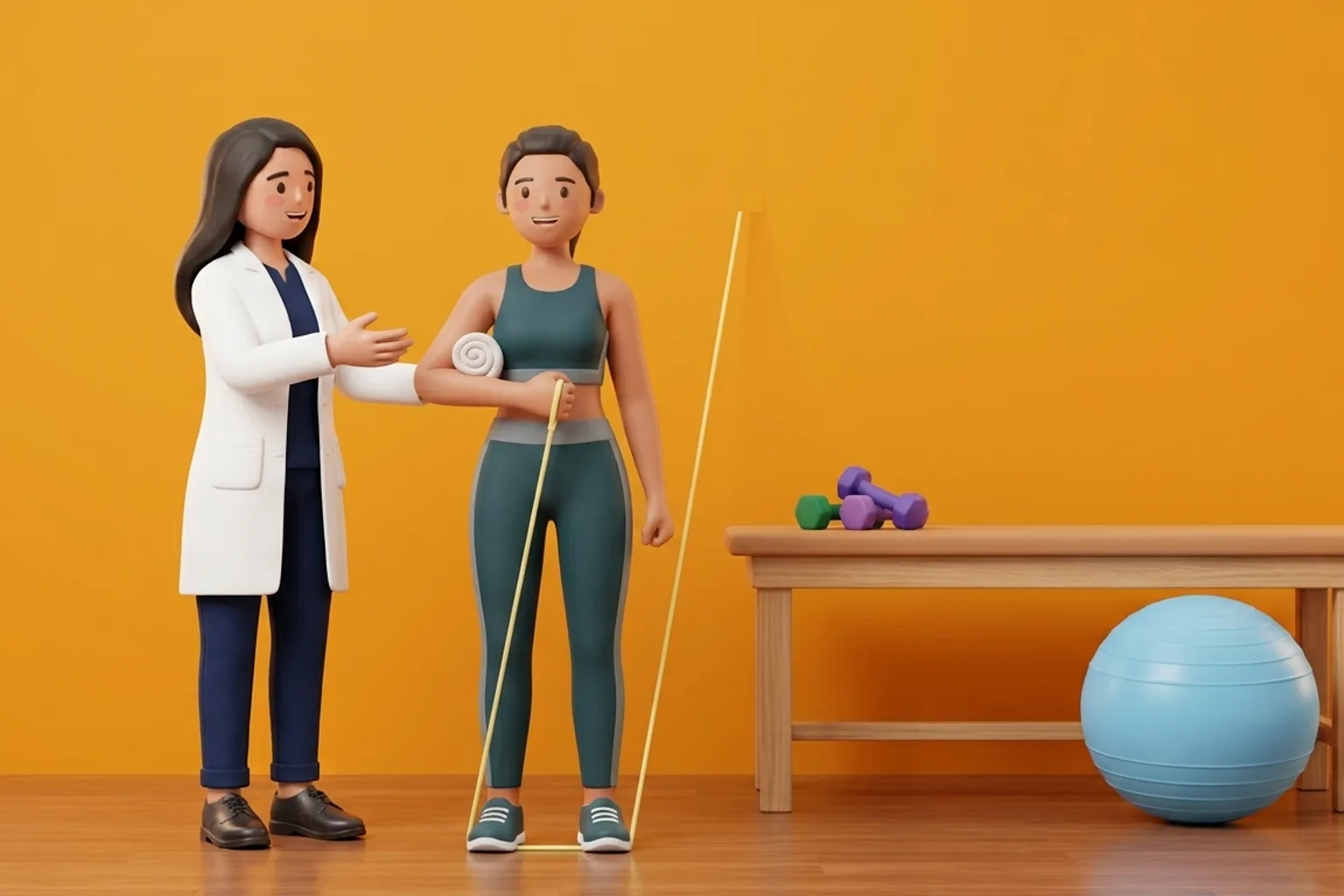
Phase 1: Isometric Shoulder External Rotation (The Tendon Analgesic Drill)
Objective: Trigger motor cortex inhibition and relieve tendon pain without placing compressive shear on the tendon.
- 1Stand sideways next to a sturdy wall with your elbow bent to 90 degrees and a rolled towel between your elbow and ribcage.
- 2Place the back of your wrist flat against the wall.
- 3Gently press outward against the wall as if rotating your forearm outward, without letting your body move.
- 4Build to a firm, comfortable 70% effort. You should feel your posterior shoulder working firmly without sharp pain.
- 5Hold steadily for 45 seconds while breathing normally, rest for 2 minutes, and repeat. This produces immediate local pain relief.
Phase 2: Side-Lying External Rotation (Heavy Slow Resistance)
Objective: Target the infraspinatus and teres minor to restore dynamic humeral head depression under load.
- 1Lie on your unaffected side on a mat, with a small pillow supporting your head and neck.
- 2Hold a 1 or 2-kilogram weight in your affected hand, elbow bent to 90 degrees and resting against your flank.
- 3Slowly rotate your forearm upward toward the ceiling over a 3-second count until it is parallel with your torso.
- 4Pause at the top for 1 second, then lower the weight under controlled eccentric braking over 3 seconds.
- 5Do not roll your body backward to cheat; keep your torso perpendicular to the floor.
Phase 3: Serratus Anterior Wall Slides with Foam Roller
Objective: Facilitate upward scapular rotation and posterior tilt to widen the subacromial space during overhead reach.
- 1Stand facing a wall with a small foam roller or soft towel positioned horizontally between your forearms and the wall.
- 2Place your forearms parallel at shoulder width with elbows bent at 90 degrees.
- 3Gently press your forearms into the roller to spread your shoulder blades across your back.
- 4Slowly roll the foam roller upward along the wall until your arms are nearly overhead, stepping in slightly.
- 5At the peak, push your chest subtly forward and shrug upward to fully activate the serratus anterior, then roll back down under control.
While partial-thickness tears and tendinopathies respond exceptionally well to physiotherapy, acute full-thickness traumatic tears in active individuals: often resulting from a sudden fall or heavy jerk: may benefit from early orthopaedic review. Warning signs include: immediate inability to actively lift the arm against gravity (Drop Arm Sign), sudden profound weakness in external rotation, or severe trauma accompanied by an audible pop.
4. Treatment Environment and Transparent Fee Benchmarks in India
Clinical physiotherapy provides access to specialized resistance bands, cable columns, and hand-held dynamometry to precisely measure rotator cuff force output. For patients dealing with acute reactive flare-ups where driving or transit exacerbates pain, home-visit physiotherapy provides essential bedside guidance on loading, sleeping posture, and daily modifications.
Physiotherapy clinics in Indian metropolitan areas typically charge ₹400 to ₹1,500 per session. Home-visit sessions range from ₹600 to ₹2,000 depending on location and clinical qualifications. Transparent direct-pay care ensures clinical accountability.
5. Frequently Asked Questions Regarding Rotator Cuff Physiotherapy
Can a rotator cuff tear heal without surgery?
Yes. Multiple high-level clinical trials demonstrate that for non-traumatic, degenerative rotator cuff tears and partial-thickness tears, structured physiotherapy yields clinical outcomes equivalent to arthroscopic surgical repair at 1, 2, and 5-year follow-ups. While the physical anatomical tear may not knit together like bone, physiotherapy strengthens the remaining intact rotator cuff tendons and periscapular muscles to fully compensate, restoring pain-free overhead strength and function.
Why does my rotator cuff hurt when I sleep on that side?
When you sleep directly on your affected shoulder, the humeral head is driven superiorly into the subacromial arch, directly compressing the inflamed supraspinatus tendon and bursa. Furthermore, prolonged side-sleeping kinks the microvascular blood supply to the 'critical zone' of the tendon, causing localized hypoxia and aching. Sleeping on your back with a pillow beneath your forearm, or on the opposite side with a hug-pillow supporting the affected arm, prevents this compression.
Are steroid injections recommended for rotator cuff tendinopathy?
Subacromial corticosteroid injections provide potent short-term pain relief (lasting 4 to 8 weeks), but recent orthopaedic research cautions against repeated use. Corticosteroids can degrade tendon collagen synthesis, reduce tendon tensile strength, and increase the long-term risk of tear propagation. They should be used sparingly as an adjunct to enable active exercise in severe cases, never as a standalone repeated treatment.
How long does it take for a rotator cuff tendon to rebuild strength?
Tendon collagen turnover and biological remodeling are relatively slow physiological processes. While pain relief often occurs within 3 to 6 weeks as cortical inhibition normalizes, structural tendon remodeling and restoration of true high-load capacity typically require 12 to 16 weeks of progressive, consistent resistance training. Skipping exercises once pain subsides often leads to recurrent flare-ups.
Can I continue going to the gym with rotator cuff pain?
Yes, but with strategic exercise modifications. Avoid painful overhead pressing, wide-grip bench presses, and upright rows that force the shoulder into internal rotation and abduction. Substitute with neutral-grip dumbbell presses, floor presses, seated rows, and lat pulldowns in front of the body. Keep all movements within a pain threshold of 3 out of 10, ensuring that any mild discomfort settles within 24 hours.
Related condition guides

BookPhysio.in Editorial Team
The BookPhysio.in editorial team writes and maintains this content, checking it against reliable clinical sources. Content follows our medical review policy: general information only, and no page claims a clinical review until a named registered physiotherapist has signed it off.
Read our medical review policy