
Soft tissue injury: what to do after a new sprain or strain
In short
Twisted your ankle or pulled a muscle? Discover why modern sports medicine has replaced traditional icing and rest with the evidence-based PEACE & LOVE rehabilitation protocol.
In this guide (6 sections)
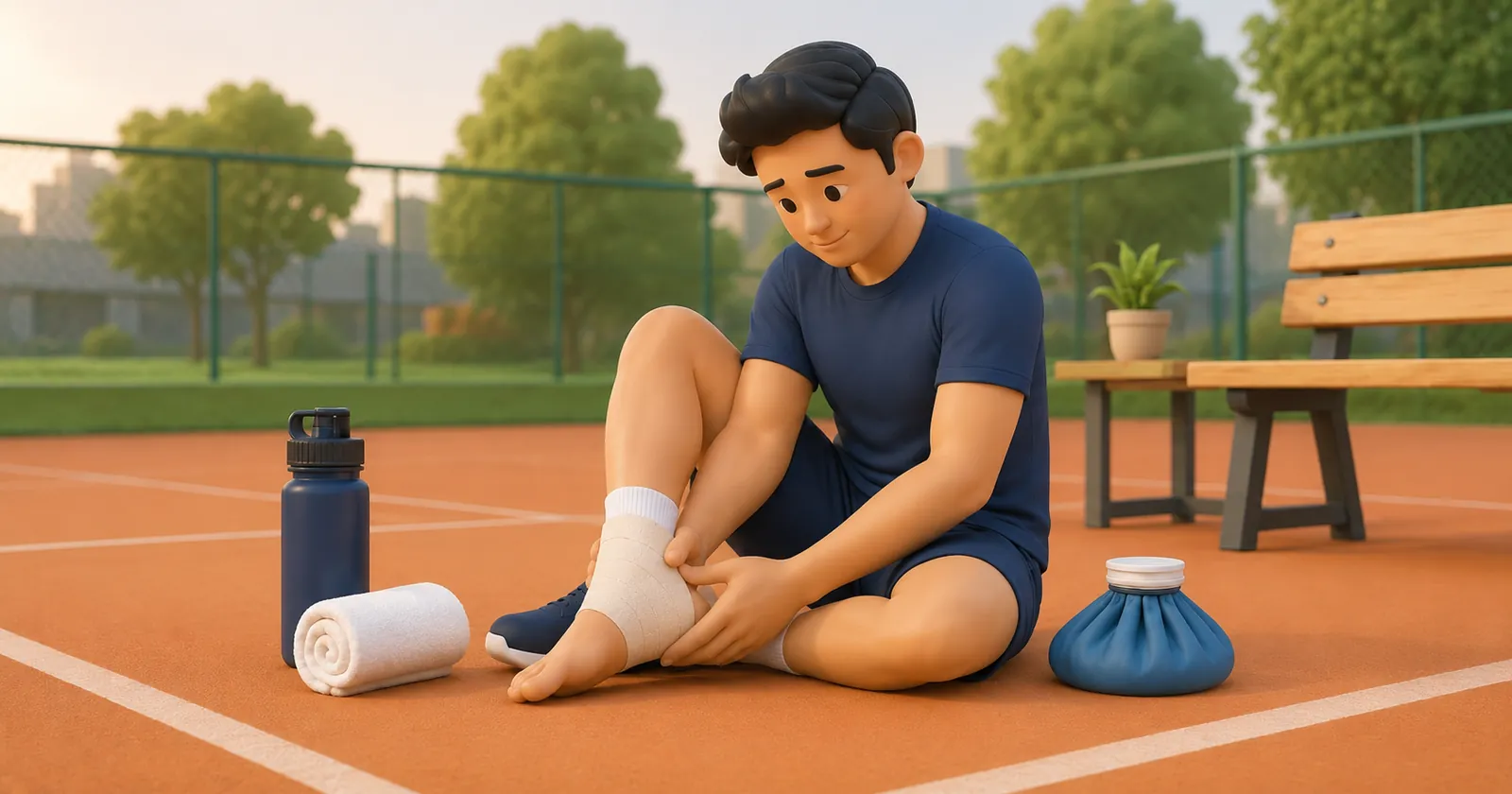
Whether twisting an ankle stepping into an unseen pothole on a monsoon evening, straining a hamstring during a weekend football match, or pulling a shoulder muscle lifting heavy domestic luggage, acute soft tissue injuries: sprains, strains, and contusions: are among the most frequent physical emergencies seen across India. For nearly half a century, the standard response was the familiar 'RICE' protocol: Rest, Ice, Compression, and Elevation.
However, modern sports medicine and cellular biology have fundamentally revolutionized acute injury care. Landmark research published in the British Journal of Sports Medicine (BJSM) demonstrated that excessive icing and prolonged immobilization actually delay biological tissue repair by blunting the natural inflammatory cascade required for collagen synthesis. Contemporary clinical practice now follows the comprehensive 'PEACE & LOVE' protocol: prioritizing early protection, controlled mechanical loading, and active neuromotor recovery under physiotherapist guidance.
1. Understanding Soft Tissue Injury Grades
Ligament sprains (connecting bone to bone) and muscle or tendon strains (connecting muscle to bone) are classified into three clinical grades based on architectural tissue damage:
- Grade 1 (Mild Microscopic Tearing): Minimal structural disruption with localized tenderness and mild swelling. Joint stability remains intact; athlete can bear weight with mild discomfort. Recovery typically spans 1 to 2 weeks.
- Grade 2 (Moderate Partial Tearing): Significant tearing of collagen fibers with marked pain, swelling, bruising (ecchymosis), and partial loss of function or mild joint laxity. Recovery requires structured rehabilitation over 3 to 6 weeks.
- Grade 3 (Severe Complete Rupture): Complete structural discontinuity of the ligament or muscle-tendon junction. Marked instability, inability to bear weight, and severe swelling. Demands immediate orthopaedic evaluation and 8 to 16+ weeks of intensive rehabilitation or surgical repair.
| Phase / Protocol | Traditional RICE Concept | Modern PEACE & LOVE Standard | Biological Rationale | |
|---|---|---|---|---|
| Immediate (Days 1 to 3) | Strict immobilization and aggressive icing every 2 hours | PEACE: Protect, Elevate, Avoid anti-inflammatories, Compress, Educate | Allows biological macrophage response to clean cellular debris without delaying blood vessel formation | |
| Subacute (Days 3+) | Passive rest until pain is completely gone | LOVE: Load, Optimism, Vascularisation, Exercise | Controlled mechanical tension stimulates fibroblast alignment and builds durable collagen architecture | |
| Medication Strategy | Heavy oral NSAIDs (ibuprofen, diclofenac) to suppress swelling | Avoid routine NSAIDs; rely on paracetamol if needed for pain relief | Inflammatory prostaglandins are essential triggers for tenocyte and ligamentous regeneration |
2. Step-by-Step Implementation of PEACE & LOVE
When you experience a new soft tissue injury, follow this evidence-based clinical roadmap:
P - Protect: Unload or restrict movement for the first 24 to 72 hours to minimize bleeding and reduce the risk of aggravating the lesion. E - Elevate: Elevate the injured limb higher than the heart to promote interstitial fluid drainage out of injured tissues. A - Avoid Anti-inflammatory Modalities: Avoid popping high-dose NSAIDs or applying ice packs for hours on end, as inflammation is the essential first phase of biological tissue healing. C - Compress: Apply an elastic cohesive bandage or compression sleeve to limit excessive intra-articular effusion. E - Educate: Learn from your physiotherapist about active recovery rather than adopting passive invalidism.
After the first few days, transition smoothly to LOVE: L - Load: Introduce active, pain-free mechanical loading early. O - Optimism: Stay confident, as psychological catastrophizing amplifies central pain sensitivity. V - Vascularisation: Engage in pain-free cardiovascular activity (such as stationary cycling or upper body ergometry) to boost systemic blood flow. E - Exercise: Perform progressive strengthening, proprioception, and motor control drills.
3. Rehabilitation Protocol for Early Subacute Recovery
Subacute Soft Tissue Mobilisation and Neuromotor Circuit
Objective: Prevent joint stiffness, re-educate mechanoreceptors, and stimulate tensile collagen alignment.
- 1Pain-Free Active Range of Motion: Perform gentle active circles and alphabet tracing (for ankles) or pendular sways (for shoulders) within a pain-free boundary to pump out joint effusion. 20 repetitions.
- 2Submaximal Isometric Holds: Gently contract the injured muscle against an immovable resistance (e.g. wall or floor) at 30 to 50% effort without moving the joint, holding for 6 seconds across 10 repetitions.
- 3Early Proprioceptive Re-Education: Stand on the injured leg on a flat, firm surface with eyes open for 30 seconds, maintaining level hips. Progress to tandem stance and soft foam pads.
- 4Controlled Eccentric Loading: Slowly lower the limb under bodyweight tension (e.g. two-leg calf rise, single-leg lowering) to direct collagen bundle orientation along force vectors.
4. Red Flags Demanding Immediate Medical Evaluation
While most sprains and strains heal with conservative physiotherapy, specific warning signs indicate serious bone, nerve, or vascular pathology. Consult an orthopaedic surgeon immediately if you experience: inability to take four independent steps immediately after an ankle injury (Ottawa Ankle Rules); visible joint deformity, bone protrusion, or abnormal joint angles; coldness, pallor, or loss of pulse distal to the injury; or severe numbness and loss of motor function.
5. Consultation Rates and Clinical Care Access in India
Prompt evaluation by a licensed physiotherapist ensures you receive accurate clinical grading and avoid chronic joint instability. In Indian cities, outpatient physiotherapy consultations range from ₹400 to ₹1,500 per session. For patients with acute mobility impairment who cannot walk or drive, home visit physiotherapy is readily accessible, typically costing between ₹600 and ₹2,000 per session. BookPhysio.in connects you directly with verified state council registered practitioners with direct session payments and zero hidden booking commissions.
6. Frequently Asked Questions
Why is ice no longer recommended as the primary treatment for sprains?
While ice temporarily numbs localized pain receptors, recent physiological studies demonstrate that aggressive cryotherapy causes vasoconstriction that prevents macrophages and insulin-like growth factor-1 (IGF-1) from reaching damaged tissues. This blunts the natural inflammatory phase, delaying cellular repair and new capillary formation. Modern guidelines suggest using ice briefly only if pain is unmanageable, rather than continuously as a healing agent.
Can I take ibuprofen or painkiller pills for my sprained ankle?
Routine use of non-steroidal anti-inflammatory drugs (NSAIDs) like ibuprofen or diclofenac during the first 48 hours is discouraged in modern guidelines. NSAIDs inhibit cyclooxygenase enzymes, suppressing the vital biological signals that recruit healing cells to repair torn ligaments. If pain relief is urgently required, paracetamol is preferred under medical advice as it reduces pain without blunting peripheral tissue inflammation.
How do I know if my sprained ankle is actually fractured?
Physiotherapists use the validated Ottawa Ankle Rules to determine if an X-ray is required. An X-ray is necessary if you have bone tenderness along the posterior edge or tip of either malleolus (ankle bone), bone tenderness at the base of the fifth metatarsal or navicular bone, or an inability to bear weight and take four steps both immediately after the injury and in the clinic. If these signs are absent, a fracture is exceedingly unlikely.
Why do ankles sprain repeatedly once injured?
When a ligament tears, specialized nerve endings called mechanoreceptors: which inform your brain about your joint position in space: are also damaged. If an ankle heals without dedicated proprioceptive and balance retraining, your brain cannot react quickly enough to subtle surface tilts, leading to chronic ankle instability and recurrent sprains. Structured balance physiotherapy completely restores neuromotor reflexes.
How quickly should I start physiotherapy after a soft tissue injury?
Consulting a physiotherapist within 48 to 72 hours of injury is ideal. Early consultation allows the clinician to rule out severe fractures or full ruptures, apply supportive compression taping, and prescribe safe, pain-free active movements that prevent muscle atrophy and promote optimal collagen healing.
Related condition guides


BookPhysio.in Editorial Team
The BookPhysio.in editorial team writes and maintains this content, checking it against reliable clinical sources. Content follows our medical review policy: general information only, and no page claims a clinical review until a named registered physiotherapist has signed it off.
Read our medical review policy