
Sports injury rehabilitation: what a safe return should consider
In short
Returning to competitive sport based on the calendar rather than objective physical criteria causes thousands of re-injuries every year. Discover the clinical framework for a truly safe return.
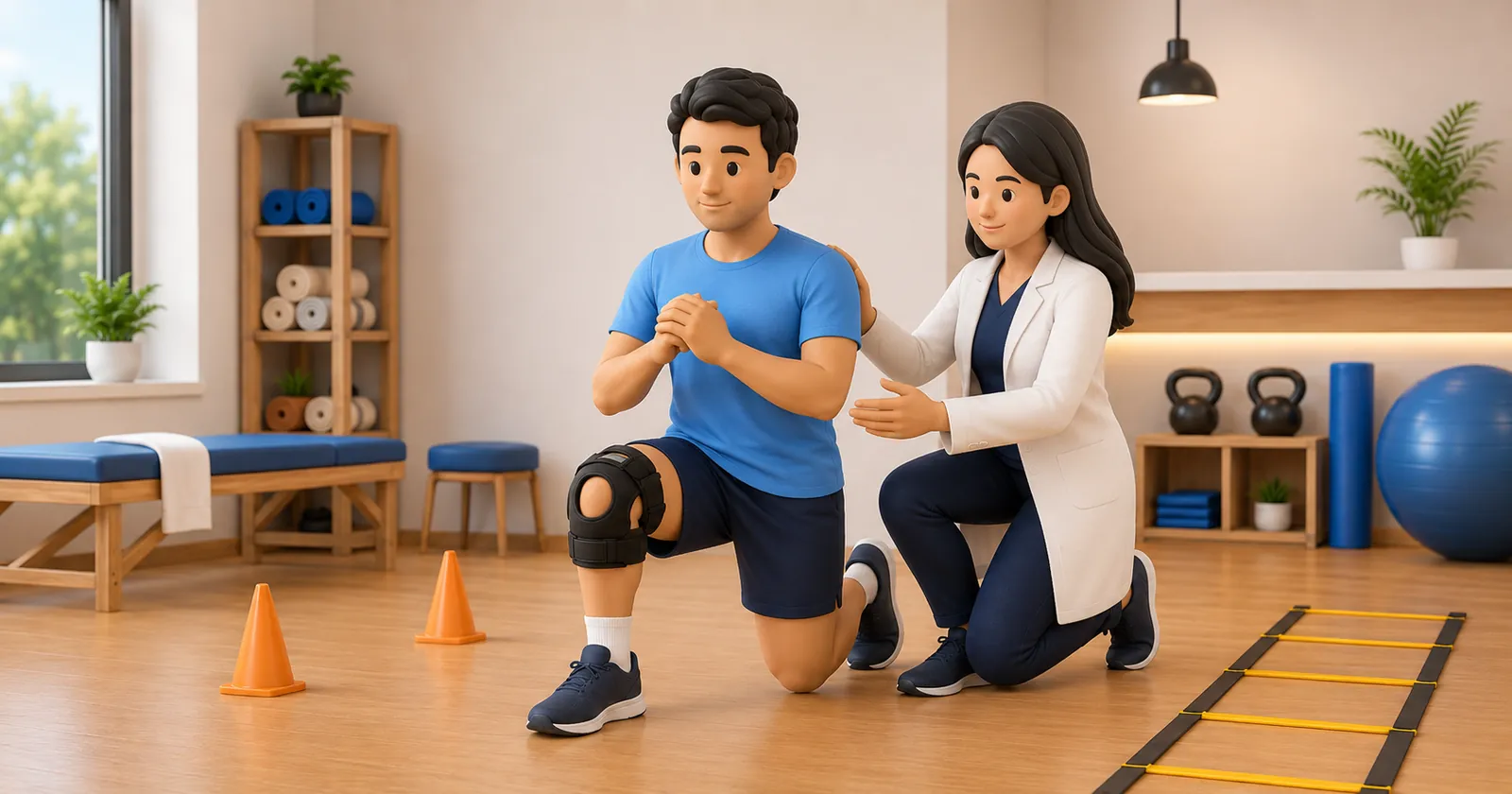
In this guide (6 sections)
In competitive sports and recreational athletics across India: from weekend badminton and club cricket to amateur marathon running and academy football: the most dangerous phase of an athlete's journey is not the moment of initial injury, but the premature return to the field. Thousands of athletes who suffer an ACL tear, hamstring pull, or ankle sprain return to high-intensity competition simply because 'the pain is gone' or because an arbitrary calendar milestone has elapsed.
Absence of pain during daily walking does not mean a ligament, tendon, or muscle is prepared to absorb cutting, pivoting, decelerating, or jumping forces. Premature return-to-play carries disastrous re-injury rates: up to 30 percent for secondary ACL tears and over 25 percent for recurrent hamstring strains. Modern sports physiotherapy replaces subjective guesses with objective, criterion-based rehabilitation milestones across biomechanical, physical, and psychological domains.
1. The Four Continuous Phases of Sports Rehabilitation
Comprehensive sports rehabilitation progresses systematically through four interconnected phases:
- Phase 1: Acute Protection and Effusion Resolution: Eliminate joint swelling, restore full passive and active range of motion, and re-establish baseline quadriceps/muscle activation through neuromuscular electrical stimulation (NMES) and isometric loading.
- Phase 2: Hypertrophy and Isolated Strength Rebuilding: Rebuild cross-sectional muscle volume, addressing kinetic chain deficits in the trunk, hips, and ankles. Heavy slow resistance (HSR) training stimulates tendon stiffness and muscular endurance.
- Phase 3: Rate of Force Development (RFD) and Plyometrics: Transition from slow strength to explosive power. High-velocity stretch-shortening cycle (SSC) training teaches tissues to absorb and transmit ground reaction forces in under 200 milliseconds.
- Phase 4: Sport-Specific Agility and Psychological Clearance: Multi-directional cutting, deceleration drills, chaotic reactive agility, contact simulation, and psychological readiness screening before full unrestricted match play.
| Assessment Battery | Clinical Testing Protocol | Passing Criterion Threshold | Pathology Addressed | |
|---|---|---|---|---|
| Limb Symmetry Index (LSI) - Strength | Isokinetic dynamometry or hand-held dynamometer testing of quads/hamstrings | Greater than 90% strength parity compared to uninjured contralateral limb | Prevents asymmetrical compensatory loading that triggers secondary tears | |
| Hop Testing Battery | Single hop, triple hop, crossover hop, and 6-meter timed hop tests | LSI greater than 90% distance with stable, controlled stick landing | Tests dynamic eccentric deceleration and knee stability under propulsion | |
| Dynamic Balance (Y-Balance Test) | Single-leg reach in anterior, posteromedial, and posterolateral directions | Composite score greater than 95% with less than 4 cm anterior asymmetry | Detects subtle multi-planar proprioceptive deficits and hip control failure | |
| Psychological Readiness (ACL-RSI / TSK) | Validated questionnaire assessing fear of re-injury and athletic confidence | Score greater than 60-70% on ACL-Return to Sport after Injury scale | Identifies kinesiophobia (movement fear) which alters movement kinematics |
2. Biomechanical Factors: The Importance of Deceleration
Most non-contact sports injuries occur not when an athlete is speeding up, but when they are rapidly slowing down or changing direction. Deceleration generates ground reaction forces up to three times greater than acceleration. If the eccentric strength of the quadriceps, hamstrings, and gluteal complex is insufficient, the body compensates through knee valgus collapse (inward knee buckling) and trunk lateral tilt: the classic mechanism of non-contact ACL and meniscus tears.
Sports physiotherapists systematically train deceleration mechanics: teaching athletes to land softly on the balls of their feet with hips and knees flexed, chest forward, and knees tracking directly over toes. In addition, multi-joint neuromuscular control must be tested under conditions of cardiovascular fatigue, simulating the final 15 minutes of a competitive match where unforced errors and ligament failures most commonly happen.
3. Criterion-Based Return-to-Play Exercise Progression
Late-Stage Agility and Deceleration Conditioning Circuit
Objective: Prepare the musculoskeletal system for unpredictable match velocities and multi-planar reactive demands.
- 1Box Drop to Unplanned Reactive Cut: Step off a 30 cm box, land symmetrically, and immediately react to a visual or auditory cue from the physiotherapist to cut 45 degrees left or right. 3 sets of 6 reps.
- 2T-Drill Deceleration Shuttle: Sprint forward 10 meters, rapidly decelerate into a side shuffle left 5 meters, cross shuffle right 10 meters, and backpedal to start with low center of gravity. 4 rounds.
- 3Single-Leg Lateral Bounds (Skater Jumps): Bound laterally from one leg to the other over a 1-meter hurdle, landing on a flexed knee and holding the single-leg stick position for 2 seconds. 3 sets of 8 reps per side.
- 4Sport-Specific High-Velocity Drills: For cricketers: high-speed fielding pickup and throw; for footballers: slide tackling and heading duels; for badminton players: rapid split-step corner lunging.
4. Psychological Readiness and Fear of Re-Injury
Physical healing does not automatically confer psychological confidence. Athletes who return to sport while harboring intense fear of re-injury exhibit hesitant, altered movement patterns: landing with stiffer knees, hesitating during tackles, or avoiding high-speed sprints. This altered motor control paradoxically increases the risk of injuring either the reconstructed limb or the uninjured opposite side. Sports physiotherapists utilize structured psychological questionnaires (such as the ACL-RSI scale) and simulated high-pressure drills to rebuild complete mental confidence.
5. Consultation Rates and Sports Rehabilitation in India
Accessing advanced sports physiotherapy with functional movement screening and objective return-to-play testing is vital for athletes at every level. In Indian sports clinics, consultations and rehab sessions typically cost between ₹400 and ₹1,500 per session. For specialized on-field testing, academy movement screens, or home rehabilitation, fees range between ₹600 and ₹2,000 per session. BookPhysio.in connects athletes directly with verified state council registered physiotherapists with direct session payment and zero platform booking surcharges.
6. Frequently Asked Questions
Can I return to playing cricket or football as soon as my knee stops hurting?
No. The absence of pain indicates that acute biological inflammation has settled, but it does not mean muscle strength, reactive agility, or ligament tensile tolerance have been restored. Returning to competitive sports without passing objective functional tests (such as achieving 90% limb symmetry on strength and single-leg hop testing) increases your risk of catastrophic re-injury by over fourfold.
What is the Limb Symmetry Index (LSI) and why does my sports physiotherapist test it?
The Limb Symmetry Index (LSI) is a mathematical percentage comparing the functional performance of your injured limb against your uninjured limb. For example, if your uninjured leg hops 150 cm and your injured leg hops 135 cm, your LSI is 90 percent. Leading sports medicine guidelines require an LSI of at least 90 to 95 percent across multiple strength and hop tests before an athlete is cleared for full competitive play.
How long does full sports rehabilitation take after an ACL reconstruction?
Biological graft maturation and neuromuscular re-education require a minimum of 9 to 12 months. Landmark clinical studies demonstrate that for every month return-to-sport is delayed up to 9 months post-surgery, the rate of secondary ACL rupture decreases by approximately 50 percent. Rushing back at 6 months carries a substantially higher rate of graft re-tear.
What is the difference between general physiotherapy and sports physiotherapy?
General physiotherapy focuses primarily on restoring pain-free activities of daily living: walking, climbing stairs, and sitting comfortably. Sports physiotherapy focuses on high-performance athletic demands: high-speed deceleration, multi-directional cutting, plyometric rate of force development, energy systems conditioning, and sport-specific biomechanics.
Why do athletes often tear their opposite (uninjured) knee after returning from an injury?
This common phenomenon is caused by asymmetrical movement compensation and persistent fear. If an athlete's reconstructed or injured leg remains weaker, their central nervous system unconsciously shifts landing and braking forces onto the uninjured limb. If the uninjured limb is overloaded beyond its physiological capacity, it can tear under the sudden excess strain.
Related condition guides


BookPhysio.in Editorial Team
The BookPhysio.in editorial team writes and maintains this content, checking it against reliable clinical sources. Content follows our medical review policy: general information only, and no page claims a clinical review until a named registered physiotherapist has signed it off.
Read our medical review policy