
Balance and Proprioception Retraining to Prevent Tripping Falls in Knee Osteoarthritis
In short
Examine how knee osteoarthritis degrades joint position sense and discover evidence-based proprioceptive balance retraining to prevent devastating tripping falls.
In this guide (4 sections)
While pain and joint stiffness are the most overt symptoms of knee osteoarthritis, the insidious loss of joint proprioception and postural balance represents the greatest threat to a patient’s long-term survival and independence. Proprioception, the unconscious perception of joint position, movement velocity, and mechanical load, relies on specialized mechanoreceptors embedded within the knee joint capsule, cruciate ligaments, collateral ligaments, and menisci. In osteoarthritis, the progressive degradation of articular cartilage, capsular fibrotic thickening, and chronic low-grade effusion mechanically damage these mechanoreceptors, blunting the afferent sensory signals sent to the central nervous system. As a consequence, patients experience impaired joint position sense and delayed quadriceps-hamstring reflex activation times. When walking across uneven surfaces, the nervous system cannot detect rapid joint perturbations in time to execute protective muscular adjustments. This sensorimotor deficit dramatically increases the risk of tripping, stumbling, and catastrophic falls resulting in hip fractures or traumatic brain injuries.
Indian Household Hazards: Wet Bathroom Tiles, Loose Rugs, and Door Thresholds
In Indian domestic environments, tripping hazards are prevalent and dangerous. Traditional Indian bathrooms feature smooth ceramic tiles that become treacherous when wet with soapy bathwater, while elevated stone or marble door sills (chaukhats) installed at room thresholds pose constant obstacles. In living areas, decorative cotton durries, silk carpets, and loose doormats placed over polished marble lack non-slip rubber backings, sliding instantly underfoot when stepped upon. Furthermore, elderly individuals frequently walk through dim hallways at night to use the bathroom without turning on lights to avoid disturbing sleeping family members. Removing loose throw rugs, installing continuous high-friction adhesive strips on bathroom tiles, adding motion-sensor nightlights in hallways, and mounting solid grab bars next to commodes drastically reduces domestic fall risks.
Mechanoreceptor Deafferentation, Reflex Latency, and Postural Sway Amplification
The neurobiological mechanism of proprioceptive decline in knee osteoarthritis involves both peripheral and central sensorimotor pathway breakdown. Histological examinations of arthritic joint tissues demonstrate marked reduction in the density and morphological integrity of Ruffini endings (which signal static joint angle), Pacinian corpuscles (which detect rapid acceleration and vibration), and Golgi-like tendon organs within the periarticular connective tissues. This peripheral deafferentation increases the reflex latency of the quadriceps and hamstring muscles by 20 to 40 milliseconds following sudden joint displacement. In dynamic terms, by the time the nervous system detects an unexpected slip or trip, the center of mass has already displaced beyond the base of support. Posturographic analyses demonstrate significant increases in center-of-pressure sway velocity and area in osteoarthritic individuals, confirming a persistent state of postural instability during quiet standing.
Staged Sensorimotor Training: From Firm Surfaces to Dynamic Perturbations
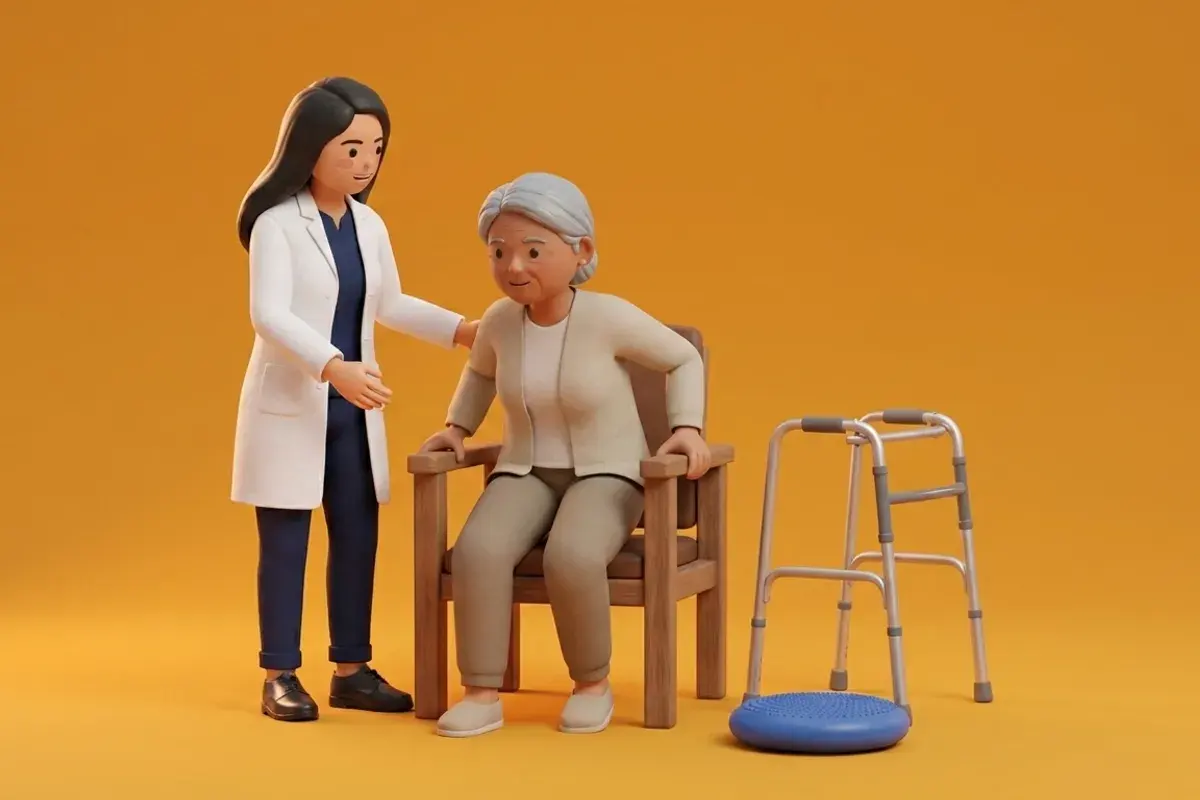
Sensorimotor rehabilitation must be staged systematically to retrain postural stability without provoking joint pain or fall anxiety. Training begins on firm, stable surfaces with wide bases of support, focusing on static balance with eyes open before progressing to altered sensory conditions (narrow base of support, tandem stance, and eyes-closed conditions to challenge the vestibular and somatosensory systems). Once static control is mastered, therapy advances to dynamic balance drills, including slow tandem walking, multidirectional stepping, and controlled weight-shifts on compliant foam balance pads. Perturbation training, where the clinician applies gentle, unpredictable manual nudges to the pelvis while the patient maintains balance, specifically trains reactive stepping strategies and restores fast reflex protective muscle contractions.
Supported Single-Leg Stance Balance Hold with Countertop Touch
Objective: Stimulate joint mechanoreceptors, reduce postural sway, and retrain single-limb stance stability safely
- 1Stand upright facing a sturdy kitchen counter or heavy table, resting both hands lightly on the surface for immediate balance support.
- 2Position your feet hip-width apart and fix your eyes on a stationary visual target on the wall at eye level.
- 3Slowly lift your unaffected foot slightly off the floor, transferring your full body weight onto your arthritic leg.
- 4Maintain a tall posture with a soft, unlocked knee, aiming to balance for 20 to 30 seconds with minimal fingertip pressure on the counter.
- 5Lower your foot smoothly to the floor, rest for 10 seconds, and repeat 3 times before switching legs.
| Rehabilitation Stage | Sensory Challenge Parameter | Neuromuscular Mechanism | Representative Clinical Exercise |
|---|---|---|---|
| Stage 1: Static Base | Firm floor, wide to narrow base, eyes open with nearby hand support | Recruits residual capsular mechanoreceptors and static postural alignment | Parallel feet stance, semi-tandem stance, and single-leg balance holds |
| Stage 2: Sensory Alteration | Firm floor, tandem heel-to-toe stance, incorporating head turns or closed eyes | Forces integration of vestibular and proprioceptive inputs; suppresses visual reliance | Tandem balance with slow horizontal head turns; balance with vision occluded |
| Stage 3: Compliant Surfaces | Compliant foam pad, wobble cushion, or folded yoga mat surface | Challenges dynamic ankle and knee stabilizing co-contractions | Mini-squats on foam balance pad; single-leg stance on compliant cushion |
| Stage 4: Reactive Stepping | Dynamic multidirectional stepping and unexpected manual perturbation nudges | Restores fast reflex spinal loops and reactive protective recovery steps | Clock-stepping drills, sudden catch-and-toss drills, and perturbation recovery |
If an elderly patient experiences a fall accompanied by an inability to stand, severe groin or hip pain, leg shortening, or external rotation of the lower extremity, do not attempt to move or mobilize the patient. This presentation indicates an acute hip fracture (femoral neck or intertrochanteric fracture) that mandates immediate emergency spinal board immobilization and urgent hospital transport.
Frequently Asked Questions
Why do my knees feel so unsteady, like they might buckle and give out when I walk?
This unsteady giving-way feeling is caused by damaged position sensors (mechanoreceptors) inside your arthritic joint. Because these sensors are worn down, your brain receives delayed information about where your leg is placed, making your thigh muscles fire a split-second too late. Targeted balance exercises retrain these sensory nerve pathways and strengthen your reflexes, restoring solid joint stability and preventing falls.
Do I need a doctor referral to see a knee osteoarthritis physiotherapist on BookPhysio.in?
BookPhysio.in does not require a doctor referral. Under the National Commission for Allied and Healthcare Professions (NCAHP) Act 2021, patients across India enjoy direct access to autonomous registered physiotherapists. Through BookPhysio.in, you connect directly with verified clinicians and pay per session with transparent fees, completely free from advance package commitments, commission markups, or platform subscription charges.
Related condition guides

Related recovery guides & articles
BookPhysio.in Editorial Team
The BookPhysio.in editorial team writes and maintains this content, checking it against reliable clinical sources. Content follows our medical review policy: general information only, and no page claims a clinical review until a named registered physiotherapist has signed it off.
Read our medical review policy