
Clinic visits, home visits, or both: how to present your physiotherapy practice online
In short
List clinic and home-visit services as separate practical options with accurate location, service area, fee, and availability. Do not market home visits as medically superior or imply that every patient is suitable for them. Let clinical suitability be decided after assessment and within any medical instructions.
In this guide (13 sections)
List clinic and home-visit services as separate practical options with accurate location, service area, fee, and availability. Do not market home visits as medically superior or imply that every patient is suitable for them. Let clinical suitability be decided after assessment and within any medical instructions.
"Clinic + home visits" looks simple in a profile, but patients need enough detail to know what the two options actually mean. Clear service boundaries reduce avoidable booking confusion.
For clinic visits, make location and access clear
Use the correct clinic address and current appointment availability. If accessibility details matter to your patient population, describe them accurately rather than making assumptions. Keep clinic hours and service information current.
For home visits, define the area you can realistically serve
A vague claim such as "all across the city" can create failed bookings if travel is not practical. Define the actual service boundary and revisit it when your schedule changes. Do not promise response times or same-day visits unless you can support the exact claim consistently.
Keep fees and availability current by format
If clinic and home visits have different fees, show the correct current amount for each. If availability differs, reflect that in the profile. Patients should not discover a different fee or service area only after booking.
Describe suitability carefully
A home visit can be practical for some patients, while a clinic can be more suitable for others depending on clinical and practical needs. Avoid blanket statements that one format is better, faster, safer, or more effective.
On BookPhysio.in, professional profiles are free, no commission is taken on bookings, and patients pay the physiotherapist directly.
Read the two options as a patient choosing between them
A patient reading your profile is deciding between two services, not one. Check that each format carries its own fee, its own availability and, for home visits, its own area, because a single blended answer forces the patient to message you to find out which applies to them.
Frequently asked questions
Can I list both clinic and home visits?
Yes, if you genuinely provide both and keep the current details accurate.
Should I list every neighbourhood for SEO?
No. List the actual areas you serve. Keyword stuffing and inaccurate coverage create a poor patient experience.
Can I charge different fees?
You set your professional fees. Show the current fee clearly for the relevant visit format.
Does BookPhysio.in take commission on either format?
No. BookPhysio.in takes no commission on bookings. Patients pay the physiotherapist directly.
Evidence reviewed 20 August 2026. General information only.
Create your free profile on BookPhysio.in.
Create your free profileThe Hybrid Practice Blueprint: Balancing Clinical Equipment with Domiciliary Reach
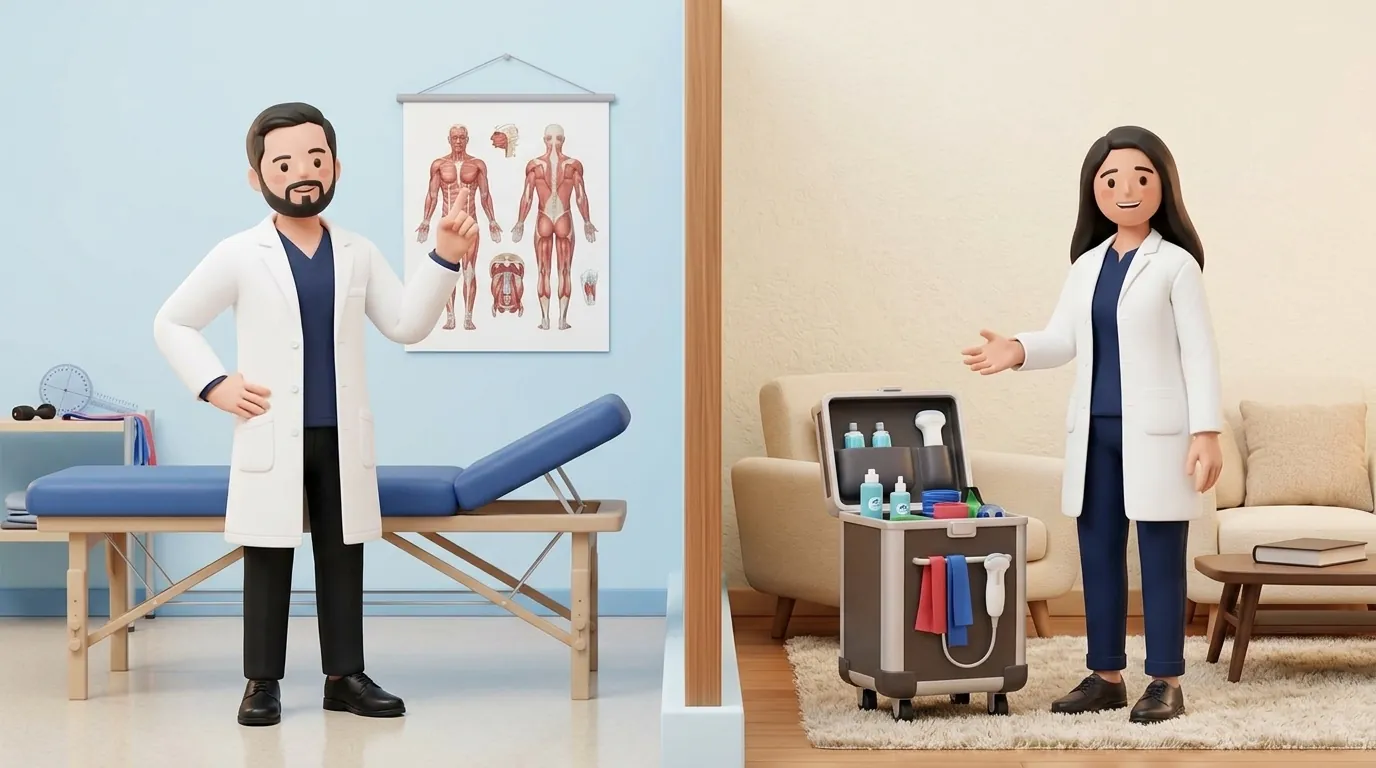
For many established physiotherapists in India, offering both clinic consultations and domiciliary home visits provides the ideal clinical and financial model. A clinic offers specialized stationary equipment: such as clinical traction units, therapeutic ultrasound, resistance cable stations, and gait bars: while home visits provide essential access for bedridden neurological patients, elderly fall-risk seniors, and post-operative joint replacement cases who cannot commute.
| Clinical Scenario | Optimal Care Setting | Primary Clinical Rationale | Typical Equipment Utilized |
|---|---|---|---|
| Athletic Sports Injury / ACL Rehab Phase 3 | In-Clinic Facility | Requires plyometric jump boxes, agility ladders, barbell loading, and open turf | Force plates, Olympic barbells, leg press, agility equipment |
| Acute Post-TKR (Days 3 to 21 Post-Op) | Home Visit Care | Severe surgical wound pain, inability to navigate car transfers or clinic stairs | Portable goniometer, cryo-compression cuff, portable TENS, walker |
| Severe Acute Lumbar Disc Herniation | Initial Home Visit, then Clinic | Acute kinesiophobia and agonizing car travel; transition to clinic once walking improves | Bedside McKenzie positioning, nerve glides, portable modalities |
| Geriatric Fall Prevention and Balance | Home Visit Care | Training in the patient real domestic layout (rugs, bathroom thresholds, bed height) | Gait belts, balance foam pads, environmental hazard assessment |
Time-Blocking and Slot Separation: Preventing Clinic Delays from Traffic Overruns
The primary risk of operating a dual clinic-home practice is scheduling collision. If a home visit is delayed by 30 minutes in city traffic, subsequent clinic appointments stack up, frustrating waiting patients. Best practice is strict block scheduling: dedicate mornings (8:00 AM to 12:00 PM) to clustered home visits in nearby neighbourhoods, allow a 90-minute buffer for lunch and travel, and open fixed clinic hours from 2:00 PM to 8:00 PM.
Transparent Fee Architecture for Dual-Format Practitioners
Clearly explain why home visit fees are higher than clinic rates. A clinic session might cost ₹600 for 45 minutes, while a home visit costs ₹1,000. Indian patients readily understand that the additional ₹400 covers dedicated one-way travel time, fuel, vehicle wear, and exclusive one-on-one bedside attention. In congested metropolitan hubs like Bengaluru, Mumbai, and Delhi NCR, commuting between patient locations requires substantial professional time and travel expense. Stating both prices transparently on your profile eliminates pricing confusion and reinforces the premium nature of personalized domiciliary care.
Managing Equipment Logistics Across Clinic and Domiciliary Settings
Practicing across both settings requires maintaining dedicated equipment kits so you never leave essential tools behind at the clinic. Keep stationary modalities (such as clinical traction, heavy resistance weights, and large treatment plinths) permanently stationed at your facility, while maintaining a dedicated, pre-packed domiciliary backpack containing portable TENS units, calibrated goniometers, graded resistance bands, and medical sanitization supplies ready for off-site calls.
Presenting Dual Care Options Clearly on BookPhysio.in
On BookPhysio.in, practitioners can highlight both modalities seamlessly. Specify your permanent clinic address, landmark, and consulting hours, while concurrently designating the exact PIN codes or neighbourhoods you serve for domiciliary visits. This ensures patients choose the care format perfectly tailored to their mobility needs.
Equipment Transition Protocols: Moving Patients from Bedside to Clinic Plinth
A structured transition protocol from home care to clinic appointments provides immense clinical benefit. In post-operative total knee arthroplasty, weeks 1 to 3 are optimally spent at home establishing wound safety, basic quadriceps activation, and safe stair climbing. By week 4, transitioning the patient to the clinic unlocks heavy closed-chain leg press loading, stationary cycling with variable resistance, and computerized balance perturbation platforms that cannot be brought into a domestic living room.
Is it ethical to charge higher fees for home visits than clinic sessions?
Yes, entirely. A home visit requires 30 to 45 minutes of transit time in addition to the 45-minute clinical treatment, consuming nearly 90 minutes of the clinician time. A higher fee fairly compensates for travel overhead and exclusive bedside care.
How do I decide whether a patient is better suited for clinic visits or home care?
Patients with limited mobility, post-operative surgical precautions, acute neurological impairment, or severe pain on vehicle transfer should start with home visits. Patients needing heavy progressive resistance equipment or agility drills are best treated in a clinic.
Can a patient transition from home visits to clinic sessions during their recovery?
Yes! In fact, transitioning a post-surgical knee or hip replacement patient from home visits to clinic appointments at Week 4 is an excellent clinical milestone that signals expanding functional independence.
What is the ideal buffer time between a home visit and my clinic shift?
Maintain at least a 60-minute buffer between your last scheduled home visit and the start of your clinic shift to absorb unexpected traffic congestion without compromising clinic punctuality.
Does BookPhysio.in let me set separate prices for clinic visits and home visits?
Yes. You can publish your distinct clinic consultation fee and home visit fee on your verified profile, ensuring complete transparency for incoming patients.
Sources reviewed
Related recovery guides & articles
BookPhysio.in Editorial Team
The BookPhysio.in editorial team writes and maintains this content, checking it against reliable clinical sources. Content follows our medical review policy: general information only, and no page claims a clinical review until a named registered physiotherapist has signed it off.
Read our medical review policy