
Eccentric Rotator Cuff Loading and Periscapular Strengthening in the Thawing Stage
In short
The thawing phase requires progressive eccentric rotator cuff loading and periscapular strengthening to restore dynamic shoulder power and functional reach.
In this guide (4 sections)
As adhesive capsulitis transitions into Stage 3 (the thawing phase), acute synovial inflammation has completely resolved, and the dense, contracted capsule undergoes spontaneous and manual-assisted matrix remodelling. During this phase, the primary clinical barrier shifts from rigid capsular contracture to profound neuromuscular weakness, chronic periscapular inhibition, and degraded tendon elasticity resulting from months of disuse. Simply regaining passive range of motion does not restore functional overhead capability. The patient requires structured eccentric rotator cuff loading and progressive periscapular strengthening to retrain the dynamic force couples that depress and stabilize the humeral head during real-world tasks.
Indian Household Realities: Carrying Heavy Groceries, Lifting Children, and Sports Return
In Indian family life, entering the thawing stage brings renewed hope and increased daily demands. Homemakers want to resume lifting heavy pressure cookers, carrying 5-kilogram grocery bags of atta and rice from the local market, and lifting their grandchildren into their arms. Active adults seek to return to recreational sports like badminton, cricket, or swimming. However, attempting these dynamic activities with weakened, deconditioned rotator cuff muscles leads to secondary subacromial bursitis and tendon strain. Prescribing a progressive eccentric exercise regimen rebuilds dynamic tendon resilience, giving patients the physical confidence to manage demanding household and athletic activities without setbacks.
Tendon Mechanobiology: Collagen Alignment, Tensile Strength, and Muscle Spindle Tuning
The biological rationale for prioritizing eccentric muscle actions during the thawing stage lies in tendon mechanobiology. Eccentric contractions, where the muscle lengthens under controlled mechanical load, generate higher mechanical tension per motor unit compared to concentric contractions. This high-load tensile strain acts directly on tenocytes within the supraspinatus and infraspinatus tendons, upregulating lysyl oxidase and stimulating parallel type I collagen synthesis, which reverses disuse-induced tendon thinning. Furthermore, eccentric loading recalibrates gamma motor neuron sensitivity within muscle spindles, restoring protective lengthening reflexes and improving neuromuscular deceleration during dynamic arm movements.
Structuring the Thawing Stage Program: Force Couples, Kinetic Chain, and Plyometrics
The rehabilitation protocol focuses on two primary anatomical force couples: the horizontal force couple (subscapularis countering infraspinatus and teres minor) to ensure anterior-posterior joint stability, and the vertical force couple (rotator cuff depressores countering deltoid upward pull). Physiotherapists introduce resistance band eccentric external rotation, where the patient assists the concentric pull with the sound arm but lowers the resistance slowly over 4 to 5 seconds with the affected arm. Periscapular drills prioritize the serratus anterior (wall push-up plus) and lower trapezius (prone Y-raises), progressing toward multiplanar kinetic chain integration from the lower limbs through the core.
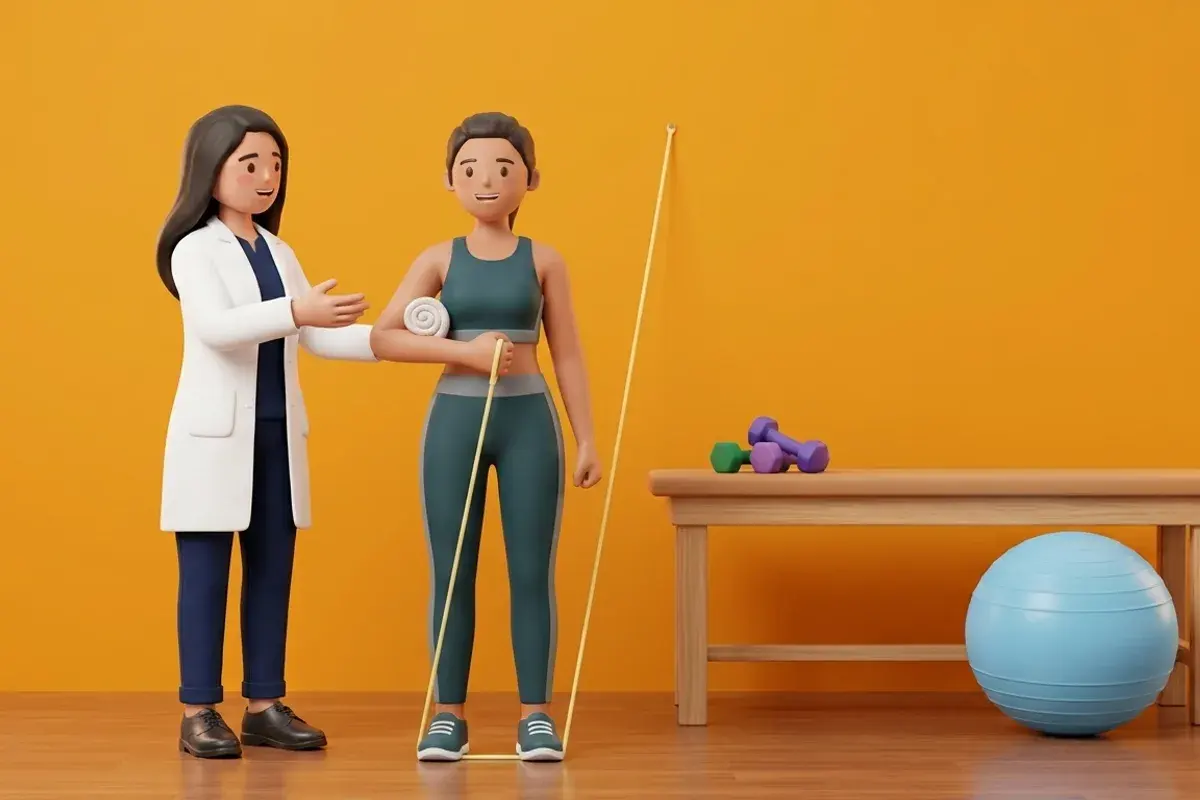
Controlled Eccentric External Rotation with Resistance Band
Objective: Stimulate tenocyte collagen realignment and dynamic posterior rotator cuff strength using slow eccentric lengthening
- 1Stand tall with your affected elbow bent at 90 degrees, holding the handle of a light elastic resistance band anchored at waist height.
- 2Place a rolled hand towel securely between your elbow and ribcage to prevent compensatory arm flaring.
- 3Use both hands to pull the band outward into external rotation over a count of 1 second.
- 4Release your sound hand, taking the entire load onto your affected shoulder.
- 5Resist the pull of the band as you slowly allow your forearm to rotate inward back across your body over 4 full seconds.
| Target Functional Unit | Primary Exercise & Movement Mechanics | Clinical Dosing & Biomechanical Objective |
|---|---|---|
| Posterior Cuff (Infraspinatus) | Side-lying eccentric external rotation with a 1-to-2 kg dumbbell; 4-second lowering phase. | 3 sets of 8 reps; restores dynamic external rotation control and humeral head depression. |
| Serratus Anterior | Wall push-up plus progressing to quadruped scapular protraction plus push-up. | 3 sets of 10 reps; facilitates scapular upward rotation and posterior tilting in overhead reach. |
| Lower Trapezius | Prone horizontal abduction at 130° in scaption (Y-raise) with thumb pointing toward ceiling. | 3 sets of 8 reps; activates lower scapular depressors, eliminating remaining shrug compensation. |
| Kinetic Chain Integration | Standing diagonal PNF D2 flexion-extension patterns with elastic tubing anchored at foot level. | 2 sets of 12 reps; coordinates leg drive, core transfer, and multi-axis functional arm reach. |
When advancing resistance training in the thawing stage, clinicians must monitor for tendon over-use tendinopathy. Developing sharp anterior pain over the bicipital groove or supraspinatus insertion indicates excessive mechanical load or inadequate recovery intervals. Any sudden onset of joint swelling with constitutional symptoms requires immediate medical evaluation to exclude delayed joint infection.
Frequently Asked Questions
Why do I still need strengthening exercises if my shoulder is moving freely again?
After having a stiff shoulder for a year or more, your rotator cuff and upper back muscles have become thin, weak, and uncoordinated from disuse. If you return to heavy lifting or sports without rebuilding their dynamic strength, your arm bone will pinch against the roof of your shoulder, causing painful tendinitis or bursitis. Strengthening ensures your recovered mobility remains permanent and functional.
Do I need a doctor referral to see a frozen shoulder physiotherapist on BookPhysio.in?
BookPhysio.in does not require a physician prescription. Under the National Commission for Allied and Healthcare Professions (NCAHP) Act 2021, patients across India enjoy direct access to autonomous registered physiotherapists. Through BookPhysio.in, you connect directly with verified clinicians and pay per session with transparent fees, completely free from advance package commitments, commission markups, or platform subscription charges.
Related recovery guides & articles
BookPhysio.in Editorial Team
The BookPhysio.in editorial team writes and maintains this content, checking it against reliable clinical sources. Content follows our medical review policy: general information only, and no page claims a clinical review until a named registered physiotherapist has signed it off.
Read our medical review policy