
Fall Prevention and Home Safety Modifications in Chronic Bone Infections
In short
Patients recovering from bone infections face severe risks from household falls. Learn essential Indian home adaptations and environmental safety audits.
In this guide (5 sections)
Patients recovering from chronic osteomyelitis, septic arthritis, and staged revision arthroplasty face severe vulnerability to household falls. The convergence of prolonged lower limb muscle wasting, impaired joint proprioception, asymmetrical gait mechanics, and medication-induced dizziness creates an exceptionally high fall risk profile. In an individual with an osteolytic bone void, a temporary antibiotic cement spacer, or fragile revision hardware, even a minor household trip can trigger catastrophic consequences, including periprosthetic fractures, spacer fragmentation, severe wound dehiscence, or secondary reinfection. Implementing structured, evidence-based home safety modifications is mandatory to protect healing bone and joints.
Domestic and Cultural Indian Realities
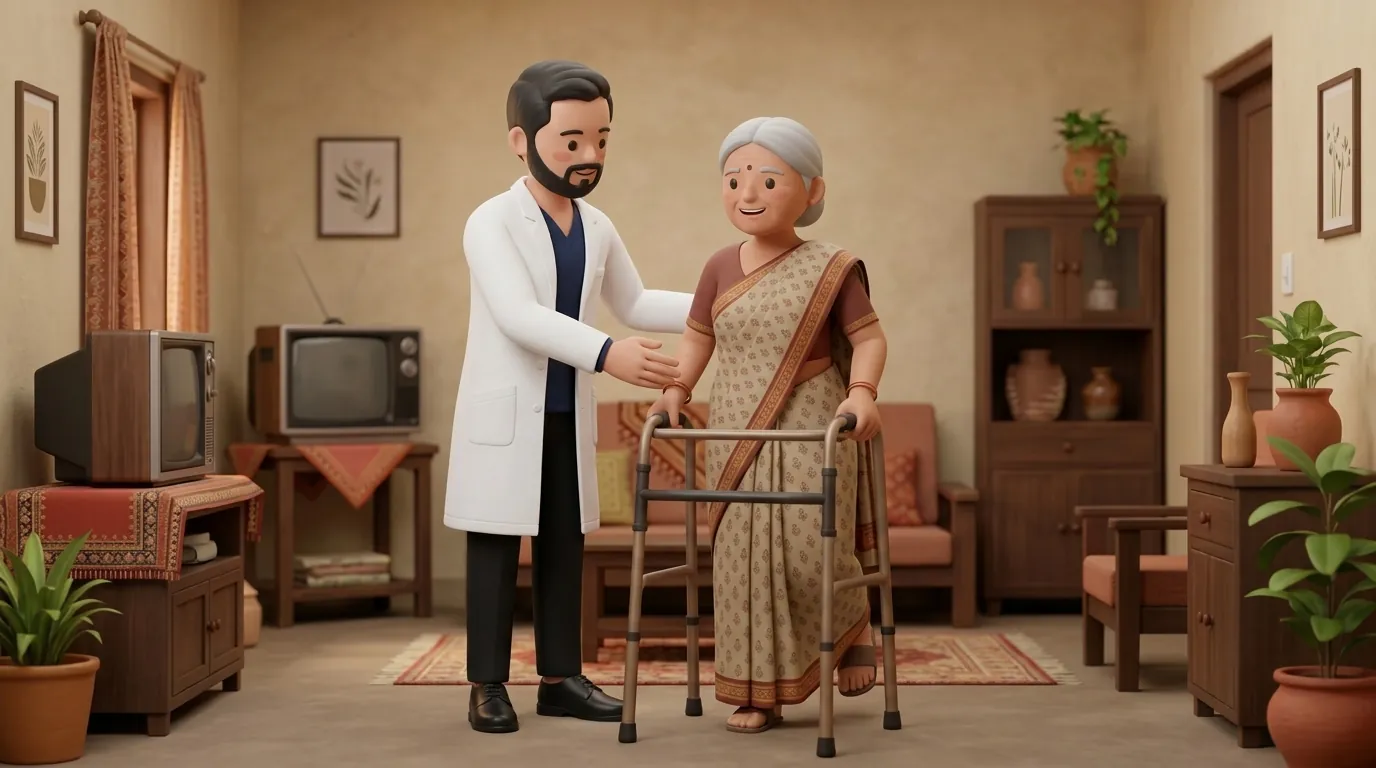
Indian residential architecture presents unique environmental fall hazards that require targeted interventions. Common features include polished marble or vitrified tile flooring that becomes treacherous when wet, unanchored decorative cotton rugs (dhurries), and raised stone or wooden door thresholds (chaukhats) that catch crutch tips. Traditional Indian bathrooms often lack separate shower stalls, leading to slippery, soap-filmed wet zones throughout the entire bathroom area. Physiotherapists conduct comprehensive domestic safety audits, instructing families to install non-slip rubber mats, secure sturdy stainless steel grab bars, and fit raised Western commodes with armrests.
Proprioceptive Deficits and Balance Degradation Dynamics
Joint sepsis and surgical debridement damage the mechanoreceptors located within the joint capsule, cruciate ligaments, and subchondral bone. These Ruffini and Pacinian endings normally provide continuous afferent feedback regarding joint position sense. When proprioception is blunted, the central nervous system experiences delayed postural reflex responses to unexpected perturbations. Coupled with severe disuse atrophy of the hip abductors and quadriceps, the patient cannot execute rapid compensatory stepping to prevent a fall when stumbling over domestic obstacles.
Evidence-Based Home Modifications and Balance Retraining
A structured home safety checklist must be implemented before hospital discharge. Bathrooms require immediate priority: installing professional-grade, wall-anchored grab bars beside the commode and bathing area, placing high-traction rubber suction mats on floors, and providing a stable shower stool. Walking corridors must be cleared of all trailing electrical wires, phone charger cords, and loose floor coverings. Nightlights (0.5 to 1.0 watt warm LEDs) should illuminate hallways connecting the bedroom to the bathroom. Concurrently, physiotherapy incorporates supported balance retraining, weight-shifting drills, and sensory proprioceptive exercises.
Supported Static Tandem Stance and Postural Stability Drill
Objective: Retrain sensory proprioceptive pathways and postural stability in a secure environment
- 1Stand securely in the corner of a room or next to a sturdy, heavy dining table holding firmly with both hands.
- 2Place the heel of your sound foot directly in front of the toes of your operative foot (tandem stance).
- 3Distribute your weight equally between both feet, keeping your posture tall and shoulders relaxed.
- 4Gently reduce your handgrip to light fingertip contact on the table, maintaining your balance for 10 seconds.
- 5Step your feet back to a comfortable shoulder-width stance, take a deep breath, and repeat the balance hold.
| Domestic Fall Hazard | Biomechanical Risk Mechanism | Mandatory Home Safety Adaptation |
|---|---|---|
| Slippery Bathroom Marble / Tiles | Sudden loss of traction on soapy, wet surfaces leading to uncontrolled lateral falls | Install heavy-duty textured rubber suction mats; use non-slip bathroom slippers with treaded soles |
| Raised Door Sills (Chaukhats) | Crutch or walker rubber tips catching on 2-5 cm raised stone thresholds, causing forward tripping | Install small wooden wedge ramps; mark threshold edges with high-contrast colored tape |
| Low Indian Squatting Commode | Extreme knee and hip flexion >110 degrees causing spacer dislocation or bone overloading | Mandatory installation of a rigid raised Western toilet seat (45-50 cm height) with dual grab rails |
| Inadequate Hallway Night Lighting | Loss of visual cues during nocturnal bathroom visits compounded by proprioceptive deficit | Install continuous plug-in warm LED nightlights along bedroom-to-bathroom corridors |
Red Flags and Specialist Escalation
Seek emergency medical evaluation immediately if the patient experiences any slip, stumble, or fall event, even if no immediate pain is reported. Furthermore, sudden localized swelling, inability to bear previously tolerated weight, acute bruising around the operative joint, or a new limb deformity requires urgent radiographic evaluation to rule out a periprosthetic or pathological fracture.
Frequently Asked Questions
What is the single most dangerous area in the house for someone recovering from a bone infection?
The bathroom is statistically the most dangerous room in the house. Wet tiles, soapy surfaces, and the need to bend and sit on low toilets create an exceptionally high slip-and-fall risk. Installing wall grab bars, non-slip rubber mats, and a raised Western toilet seat is essential before returning home.
Do I need a doctor referral to consult an orthopaedic physiotherapist on BookPhysio.in?
BookPhysio.in does not require a doctor referral. Under the National Commission for Allied and Healthcare Professions (NCAHP) Act 2021, patients in India have direct access to registered physiotherapists. You pay your clinician directly per session with transparent fees and zero booking commissions or platform subscriptions.
Related condition guides

Related recovery guides & articles
BookPhysio.in Editorial Team
The BookPhysio.in editorial team writes and maintains this content, checking it against reliable clinical sources. Content follows our medical review policy: general information only, and no page claims a clinical review until a named registered physiotherapist has signed it off.
Read our medical review policy