
Geriatric Ankle Stiffness and Trip-Fall Prevention: Balance, Foot Clearance, and Mobility
In short
Understand how age-related ankle stiffness increases trip-and-fall risks in older adults, and discover evidence-based mobility and balance exercises.
In this guide (4 sections)
In geriatric medicine and public health, accidental falls among older adults represent a leading cause of severe disability, loss of independence, and mortality. While traditional fall-prevention programs focus broadly on generalized quadriceps strengthening and environmental hazard removal, contemporary biomechanical research identifies a critical, highly localized predictor of fall risk: age-related ankle joint stiffness and toe-clearance deficit. As individuals age, progressive dehydration of articular hyaline cartilage, cross-linking of collagen fibers within the Achilles tendon, and disuse-induced capsular contracture severely diminish closed-chain ankle dorsiflexion. When an older adult cannot achieve at least fifteen to twenty degrees of dorsiflexion, their functional toe clearance during the swing phase of gait drops precipitously, transforming minor floor irregularities into catastrophic tripping hazards.
Navigating Raised Door Thresholds, Wet Bathroom Tiles, and Sari Draping
In traditional Indian households, architectural layouts present unique hazards for aging family members. Most older residences incorporate raised stone door thresholds (chaukhat), varying from two to five centimetres in height, between every room and doorway. For an elderly grandparent with restricted ankle dorsiflexion, the foot fails to clear this raised sill during normal shuffling gait, causing the toe to catch and triggering a violent forward fall. Furthermore, Indian bathrooms are frequently wet and paved with slick ceramic tiles, while the daily wearing of loose, flowing ethnic garments such as sarees or dhotis can obscure foot visibility and entangle dragging feet. When a senior adult trips, age-related bone osteopenia significantly increases the likelihood that a simple ankle sprain will manifest as a devastating bimalleolar fracture or hip fracture, making ankle mobility restoration a matter of survival.
The Ankle Balance Strategy, Sarcopenic Latency, and Minimum Toe Clearance
The neurobiomechanics of geriatric fall risk involve a breakdown of automated postural equilibrium. When standing upright, the body naturally relies on the ankle strategy, subtle anterior and posterior contractions of the tibialis anterior and gastrosoleus, to sway gently within the cone of stability. In the elderly, sarcopenic loss of fast-twitch Type II motor units delays muscle activation latency from fifty milliseconds to over one hundred milliseconds. Concurrently, capsular contracture restricts anterior tibial translation, preventing the ankle strategy from functioning. During dynamic gait, this lack of dorsiflexion reduces the Minimum Toe Clearance (MTC), the critical distance between the sole of the shoe and the floor during mid-swing, to less than one centimetre. Under these conditions, stepping onto a loose rug, a low doorstep, or an uneven paver tile catches the foot, precipitating an unrecoverable forward fall.
Geriatric Mobility Protocols: Supported Dorsiflexion, Seated Banding, and Balance
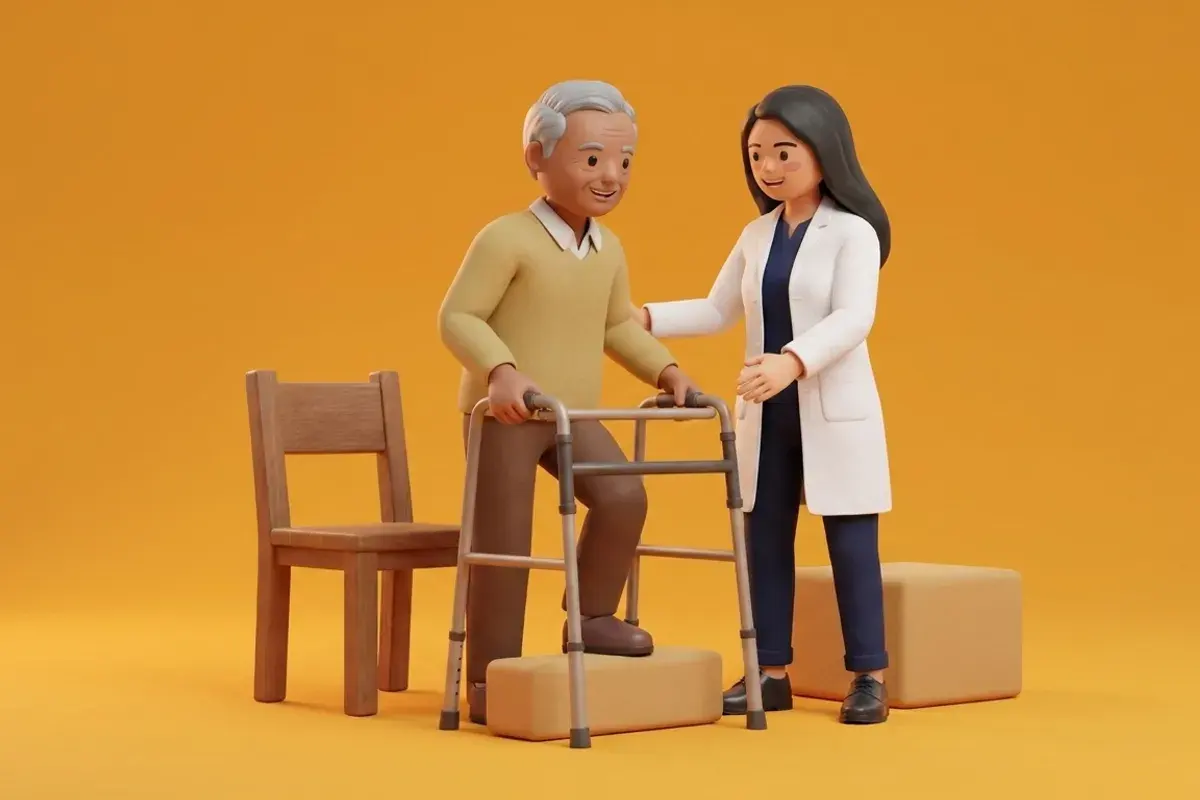
Geriatric rehabilitation delivered by registered physiotherapists focuses on safely restoring functional ankle excursion and reactive balance while ensuring patient safety. Mobilization begins with seated passive and active-assisted dorsiflexion using elastic resistance bands or towel loops to gently stretch the contracted Achilles tendon and posterior capsule. In standing, patients perform supported knee-to-wall lunges and eccentric heel-lowering drills with hands firmly placed on a kitchen countertop or parallel bars. Concurrently, progressive balance training challenges the ankle strategy: patients practice tandem stance (heel-to-toe standing), standing on textured balance pads, and performing deliberate high-stepping obstacle marches over low foam hurdles. Restoring just five degrees of closed-chain dorsiflexion significantly expands minimum toe clearance, dramatically reducing tripping frequency.
Countertop-Supported Ankle Rocker and Toe-Lift Progression for Seniors
Objective: Enhance active ankle dorsiflexion range of motion, toe clearance, and dynamic ankle balance strategy
- 1Stand tall facing a sturdy, immovable kitchen countertop or heavy dining table, placing both hands firmly on the surface for balance.
- 2Position your feet parallel and hip-width apart, standing tall with good upright spinal posture.
- 3Slowly shift your weight onto your heels, actively lifting your toes and the front halves of both feet off the floor as high as comfortable.
- 4Hold your toes lifted for 2 seconds, feeling the muscles on the front of your shins working firmly.
- 5Gently roll your feet back down, smoothly shifting your weight forward onto your toes to lift your heels three to five centimetres off the floor, holding for 2 seconds before repeating.
| Anatomical and Functional Domain | Young Healthy Ankle Complex | Aging Geriatric Ankle Complex | Physiotherapy Countermeasure Protocol |
|---|---|---|---|
| Closed-Chain Dorsiflexion Range | 35 to 45 degrees of tibial excursion (WBLT 10 to 12 cm) | Severely restricted to 15 to 25 degrees (WBLT less than 6 cm) | Maitland posterior talar glides and supported calf lunge stretches |
| Minimum Toe Clearance (MTC) | Safe clearance of 1.5 to 2.5 centimetres during mid-swing | Severely reduced to under 0.8 to 1.0 centimetre (high trip risk) | High-stepping obstacle drills and active tibialis anterior strengthening |
| Postural Ankle Strategy | Primary automated defense against small balance perturbations | Severely blunted; patient forced into unstable hip or stepping strategy | Tandem stance balance drills and rocker board weight-shifting |
| Bone Mineral Density Resistance | High bone mineral density resistant to low-energy avulsion fractures | Osteopenic or osteoporotic bone vulnerable to bimalleolar fractures | Fall-prevention education and non-slip home environment modifications |
For an older adult recovering from an ankle sprain or presenting with chronic joint stiffness, prescribing exercises is insufficient without addressing home hazards. Families must immediately secure loose floor carpets, install high-friction rubber mats in bathrooms, ensure adequate nighttime lighting with night-bulbs in hallways, and mark raised stone door thresholds with contrasting high-visibility tape to prevent tripping.
Frequently Asked Questions
Can an older adult in their 70s really regain ankle flexibility after years of stiffness?
Yes, clinical research confirms that the human muscular and connective tissue system retains positive adaptability at any age. With gentle, daily supported stretching, seated resistance exercises, and balance training, older adults in their seventies and eighties can safely regain valuable ankle flexibility within six to eight weeks, significantly improving foot clearance and reducing fall risk.
Do I need a doctor referral to see an ankle sprain physiotherapist on BookPhysio.in?
BookPhysio.in does not require a doctor referral. Under the National Commission for Allied and Healthcare Professions (NCAHP) Act 2021, patients across India enjoy direct access to autonomous registered physiotherapists. Through BookPhysio.in, you connect directly with verified clinicians and pay per session with transparent fees, completely free from advance package commitments, commission markups, or platform subscription charges.
Related condition guides

Related recovery guides & articles
BookPhysio.in Editorial Team
The BookPhysio.in editorial team writes and maintains this content, checking it against reliable clinical sources. Content follows our medical review policy: general information only, and no page claims a clinical review until a named registered physiotherapist has signed it off.
Read our medical review policy