
Lumbosacral Orthosis (LSO) Biomechanics in Segmental Instability
In short
Lumbosacral orthoses provide vital external stability for lumbar instability. Learn biomechanical mechanisms, proper strap tensioning, and weaning guidelines.
In this guide (4 sections)
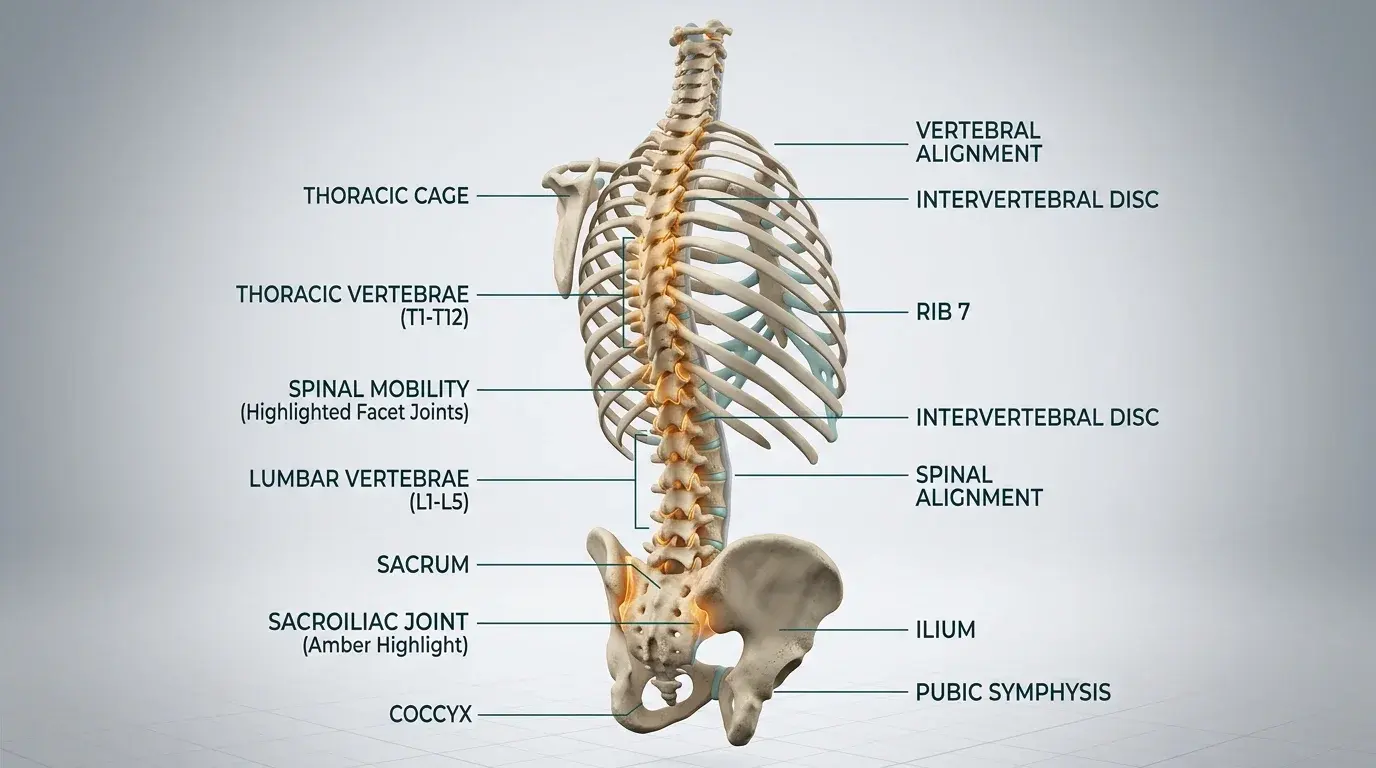
Lumbosacral orthoses (LSO) represent widely prescribed external spinal supports designed to restrict gross trunk motion, augment intra-abdominal pressure, and alleviate mechanical pain in patients suffering from lumbar segmental instability and low-grade spondylolisthesis. Ranging from flexible neoprene corsets with flexible stays to semi-rigid orthoses featuring molded thermoplastic posterior panels and mechanical pulley closure systems, LSOs alter spinal mechanics through several distinct pathways. While an LSO cannot completely eliminate micro-motion at an isolated vertebral level, its capacity to reduce lumbosacral flexion-extension arcs, enhance kinesthetic postural awareness, and offload paraspinal muscle fatigue makes it an invaluable adjunct in conservative orthopedic rehabilitation.
Indian Road Transit Vibrations, Market Porterage, and Household Chores
The physical demands of everyday life in India frequently warrant temporary orthotic assistance to protect unstable spinal segments. Commuters navigating bumpy bus rides or riding two-wheelers through urban traffic find that wearing a semi-rigid LSO provides vital mechanical damping against abrupt vertical road shocks. In wholesale markets and residential communities, individuals who must carry heavy grocery baskets or maneuver LPG gas cylinders benefit from the structural support of an LSO, which prevents sudden involuntary lumbar extension catches. However, many Indian patients fall into the trap of wearing flexible belts continuously for months out of fear, leading to profound core muscle deconditioning and psychological dependence.
Cylinder Mechanics, Intra-Abdominal Pressure, and Shear Attenuation
The mechanical action of an LSO operates primarily through two distinct physical mechanisms: fluid cylinder creation and multi-point motion restriction. When the orthosis is cinched securely around the abdomen, it compresses the fluid-filled visceral cylinder, elevating intra-abdominal pressure by up to thirty percent. According to mechanical modeling, this elevated internal pressure acts like a pressurized column anterior to the spine, generating an internal extension moment that relieves vertical compressive loads on the lumbar discs and vertebral bodies by approximately twenty to twenty-five percent. Concurrently, the rigid posterior panel acts as a physical barrier against lumbar hyperextension, reducing the anterior shear vector that drives forward slippage at L5-S1. Sensory tactile feedback from the tight circumferential band also alerts the patient whenever they attempt hazardous movement.
Judicious Application, Activity-Specific Wear, and Active Weaning
Physiotherapy management emphasizes the judicious, task-specific utilization of an LSO rather than continuous, unyielding wear. Clinicians instruct patients to wear the orthosis exclusively during high-demand physical tasks, such as prolonged standing, lifting household objects, or traveling over rough roads, while removing it during sedentary rest and structured exercise sessions. Active rehabilitation focuses on training the internal muscular corset (transversus abdominis, internal obliques, and multifidus) to replicate the mechanical functions of the external orthosis. As deep stabilizing endurance improves, the wearing time is systematically reduced, ensuring that the patient transitions smoothly toward self-sufficient active spinal stability.
Active Core Bracing with Belt Tactile Biofeedback
Objective: Train internal abdominal wall expansion and stabilization against external orthotic tactile cues
- 1Fasten your semi-rigid LSO snugly around your midsection while standing tall in a relaxed, neutral posture.
- 2Place your open palms flat against the front and sides of the brace to feel the surface tension.
- 3Take a slow, relaxed diaphragmatic breath in through your nose, letting your lower abdomen expand into the belt.
- 4As you exhale, gently tighten your abdominal wall as if pushing outward evenly into all three hundred sixty degrees of the belt.
- 5Hold this muscular brace firmly for 8 seconds without holding your breath, feeling your core mimic the firmness of the brace.
| Orthosis Category | Biomechanical Rigidity and Motion Restriction | Appropriate Clinical Indication and Duration |
|---|---|---|
| Elastic Lumbar Corset | Minimal motion restriction (10-15%); elevates intra-abdominal pressure and provides warmth | Mild muscular fatigue, non-specific low back pain; safe for short-term symptomatic relief |
| Semi-Rigid LSO (with Panels) | Moderate restriction (30-50% sagittal motion); mechanical pulley systems ensure tight compression | Symptomatic Grade I spondylolisthesis, moderate segmental hypermobility; worn during active tasks |
| Rigid Custom Body Jacket | High restriction (>70% sagittal and coronal motion); completely blocks lumbar extension | Acute pars stress fractures, postoperative spinal fusion protection; worn 20+ hours daily |
| Chairback / Knight Orthosis | Rigid aluminum framework restricting extension and lateral bending while allowing flexion | Severe multi-level degenerative instability in elderly patients; long-term supportive management |
Wearing a semi-rigid LSO continuously for prolonged periods exceeding eight to twelve weeks without structured core exercise leads to severe disuse atrophy of the abdominal and paraspinal musculature. Patients often report that their back feels completely broken whenever the belt is removed. Physiotherapy must enforce active stabilization drills alongside orthotic use to prevent psychological dependence and secondary muscle deterioration.
Frequently Asked Questions
Should I wear my lumbar support belt while sleeping or resting in bed?
No, you should never wear your lumbar support belt while sleeping or lying in bed unless specifically instructed by your spine surgeon following acute fracture or surgery. When you are lying down, your spine is completely unweighted, eliminating gravitational compressive and shear loads. Wearing a tight belt in bed restricts normal diaphragmatic breathing, impairs local skin circulation, and encourages muscle atrophy. The belt should be reserved strictly for upright, weight-bearing activities such as standing, walking, or traveling.
Do I need a doctor referral to consult a spondylolisthesis physiotherapist on BookPhysio.in?
BookPhysio.in does not require a doctor referral. Under the National Commission for Allied and Healthcare Professions (NCAHP) Act 2021, patients across India enjoy direct access to autonomous registered physiotherapists. Through BookPhysio.in, you connect directly with verified clinicians and pay per session with transparent fees, completely free from advance package commitments, commission markups, or platform subscription charges.
Related recovery guides & articles
BookPhysio.in Editorial Team
The BookPhysio.in editorial team writes and maintains this content, checking it against reliable clinical sources. Content follows our medical review policy: general information only, and no page claims a clinical review until a named registered physiotherapist has signed it off.
Read our medical review policy