
Multi-Generational Family Education: Respectful Fall Prevention in Indian Homes
In short
Overprotective restriction strips older adults of dignity and accelerates deconditioning. Discover how to communicate fall prevention with respect in Indian homes.
In this guide (6 sections)
Effective fall prevention in older adults extends far beyond clinical exercise prescription; it requires harmonious alignment with family dynamics, cultural values, and patient dignity. In multi-generational households, efforts to protect an ageing parent frequently clash with the elder's fierce desire to maintain personal autonomy and self-respect. When well-meaning adult children issue patronizing commands or enforce total bed rest, seniors often rebel by hiding falls or refusing walking aids. Educating families in respectful, collaborative fall prevention preserves senior dignity while creating a secure domestic environment.
Domestic and Cultural Indian Realities
In Indian culture, reverence for elders (pranam and samman) is deeply ingrained. However, when an elderly matriarch or patriarch begins stumbling, adult children often find themselves in an awkward role reversal. Children may scold their parents, saying, "Aap baith jao, kuch mat karo" (Sit down, do not do anything). Elders often perceive recommendations to install bathroom grab bars, use a walking stick, or modify high door thresholds as humiliating admissions of helplessness. Consequently, elders hide minor trips and near-misses from family members, fearing that disclosure will lead to loss of independence or being placed under round-the-clock attendant surveillance.
Clinical Biomechanics and Postural Control Decay
Culturally enforced immobility has severe biological consequences. Confining an older adult to a chair or bed causes skeletal muscle loss of up to one kilogram per week of bed rest, accelerates bone mineral resorption, and worsens joint contractures. Within fourteen days of forced sedentariness, quadriceps force output drops by twenty percent, severely impairing the motor capacity needed for sit-to-stand transfers. By restricting an elder's movements out of love, families unintentionally accelerate the exact biomechanical decay that turns minor balance losses into traumatic fractures.
Functional Assessment and Risk Stratification
Clinical assessment evaluates family dynamics and caregiver strain using the Zarit Burden Interview alongside patient autonomy scales. The physiotherapist identifies communication friction points, assessing whether the senior feels patronized or supported. The goal is to establish shared, respectful agreements where the elder actively participates in safety decisions rather than having rules imposed upon them.
Targeted Strength and Balance Exercises
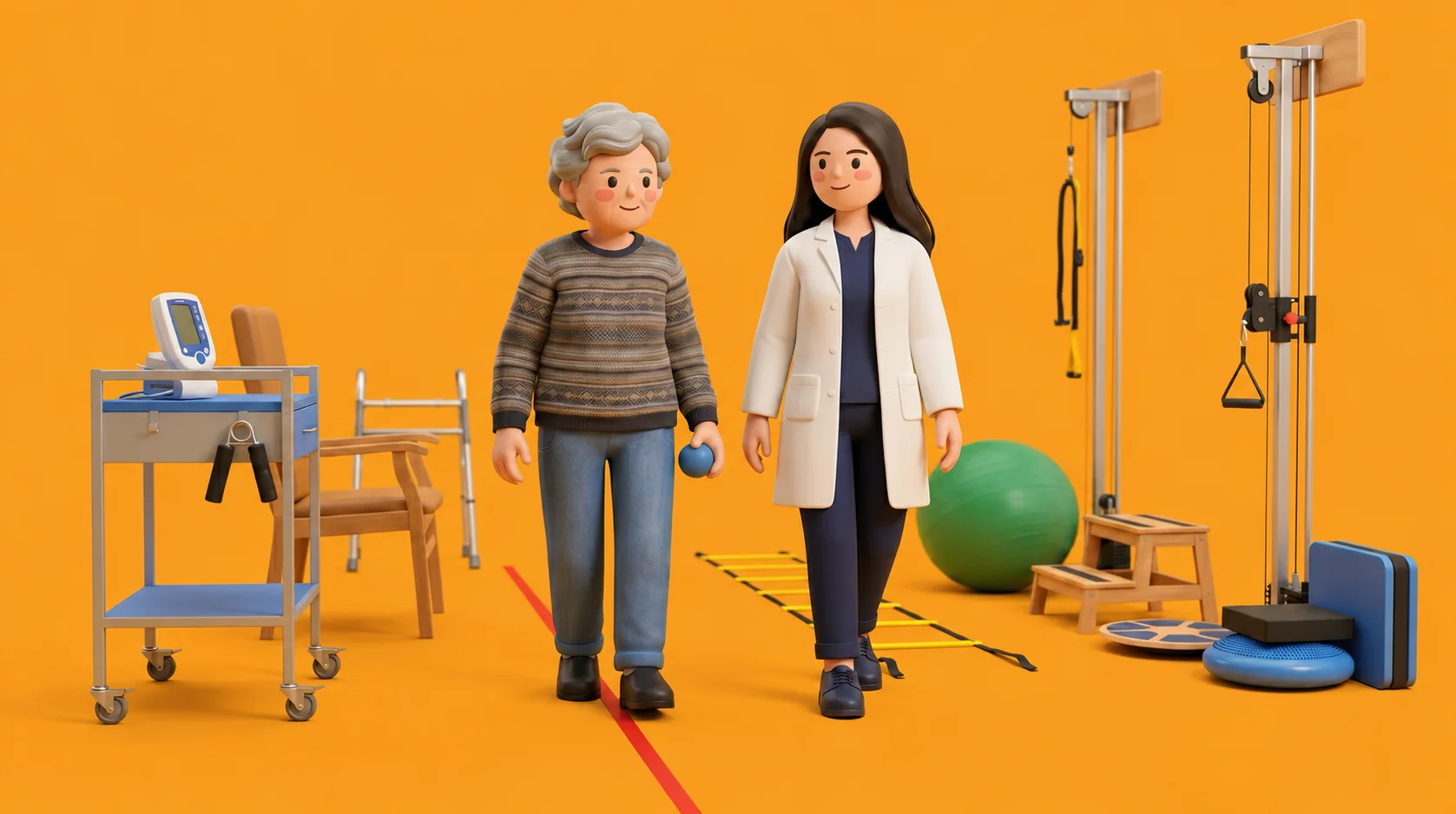
Physiotherapy rehabilitation frames exercises not as medical treatments for weakness, but as vitality-boosting practices (such as functional fitness for temple visits or playing with grandchildren). Family members participate in supervised partner exercises, turning rehabilitation into positive joint activities.
Partner-Supported Functional Weight-Shift and Step Drill
Objective: Engage family members in positive, non-judgmental balance coaching and stability practice
- 1Stand facing your family member or partner, maintaining a comfortable one-metre distance on a firm floor.
- 2Hold both hands lightly with your partner at waist height for reassuring, gentle balance support.
- 3Take a slow, deliberate step forward with your right foot, shifting weight smoothly while your partner mirrors you.
- 4Step back to central stance, then step forward with your left foot, maintaining warm eye contact and upright posture.
- 5Practice shifting weight side-to-side rhythmically, feeling stable and supported throughout.
| Domestic Situation | Patronizing Restriction (Avoid) | Respectful Collaboration (Recommended) |
|---|---|---|
| Walking Aid Introduction | "You are too old to walk alone; you must use this stick" | "This walking stick gives extra stability so you can continue visiting the temple comfortably" |
| Bathroom Grab Bar Installation | "We are putting bars because you cannot balance yourself" | "We are installing modern safety rails so everyone in the house has secure support on wet tiles" |
| Handling a Near-Miss Stumble | "See? You should not have walked! Stay seated from now on" | "Let us sit together and check what happened; we can practice exercises with the physio to prevent that" |
| Household Chores Participation | Banning the elder from kitchen or gardening entirely | Organising comfortable seated workstations so the elder continues meaningful daily contributions |
Red Flags and Emergency Post-Fall Escalation
Families must be educated on objective post-fall red flags so that emergency medical help is summoned without delay or blame. If an elder falls, avoid expressing anger or panic. Check immediately for hip fractures (shortened, externally rotated leg), severe spinal tenderness, or delayed concussion signs. Always contact emergency services if the elder cannot bear weight or displays confusion.
Frequently Asked Questions
How can adult children convince an elderly Indian parent to use a walking cane without hurting their feelings?
Frame the cane not as a symbol of frailty, but as a supportive tool for independence and active living. Highlighting that a cane enables safe visits to temples, family weddings, and parks helps elders accept the aid with dignity.
Can physiotherapists help bridge family communication gaps regarding fall prevention in India?
Geriatric physiotherapists act as objective, respected clinical mediators, facilitating family discussions and designing collaborative safety plans. Under the NCAHP Act 2021, Indian patients access registered physiotherapists directly via BookPhysio.in with direct pay-per-session pricing.
Related condition guides

Related recovery guides & articles
BookPhysio.in Editorial Team
The BookPhysio.in editorial team writes and maintains this content, checking it against reliable clinical sources. Content follows our medical review policy: general information only, and no page claims a clinical review until a named registered physiotherapist has signed it off.
Read our medical review policy