
Pillar Pain After Carpal Tunnel Release: Thenar and Hypothenar Care
In short
Pillar pain causes deep aching in the thenar and hypothenar mounds after carpal tunnel release. Learn pathomechanics, scar therapy, and functional loading.
In this guide (4 sections)
Pillar pain represents one of the most frustrating and common post-operative complications following carpal tunnel release, affecting between 25 and 40 percent of patients undergoing open decompression. It is clinically characterized by deep, localized aching, tenderness, and mechanical hypersensitivity over the thenar and hypothenar muscle eminences, flanking the surgical scar. While the primary neurological symptoms of carpal tunnel syndrome (nocturnal numbness and paresthesia) are often relieved immediately after surgery, pillar pain creates substantial functional disability, preventing patients from bearing weight through the palm, leaning on tables, pushing open doors, or operating vehicle steering controls.
Impact on Daily Indian Living and Weight-Bearing Tasks
In Indian daily life, pillar pain severely restricts basic activities of daily living. Patients find it excruciating to push themselves up from a low bed, sofa, or floor seating position, tasks that require pressing the heel of the palm firmly downward. Practicing traditional yoga asanas such as Adho Mukha Svanasana (Downward Dog) or Phalakasana (Plank) becomes impossible due to intense palm pressure. In occupational and transport domains, gripping the throttle of a motorcycle, turning a heavy iron key in a lock, or using a rolling pin (belan) to flatten bread dough provokes sharp, deep aching that leads patients to worry that their surgery has failed.
Biomechanics of the Divided Transverse Carpal Ligament
The pathophysiological mechanisms underlying pillar pain stem from alterations in carpal arch anatomy and soft tissue re-anchoring following surgical division of the transverse carpal ligament (TCL). The TCL serves as the primary stabilizing tie-beam for the transverse carpal arch, anchoring the origins of the thenar (abductor pollicis brevis, opponens pollicis) and hypothenar (abductor digiti minimi, flexor digiti minimi) musculature. When the ligament is transected, the carpal arch widens by 2 to 4 millimeters, altering the spatial relationship between the carpal bones (particularly the scaphoid and pisiform). This structural widening creates localized micro-instability and chronic traction strain at the muscular insertion sites. Furthermore, transection of tiny palmar cutaneous nerve branches can produce microscopic neuromas, while deep scar tissue adhesions bind the divided ligament ends to adjacent muscle bellies.
Physiotherapy Interventions: Desensitization, Myofascial Release, and Padding
Clinical physiotherapy for pillar pain centers on restoring soft tissue compliance, stabilizing the carpal arch, and desensitizing hyperesthetic tissues. Therapy begins with deep cross-friction massage and instrument-assisted soft tissue mobilization (IASTM) directed over the muscular pillars, combined with silicone gel sheeting to soften rigid fibrotic scars. To enable pain-free functional hand use, clinicians fit patients with custom gel-padded gloves featuring a hollow central channel that bridges the surgical scar and distributes contact forces outward. Active rehabilitation incorporates isometric carpal arch squeezing drills, progressive wrist extensor loading, and gradual weight-bearing progressions starting against a wall before advancing to flat surfaces.
Pillar Desensitization and Carpal Arch Isometric Activation Drill
Objective: Reduce local mechanical hypersensitivity and retrain transverse carpal arch stabilizing force couples
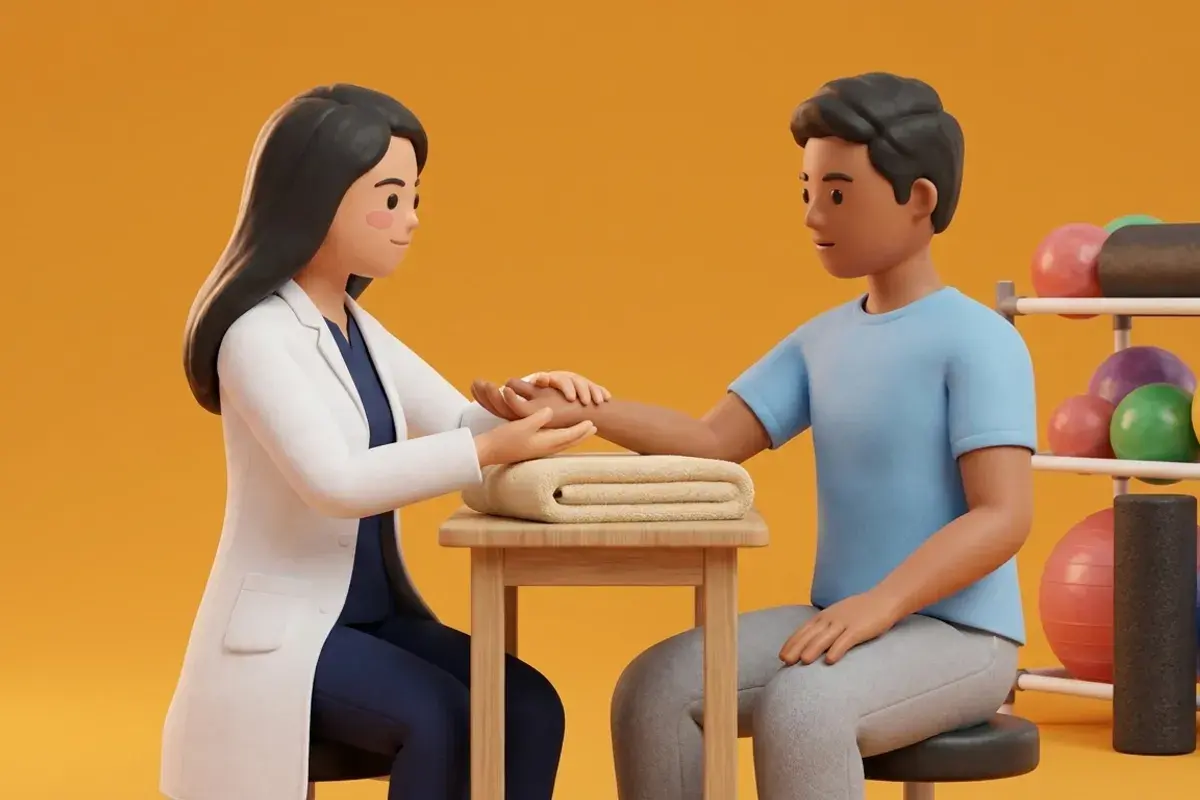
- 1Rest your operated hand on a soft towel on a table, with your palm facing upward toward the ceiling.
- 2Use your opposite thumb pad to apply gentle, circular friction over the muscular mound at the base of your thumb (thenar) for 60 seconds.
- 3Next, apply the same gentle circular friction over the muscular mound on the little finger side (hypothenar) for 60 seconds.
- 4Now, place a soft foam stress ball or rolled pair of socks in your palm and gently squeeze your thumb and little finger bases toward each other.
- 5Hold this carpal arch cupping contraction for 5 seconds, feel the muscle tone build across the palm, and release slowly.
| Clinical Feature | Pillar Pain | Recurrent Carpal Tunnel Syndrome |
|---|---|---|
| Primary Symptom Location | Deep ache and tenderness localized strictly over the thenar and hypothenar mounds | Numbness, tingling, and paresthesias radiating into the thumb, index, and middle fingers |
| Provocative Factors | Direct weight-bearing on the palm, pushing off chairs, firm grasping | Repetitive wrist flexion, nocturnal sleeping, sustained phone holding |
| Phalen and Tinel Signs | Negative; direct percussion over carpal canal does not elicit digital tingling | Positive; reproduces sharp electric shocks radiating into median nerve digits |
| Typical Natural History | Self-limiting condition that steadily resolves over 3 to 6 months with conservative therapy | Persistent or progressive neurological decline requiring revision surgical exploration |
Pillar pain is extraordinarily common and naturally self-limiting, typically resolving completely within 3 to 9 months post-surgery. However, clinicians must carefully distinguish benign mechanical pillar tenderness from deep palmar space infection or foreign body granuloma. If palmar tenderness is accompanied by spreading erythema, localized heat, systemic fever, or purulent drainage, emergency surgical consultation is required.
Frequently Asked Questions
Why does the heel of my palm hurt so much when I try to push myself up from a chair?
When the surgeon cuts the tight ligament across your wrist to free your nerve, the ligament ends spring apart slightly. The muscles at the base of your thumb and little finger were firmly attached to that ligament, so they now experience new pull and strain. When you push your palm flat against a chair, you compress these sensitive muscle attachments. This pillar pain will steadily fade as the tissues remodel over the next few months.
Do I need a doctor referral to see a peripheral nerve physiotherapist on BookPhysio.in?
BookPhysio.in does not require a physician prescription. Under the National Commission for Allied and Healthcare Professions (NCAHP) Act 2021, patients across India enjoy direct access to autonomous registered physiotherapists. Through BookPhysio.in, you connect directly with verified clinicians and pay per session with transparent fees, completely free from advance package commitments, commission markups, or platform subscription charges.
Related recovery guides & articles
BookPhysio.in Editorial Team
The BookPhysio.in editorial team writes and maintains this content, checking it against reliable clinical sources. Content follows our medical review policy: general information only, and no page claims a clinical review until a named registered physiotherapist has signed it off.
Read our medical review policy