
Pregnancy-Related Back Pain in Women with Pre-Existing Scoliosis
In short
Understand how pregnancy affects pre-existing scoliosis, managing relaxin-induced joint laxity, postural center-of-gravity shifts, and safe pain relief.
In this guide (4 sections)
Pregnancy induces profound anatomical, hormonal, and biomechanical changes across the female musculoskeletal system. For women living with pre-existing adolescent idiopathic or adult degenerative scoliosis, entering pregnancy often raises intense anxieties regarding potential curve progression, severe back pain, and labor complications. Extensive clinical research provides robust reassurance: mature structural scoliosis curves rarely experience permanent radiographic progression during pregnancy. However, the surge in the hormone relaxin, combined with an anteriorly shifting center of gravity and rapid gestational weight gain, places immense mechanical strain on an already asymmetric spine and pelvis. Understanding these biomechanical shifts and implementing proactive physiotherapy safeguards maternal spinal health throughout all trimesters.
Joint Family Expectations, Floor Tasks, and Maternal Support in India
In Indian joint family households, pregnant women frequently navigate demanding domestic expectations alongside traditional maternal rituals. Tasks such as preparing large meals, standing for extended hours during family poojas, or washing clothes on low platforms place severe strain on the lower back and sacroiliac joints. When an expectant mother with pre-existing scoliosis experiences intensifying backache, well-meaning family elders often advise total bed rest, which can lead to rapid core deconditioning, worsening pelvic girdle pain, and constipation. Furthermore, finding a comfortable sleeping position on firm Indian mattresses becomes agonizing as the abdomen expands. Physiotherapists educate Indian families on ergonomic maternal pacing, specialized bolster sleeping setups, and active pelvic stabilization exercises.
Relaxin-Induced Ligamentous Laxity, Sacroiliac Shear, and Sagittal Exaggeration
The pathophysiology of pregnancy-related back pain in scoliosis is driven by hormonal and mechanical interactions. Beginning in the first trimester, the corpus luteum and placenta secrete elevated levels of relaxin and estrogen, which deliberately loosen the pelvic ligaments (sacroiliac, sacrotuberous, and pubic symphysis) to prepare the birth canal for labor. In an asymmetric pelvis associated with scoliosis, this generalized ligamentous laxity allows underlying pelvic obliquity and sacroiliac torsion to become exaggerated, producing severe pelvic girdle pain (PGP). Concurrently, as the fetus and uterus grow forward during the second and third trimesters, maternal lumbar lordosis increases, and the center of gravity shifts anteriorly. In a scoliotic spine, this increased lordotic strain overburdens the paraspinal muscles, provoking intense muscle spasms along the curve convexity.
Maternal Pelvic Girdle Taping, Side-Lying Bolstering, and Gentle Core Bracing
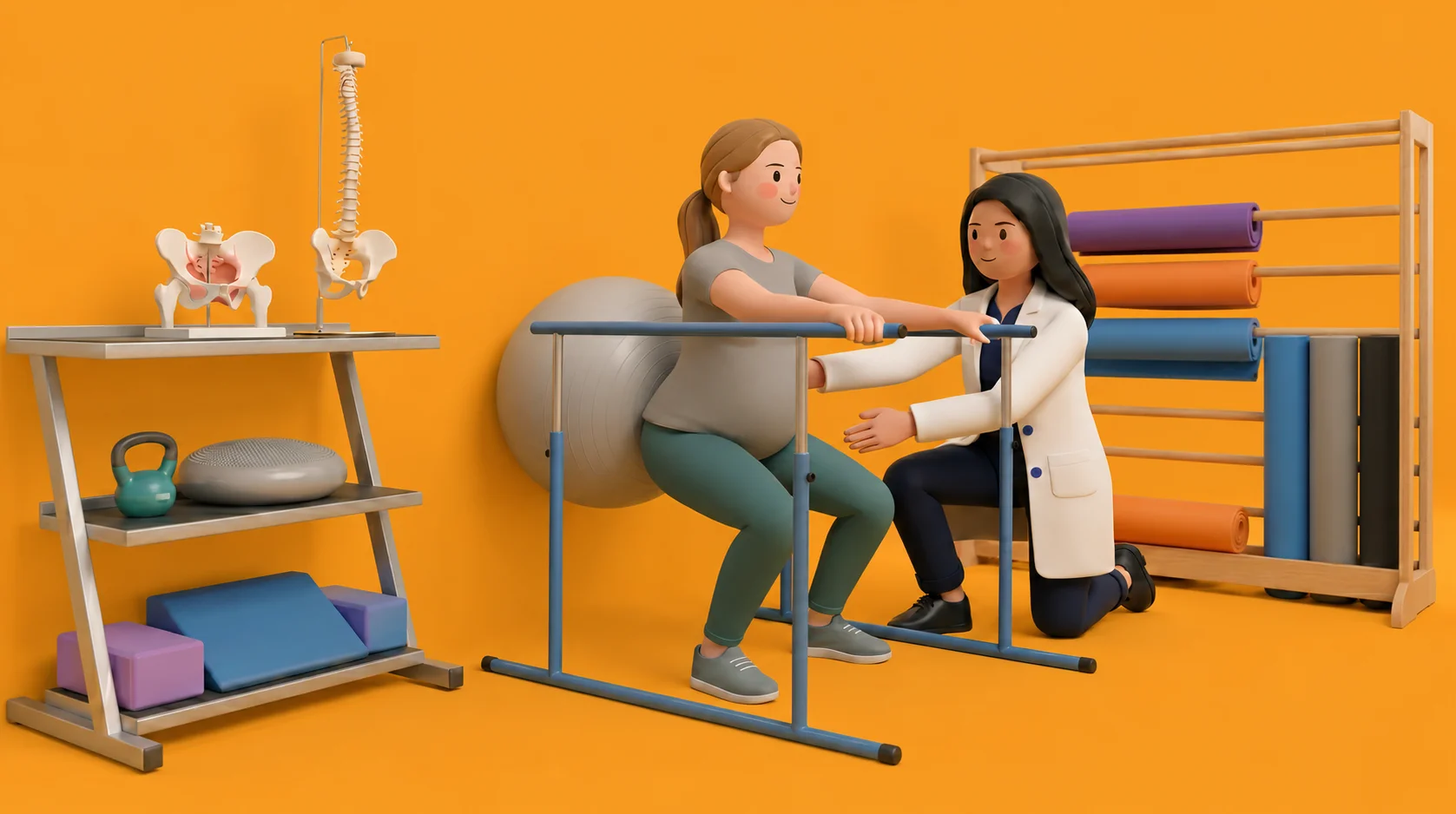
Physiotherapy care for pregnant women with scoliosis focuses on gentle stabilization, pain reduction, and labor preparation without endangering the developing fetus. Clinicians fit supportive maternity pelvic belts (such as a trochanteric SI belt) to compress the hypermobile sacroiliac joints, instantly relieving walking discomfort. Kinesiology taping applied across the lower back provides gentle, safe cutaneous support. Sleeping ergonomics are optimized using the side-lying position with supportive pillows placed beneath the abdomen and between the knees to maintain a level pelvic platform. Active exercises center on gentle pelvic tilting on birthing balls, transverse abdominis activation, and safe pelvic floor co-contractions, maintaining vital core endurance for labor.
Pelvic Tilting and Gentle Pelvic Rocking on a Birthing Ball
Objective: Relieve sacroiliac shear and promote pelvic mobility safely during pregnancy with scoliosis
- 1Sit comfortably on a properly inflated 65 cm birthing or stability ball with feet planted flat and wide on the floor.
- 2Rest your hands gently on your knees, keeping your spine tall and shoulders relaxed.
- 3Slowly rock your pelvis forward and backward in smooth, gentle pelvic tilts, matching the movement to your breath.
- 4Next, make slow, gentle circular hip circles on the ball, moving clockwise for 10 circles, then counter-clockwise.
- 5Maintain continuous, relaxed breathing, using the softness of the ball to cushion your pelvic floor.
| Pregnancy Trimester | Biomechanical Changes & Symptoms | Targeted Physiotherapy Clinical Strategy |
|---|---|---|
| First Trimester (Weeks 1 to 12) | Relaxin surge initiates systemic ligamentous laxity; early sacroiliac joint tenderness and mild fatigue | Postural education, gentle pelvic floor awareness, avoiding high-impact activities, baseline posture assessment |
| Second Trimester (Weeks 13 to 27) | Abdominal enlargement shifts center of gravity forward; lumbar lordosis increases, asymmetric flank strain | Maternity trochanteric belt fitting, side-lying bolster sleep setup, birthing ball mobility, water aerobics |
| Third Trimester (Weeks 28 to 40+) | Maximum gestational weight; marked pelvic girdle pain, pubic symphysis diastasis risk, severe sleep disturbance | Gentle maternal kinesiology taping, pelvic floor release breathing, labor positioning guidance, walking pacing |
If a pregnant patient develops excruciating pain over the front of the pubic bone (symphysis pubis dysfunction) that makes walking or separating the legs impossible, consult an obstetrician and physiotherapist immediately for urgent pelvic stabilization and mobility aid prescription.
Frequently Asked Questions
Can a woman with scoliosis receive an epidural during labor and delivery?
Yes, the vast majority of women with scoliosis can successfully receive an epidural or spinal anesthesia. It is essential to inform your anesthesiologist and obstetrician in advance, providing any available spinal radiographs or surgical records so they can plan the needle insertion around your curve.
Do I need a doctor referral to see a scoliosis physiotherapist on BookPhysio.in?
BookPhysio.in does not require a doctor referral. Under the National Commission for Allied and Healthcare Professions (NCAHP) Act 2021, patients across India enjoy direct access to autonomous registered physiotherapists. Through BookPhysio.in, you connect directly with verified clinicians and pay per session with transparent fees, completely free from advance package commitments, commission markups, or platform subscription charges.
Related condition guides

Related recovery guides & articles
BookPhysio.in Editorial Team
The BookPhysio.in editorial team writes and maintains this content, checking it against reliable clinical sources. Content follows our medical review policy: general information only, and no page claims a clinical review until a named registered physiotherapist has signed it off.
Read our medical review policy