
Resisted Inversion Strengthening: Elastic Band Progressions, Angle Specificity, and Tibialis Posterior Overload
In short
Master progressive resisted inversion exercises using elastic bands to rehabilitate the tibialis posterior, rebuild arch strength, and restore gait function.
In this guide (4 sections)
Resisted ankle inversion represents the primary targeted exercise for isolating and strengthening the tibialis posterior muscle-tendon unit. In healthy gait kinematics, the tibialis posterior must generate substantial eccentric and concentric torque across the subtalar joint to control pronation velocity and subsequently invert the calcaneus into rigid propulsion. When tendon degeneration or muscle disuse occurs, the capacity to invert against load diminishes rapidly. Elastic resistance band protocols offer a highly adaptable, progressive mechanotherapy method to stimulate tenocyte protein synthesis, reorganize collagen bundles, and increase muscle fiber recruitment. By systematically adjusting the vector angle, band resistance, and contraction tempo, clinicians can progressively overload the tendon without triggering inflammatory exacerbation within the vulnerable retromalleolar sheath.
Morning Routines, Stepping off Footboards, and Slipper Instability
In Indian urban life, lower leg inverters face unpredictable dynamic stresses. Stepping down from crowded suburban train coaches, negotiating wet footboards on state transport buses, or avoiding sudden potholes on unpaved roads requires sharp, rapid ankle inversion adjustments. When an individual has deconditioned or fatigued inverters, the foot sags into sudden, uncontrolled eversion upon impact, straining the inner ankle. At home, walking in loose rubber hawai chappals forces the toes to grip while the ankle wobbles sideways on slick bathroom tiles. Incorporating structured elastic band strengthening into the daily routine restores dynamic stability, giving patients the muscular power needed to navigate hazardous street environments safely.
Tendon Mechanobiology, Angle Specificity, and Selective Activation
The biomechanical isolation of the tibialis posterior requires careful limb positioning. If inversion is performed with the foot in dorsiflexion, the powerful tibialis anterior muscle dominates the movement, leaving the deeper tibialis posterior underloaded. To selectively recruit the tibialis posterior, inversion must be performed from a position of slight plantarflexion. Cellular mechanotransduction studies demonstrate that repetitive, controlled tensile loading prompts tenocytes to upregulate insulin-like growth factor-1 (IGF-1) and increase synthesis of intact type I collagen. Elastic bands provide variable accommodating resistance, where tensile load is lowest at the elongated, vulnerable stretch position and highest at the peak shortened inversion range, protecting the healing tendon from sudden peak impact shocks.
Progressive Resistance Hierarchy and Load Progression Criteria
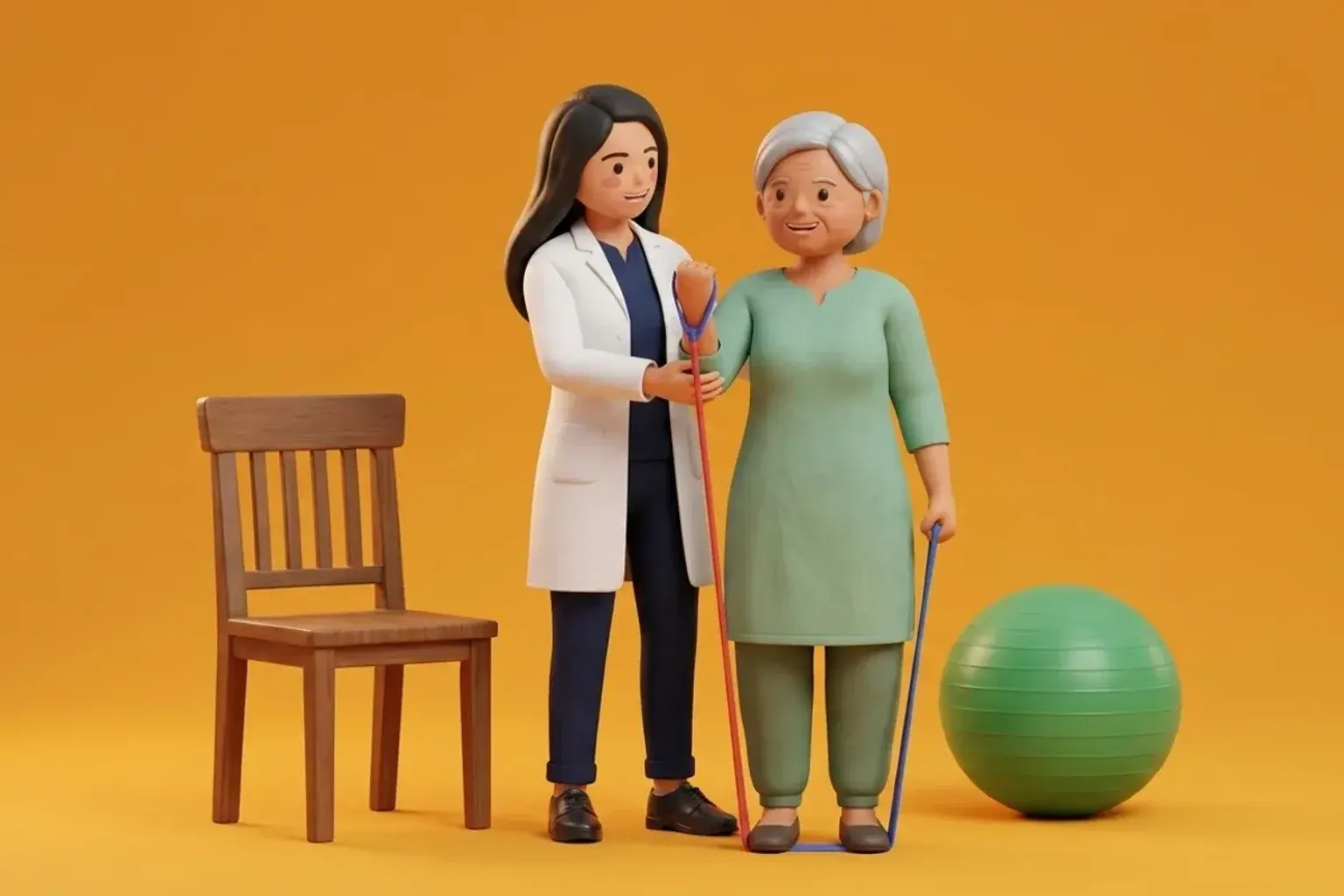
The clinical exercise hierarchy begins with low-resistance bands (yellow or red) performed in a seated, non-weight-bearing position, focusing on high repetitions (fifteen to twenty) to improve muscular endurance and tendon vascularity. The patient slowly progresses through intermediate bands (green or blue) while introducing a strict four-second eccentric return phase to maximize mechanical tension. Once thirty pain-free repetitions against high resistance are achieved, training advances to closed-kinetic-chain functional drills, such as standing resisted step-downs and single-leg balance perturbations. Weekly monitoring ensures that exercise-induced soreness resolves completely within twenty-four hours before advancing to a heavier band resistance.
Seated Plantarflexion-Inversion Pull with Elastic Band
Objective: Isolate the deep tibialis posterior by combining active plantarflexion with subtalar inversion against resistance
- 1Sit on the floor or a firm bed with your affected leg extended straight forward and your knee slightly bent.
- 2Loop the center of a resistance band around your forefoot, holding both tails securely with your hands.
- 3Cross the band across the front of your shin and anchor it laterally using your opposite foot or a heavy furniture post.
- 4Slightly point your toes downward into ten degrees of plantarflexion.
- 5Consciously pull your foot inward and slightly downward against the band, hold for two seconds at peak inversion, then slowly return over four seconds.
| Exercise Level | Band Resistance Level | Targeted Contraction Cadence | Functional Advancement Milestone |
|---|---|---|---|
| Level 1: Endurance Base | Low resistance (Yellow / Red band) | 2-second concentric, 2-second hold, 2-second eccentric | 3 sets of 20 reps without medial retromalleolar burning |
| Level 2: Hypertrophy & Remodeling | Medium resistance (Green / Blue band) | 2-second concentric, 1-second hold, 4-second eccentric | 3 sets of 15 reps with crisp calcaneal shift |
| Level 3: High-Load Functional | High resistance (Black / Silver band) | Explosive 1-second pull, 5-second slow eccentric release | Transition to standing single-leg heel raises on level floor |
Tendinopathy symptoms often display a delayed latency of twelve to twenty-four hours after exercise. If a patient reports that medial retromalleolar stiffness or morning throbbing has significantly increased the morning after an elastic band session, the mechanical dosage exceeded tissue capacity. Clinicians must drop back one resistance level and reduce total repetitions until baseline comfort is re-established.
Frequently Asked Questions
Can I do these band exercises if my inner ankle is swollen?
If the inner ankle exhibits visible soft-tissue puffiness or warmth from acute tenosynovitis, high-load resistance band exercises should be paused. Focus initially on gentle, unresisted active range of motion, cryotherapy, and supportive orthotics. Introduce light elastic resistance only after acute swelling has subsided.
Do I need a doctor referral to treat flatfoot or PTTD on BookPhysio.in?
BookPhysio.in does not require a doctor referral. Under the National Commission for Allied and Healthcare Professions (NCAHP) Act 2021, patients across India enjoy direct access to autonomous registered physiotherapists. Through BookPhysio.in, you connect directly with verified clinicians and pay per session with transparent fees, completely free from advance package commitments, commission markups, or platform subscription charges.
Related recovery guides & articles
BookPhysio.in Editorial Team
The BookPhysio.in editorial team writes and maintains this content, checking it against reliable clinical sources. Content follows our medical review policy: general information only, and no page claims a clinical review until a named registered physiotherapist has signed it off.
Read our medical review policy