
Return-to-Work Ergonomics and Pacing for Desk Professionals
In short
Returning to desk work with post-COVID brain fog and orthostatic intolerance requires strategic planning. Workplace accommodations and ergonomic adaptations protect cognitive stamina.
In this guide (6 sections)
Returning to professional desk employment represents a major hurdle for individuals recovering from Long-COVID, postural orthostatic tachycardia syndrome, and post-ICU debility. In knowledge-worker sectors, desk jobs demand intense sustained attention, complex problem-solving, multi-screen multitasking, and hours of motionless seated posture. For individuals with autonomic dysfunction and cognitive brain fog, sustained sitting causes gravitational blood pooling in the pelvis and lower legs, reducing cerebral blood flow and accelerating mental fatigue. Cardiopulmonary and occupational physiotherapists design customized return-to-work accommodations, pairing physical workstation ergonomics with cognitive pacing protocols to sustain employment without triggering devastating relapses.
Domestic and Cultural Indian Realities
In India's competitive IT, financial, and corporate sectors, workplace culture often emphasizes long office hours, mandatory attendance, and continuous responsiveness. Many professionals commute for two to three hours daily in crowded trains or heavy traffic, exhausting their entire energy reserve before arriving at their desks. Working from home in multi-generational households also presents challenges, including domestic noise, inadequate dedicated workspace, and frequent interruptions. Physiotherapists collaborate with patients to advocate for formal medical accommodations, including hybrid or work-from-home flexibility, phased return schedules, and structured rest breaks.
Clinical Biomechanics and Autonomic Pathophysiology
Prolonged motionless sitting at a desk produces significant venous pooling in the lower extremities and splanchnic circulation, similar to upright standing. The 90-degree hip and knee flexion angles compress femoral veins, creating venous resistance. Without muscle pumping, central blood volume declines, and cardiac output falls. To maintain blood pressure, the sympathetic nervous system triggers compensatory vasoconstriction and tachycardia. Concurrently, reduced middle cerebral artery blood velocity starves the prefrontal cortex of glucose and oxygen, manifesting as acute brain fog, word-finding failure, and cognitive exhaustion.
Clinical Assessment and Functional Capacity Evaluation
Assessment includes an occupational functional capacity evaluation. The physiotherapist measures seated orthostatic endurance, tracking blood pressure, heart rate, and cognitive processing speed (via digit span or Trail Making tests) at hourly intervals during simulated computer work. Workstation ergonomics (chair lumbar support, monitor height, desk clearance, and foot positioning) are audited, alongside screening for screen-induced visual fatigue and cervical spine strain.
Targeted Rehabilitation and Recumbent Conditioning Exercises
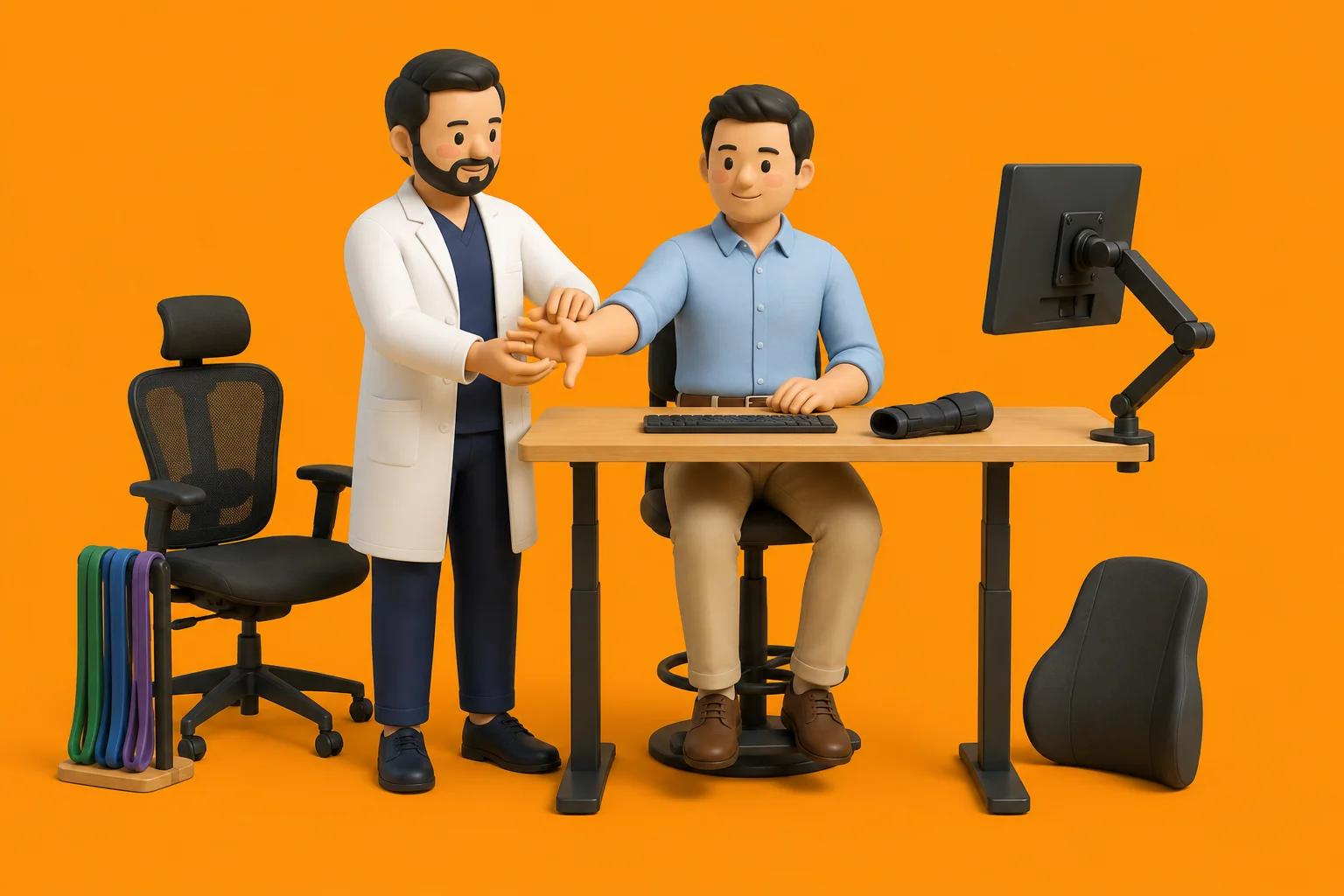
Ergonomic interventions aim to promote venous return while seated. Patients are prescribed adjustable angled footrests or compact under-desk pedal exercisers to maintain continuous calf muscle pump activation. The chair should support the thighs with slight decline or allow reclined sitting (100 to 110 degrees) to reduce pelvic venous pressure. Cognitive pacing follows the 'Pomodoro Adaptation': 25 minutes of focused single-task work followed by 5 minutes of complete sensory rest (eyes closed, horizontal leg propping, diaphragmatic breathing).
Under-Desk Seated Calf Pump and Cognitive Micro-Break
Objective: Restore cerebral perfusion and clear cognitive fatigue during professional desk work
- 1Set a timer on your computer or phone to alert you every 25 minutes of continuous screen work.
- 2Push your office chair back slightly from your desk and place your feet flat on an angled footrest.
- 3Perform 20 rapid, rhythmic ankle pumps, pressing the balls of your feet down then pulling your toes up.
- 4Close your eyes, drop your shoulders away from your ears, and take 5 slow, unhurried diaphragmatic breaths.
- 5Stand up with support, take 10 steps around your workstation, sip cold water, and resume work calmly.
| Workplace Parameter | Standard Corporate Office Setup | Physiotherapy Recommended Accommodation |
|---|---|---|
| Work Schedule Structure | Full-time 8-9 hour day with immediate full workload | Phased return (starting 4 hours/day, 3 days/week, building over 8 weeks) |
| Workstation Ergonomics | Standard 90-degree chair and flat floor desk | Reclined ergonomic chair, adjustable angled footrest, under-desk pedaller |
| Commute Management | Peak-hour public transit or congested driving | Work-from-home allowance or flexible off-peak commuting hours |
| Cognitive Task Pacing | Continuous multitasking across multiple monitors | Single-task focus, written meeting agendas, mandatory 5-minute hourly rests |
Red Flags and Immediate Cardiovascular Escalation
While cognitive fatigue and mild dizziness are managed with pacing, acute emergencies require immediate medical attention. The employee must stop work and seek emergency care if they experience acute substernal chest tightness radiating to the jaw, sudden severe visual field loss, slurred speech, acute confusion, or sudden collapse with loss of consciousness at the workstation.
Frequently Asked Questions
Can physiotherapy help me return to my desk job without triggering brain fog crashes?
Yes. Physiotherapists evaluate your seated circulation, provide under-desk movement tools, and design cognitive pacing schedules. These accommodations maintain blood flow to your brain and help manage fatigue, allowing you to sustain employment.
How do I consult a physiotherapist for a workplace accommodation report?
Under the provisions of the NCAHP Act 2021, you can consult a licensed physiotherapist directly across India without needing a physician referral. Consultations operate on a transparent pay-direct fee model per visit, providing formal ergonomic evaluations.
Related condition guides



Related recovery guides & articles
BookPhysio.in Editorial Team
The BookPhysio.in editorial team writes and maintains this content, checking it against reliable clinical sources. Content follows our medical review policy: general information only, and no page claims a clinical review until a named registered physiotherapist has signed it off.
Read our medical review policy