
Rotator Cuff Tear Classification: PASTA, Full-Thickness, and Retracted Lesions
In short
Rotator cuff tears range from articular-sided partial tears (PASTA) to massive retracted tears spanning multiple tendons. Discover how structural grading directs clinical rehabilitation.
In this guide (4 sections)
Rotator cuff tears represent a broad spectrum of structural pathology ranging from microscopic tendon fraying to complete tendon detachment with tissue loss. Precise anatomical classification is essential because clinical prognosis, surgical reparability, and conservative physiotherapy protocols differ dramatically across tear types. Clinicians categorize tears by depth, location, anatomical footprint involvement, and retraction. Partial-thickness tears frequently occur on the articular side, known as PASTA (Partial Articular Supraspinatus Tendon Avulsion) lesions, or on the bursal side beneath the subacromial bursa. Full-thickness tears penetrate through the entire substance of the tendon, creating direct communication between the glenohumeral joint and the subacromial space. When tears exceed five centimetres in diameter or involve two or more adjacent tendons with severe medial retraction, they are classified as massive tears, requiring specialised biomechanical rehabilitation strategies.
Overhead Kitchen Shelves, Water Buckets, and Domestic Loading Realities in India
In Indian households, individuals with undiagnosed or advancing rotator cuff tears experience profound functional limitations during basic household routines. A common aggravating activity involves lifting heavy twenty-litre drinking water cans or hoisting twenty-five-litre plastic buckets filled with hot water for morning bathing. In traditional kitchens, reaching upward into overhead loft cupboards to retrieve heavy cast-iron kadhais or brass utensils produces intense anterolateral shoulder pain and catch. Older homemakers frequently notice sudden weakness when attempting to hang washed sarees or heavy bed linens on elevated ceiling-mounted drying pulleys. Men traveling on suburban commuter trains in Mumbai, Chennai, and Kolkata report painful catching when grasping overhead hand rails during sudden track decelerations. Physiotherapists tailor early rehabilitation to eliminate provocative overhead impingement arcs while conditioning surrounding scapulothoracic muscles for domestic demands.
PASTA Mechanics, Footprint Morphology, and Coronal Retraction Dynamics
The supraspinatus tendon inserts onto the greater tuberosity over a trapezoidal footprint averaging twelve to sixteen millimetres in mediolateral width. PASTA lesions develop primarily at the vulnerable articular margin where vascular supply is precarious and tensile strain is maximal during humeral abduction and internal rotation. The Ellman classification grades partial tears by depth: Grade I involves less than three millimetres of tendon thickness, Grade II involves three to six millimetres, and Grade III exceeds six millimetres, representing greater than fifty percent footprint detachment. Full-thickness tears are quantified using the Cofield classification into small (less than one centimetre), medium (one to three centimetres), large (three to five centimetres), and massive (greater than five centimetres). As tears progress, the proximal tendon stump retracts medially toward the glenoid rim under the chronic unapposed tensile pull of the muscle belly, initiating progressive muscle atrophy and irreversible fatty infiltration.
Staged Physiotherapy Progression Based on Structural Tear Depth
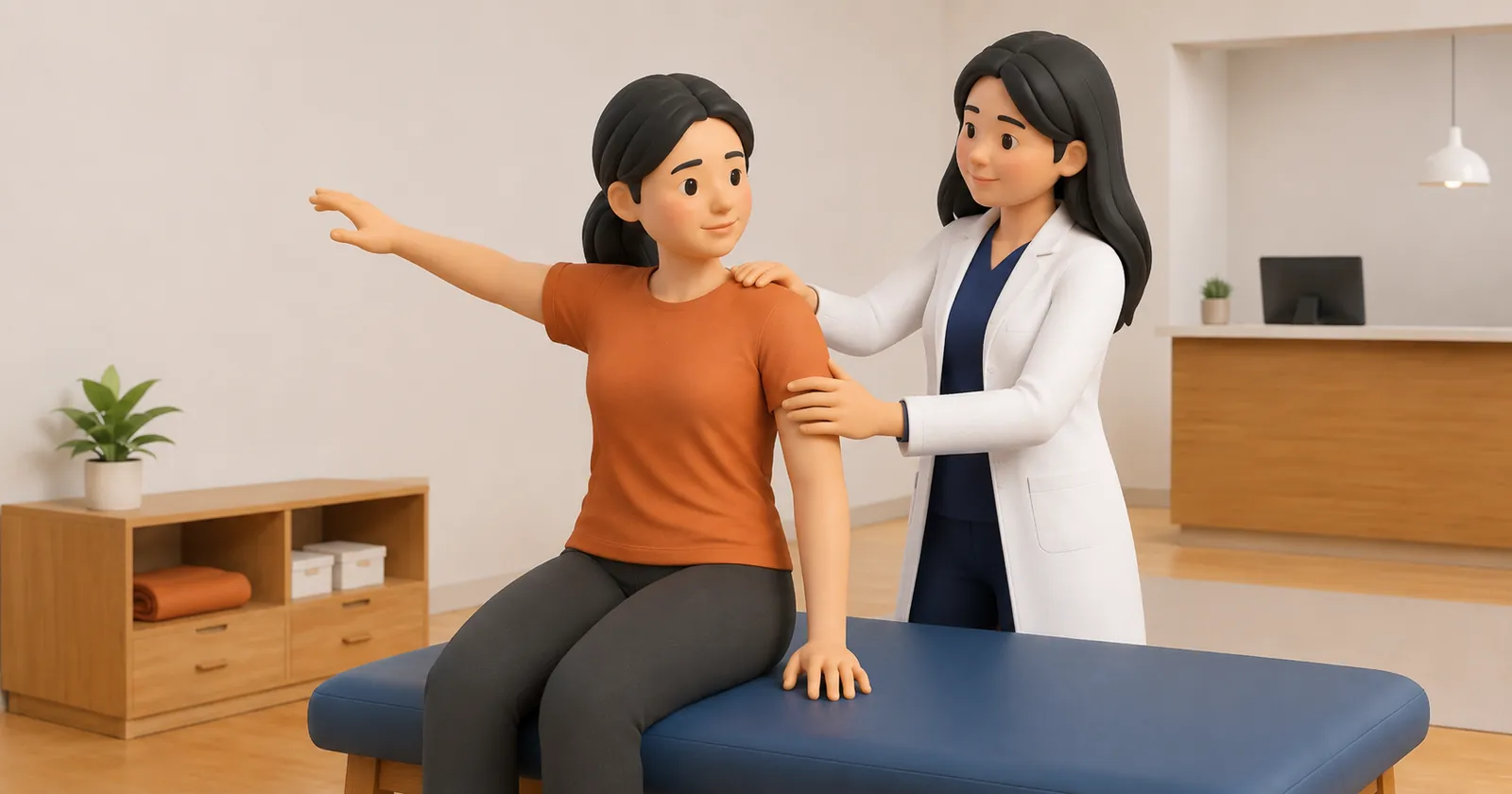
Physiotherapy management must strictly mirror the mechanical stability of the remaining tendon footprint. For PASTA lesions and partial tears under fifty percent thickness, conservative management focuses on eliminating subacromial bursal compression and restoring posterior capsular extensibility. Therapists emphasize low-velocity isometric rotator cuff recruitment followed by gradual eccentric strengthening to promote collagen remodeling without shear stress. Conversely, massive retracted full-thickness tears disrupt the primary coronal force couple. In these cases, therapy shifts from attempting to isolate the torn supraspinatus toward systematic motor re-education of the anterior deltoid and intact subscapularis. Clinicians train patients to recruit the anterior deltoid as an active humeral head depressor and elevator through progressive supine-to-standing motor learning drills.
Supine Scapular Plane Arm Elevation with Tactile Guidance
Objective: Restore active assisted glenohumeral elevation while minimizing subacromial impingement and deltoid shrugging
- 1Lie flat on your back on a firm bed or plinth with a small rolled towel supporting your neck.
- 2Hold a lightweight walking stick or wooden dowel with both hands shoulder-width apart, keeping your elbows extended.
- 3Use your unaffected arm to push the stick upward and backward at a thirty-degree angle forward from the side, moving within the scapular plane.
- 4Raise your arms only to the point of comfortable tension without letting your shoulder blades hike toward your ears.
- 5Pause for 3 seconds at the top position, then slowly guide the stick back down over a count of 5 seconds.
| Classification Category | Diagnostic Criteria and Footprint Depth | Primary Clinical Management and Rehabilitation Focus |
|---|---|---|
| Ellman Grade I Partial Tear | Tendon defect less than 3 mm in depth involving under 25 percent of the greater tuberosity footprint. | Conservative physiotherapy: rotator cuff endurance, posterior capsular stretching, and ergonomic adjustment. |
| Ellman Grade II Partial Tear | Tendon defect 3 to 6 mm in depth involving 25 to 50 percent of tendon thickness. | Targeted eccentric rotator cuff training, scapular stabilizer strengthening, and activity modification. |
| Ellman Grade III (PASTA) Tear | Articular-sided defect greater than 6 mm involving over 50 percent of the anatomical footprint. | Structured non-operative trial; surgical footprint repair considered if severe weakness persists after 3 months. |
| Cofield Small to Medium Full-Thickness | Complete through-and-through defect measuring less than 3 cm in greatest diameter. | Protected post-operative immobilization followed by staged passive to active rehabilitation, or non-operative care. |
| Massive Retracted Tear | Defect exceeding 5 cm or complete detachment of 2 or more tendons with Patte Stage 2 or 3 retraction. | Anterior deltoid re-education, transverse force couple balancing, or superior capsule reconstruction protocol. |
Never force active overhead elevation during the early recovery phase of repaired or high-grade partial tears. Aggressive active reaching creates excessive tensile shear across the vulnerable enthesis, risking suture anchor pull-out or rapid tear propagation. Ensure all movements remain within the pain-free scapular plane.
Frequently Asked Questions
Can a PASTA lesion heal completely without undergoing surgical repair?
Partial articular supraspinatus tendon avulsion (PASTA) lesions possess limited intrinsic capacity for complete biological restitution due to the avascular nature of the inner tendon footprint and continuous exposure to synovial fluid. However, high-quality physiotherapy regularly restores normal, painless shoulder function by optimising force transmission through the intact outer tendon fibers, improving scapular kinematics, and eliminating secondary subacromial bursal inflammation.
Do I need a doctor referral to see a rotator cuff physiotherapist on BookPhysio.in?
BookPhysio.in does not require a physician prescription. Under the National Commission for Allied and Healthcare Professions (NCAHP) Act 2021, patients across India enjoy direct access to autonomous registered physiotherapists. Through BookPhysio.in, you connect directly with verified clinicians and pay per session with transparent fees, completely free from advance package commitments, commission markups, or platform subscription charges.
Related recovery guides & articles
BookPhysio.in Editorial Team
The BookPhysio.in editorial team writes and maintains this content, checking it against reliable clinical sources. Content follows our medical review policy: general information only, and no page claims a clinical review until a named registered physiotherapist has signed it off.
Read our medical review policy