
School Desk and Study Ergonomics for Adolescents with Scoliosis
In short
Master study workstation ergonomics for adolescents with scoliosis, addressing rigid school benches, slanted writing surfaces, and posture pacing.
In this guide (4 sections)
Adolescents diagnosed with idiopathic scoliosis spend between 6 and 10 hours daily seated at study workstations, balancing regular school hours, intensive evening coaching sessions, and late-night homework. In growing spines undergoing rapid three-dimensional deformational forces, prolonged sitting on poorly configured furniture exerts severe detrimental effects. When an adolescent sits hunched over a flat, low desk, the natural lumbar lordosis collapses into kyphosis, shifting the entire center of gravity forward and multiplying intradiscal pressure. For an asymmetric spine, prolonged static flexion inevitably encourages the torso to collapse into its primary curve concavity, causing severe paraspinal strain, neck tension, and mental fatigue. Configuring an ergonomically sound study environment is a vital clinical pillar in halting scoliosis progression.
Rigid Wooden Coaching Benches, Bed Study Habits, and Laptop Slouching in India
In urban Indian households and competitive educational hubs like Kota, Hyderabad, and Delhi, students prepare for board exams and engineering or medical entrance tests (JEE, NEET) by enduring marathon study sessions. Many commercial coaching institutes utilize rigid, backless wooden benches where students sit crammed shoulder-to-shoulder, making ergonomic posture virtually impossible. At home, teenagers frequently study while propped up against pillows on soft beds or slumped over low coffee tables with laptops on their laps. These positions force the scoliotic spine into pronounced asymmetric torsion, with the student leaning heavily onto their non-dominant elbow while writing with the other hand. Physiotherapists guide Indian families to transform study environments through practical, affordable modifications.
Creep Deformity, Ligamentous Strain, and Asymmetric Anterior Compression
The physiological danger of prolonged improper sitting in scoliosis centers on the viscoelastic property of spinal tissues known as creep. When paraspinal ligaments and intervertebral discs are subjected to continuous mechanical strain in a slumped, twisted posture, they undergo progressive, time-dependent elongation and lose their elastic recoil capacity. As the active musculature fatigues after 20 to 30 minutes of static sitting, the burden of maintaining posture shifts entirely onto passive spinal ligaments. In scoliosis, because the anterior and concave aspects of the vertebral bodies already experience heightened compressive loads, sustained slumped flexion further suppresses chondrocyte proliferation according to the Heuter-Volkmann law. This sustained asymmetric loading accelerates structural wedging and transforms flexible postural curves into rigid structural deformities.
The 90-90-90 Rule, Slanted Writing Slopes, and Microbreak Posture Resets
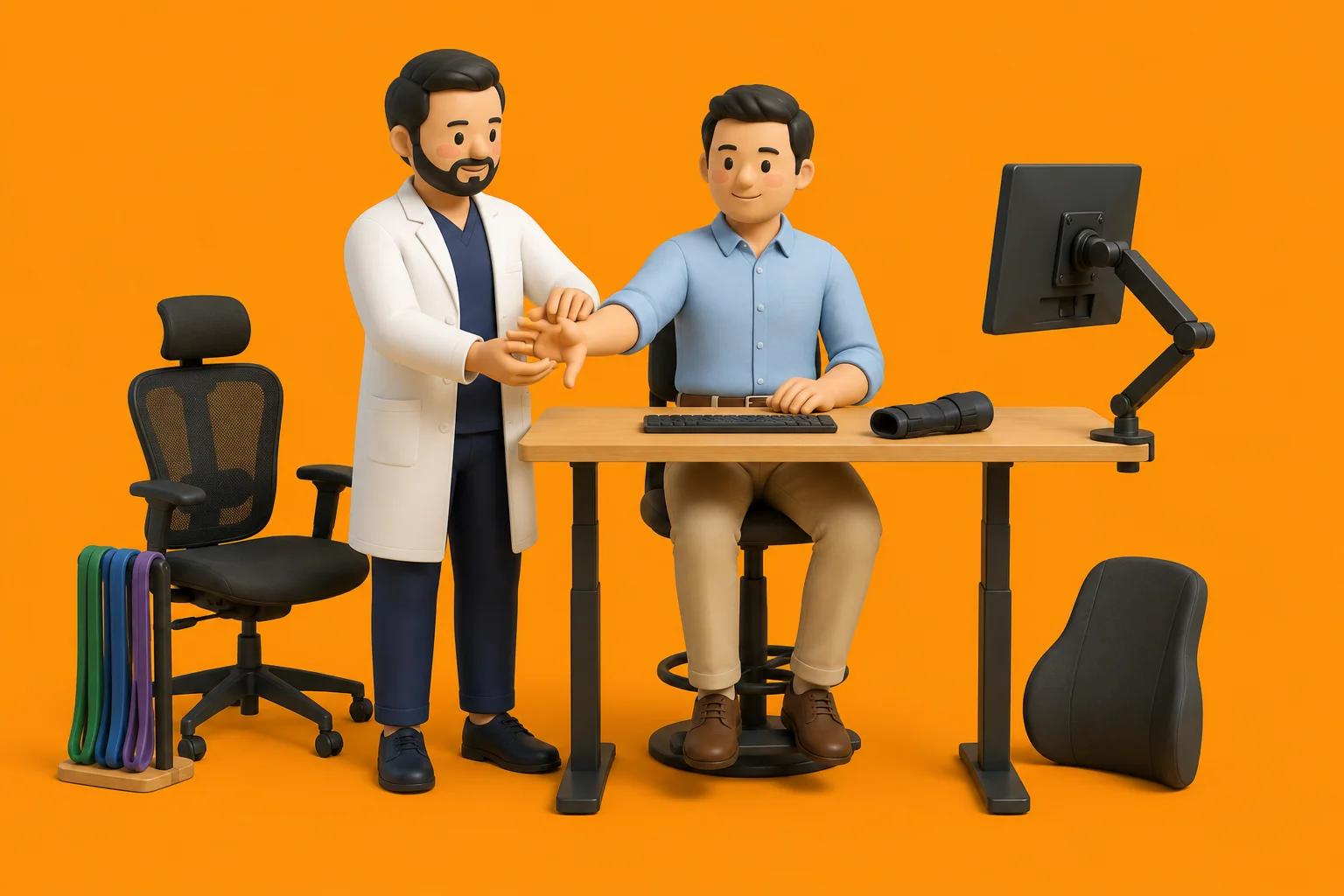
Physiotherapy ergonomic interventions establish an active, supportive study station based on the 90-90-90 rule: hips, knees, and elbows bent at 90 degrees, with feet resting firmly flat on the floor or a solid footrest. Clinicians strongly recommend introducing a 20-degree slanted writing board or document holder, which brings study materials up to eye level and eliminates the need for extreme cervical and thoracic forward bending. Chairs must provide adjustable lumbar support, or be supplemented with a firm cylindrical lumbar roll positioned at the beltline to preserve natural lordosis. Furthermore, students are trained in structured microbreak pacing: every 30 minutes, they stand up, perform 30 seconds of active spinal auto-elongation, and take three deep rotational angular breaths before resuming study.
Seated Posture Reset with Cervical Retraction and Rotational Breathing
Objective: Interrupt sustained ligamentous creep and re-establish three-dimensional spinal alignment during study
- 1Sit forward on the front half of your study chair with your feet flat on the floor, spaced hip-width apart.
- 2Place your hands flat on your thighs and gently roll your pelvis forward to recreate your natural lower back arch.
- 3Draw your chin straight backward in a gentle double-chin nod without tilting your head up or down.
- 4Inhale deeply through your nose, intentionally expanding your collapsed concave rib cage outward.
- 5Exhale through pursed lips, lifting the crown of your head tall toward the ceiling while maintaining the expanded posture for 5 breaths.
| Workstation Component | Non-Ergonomic Setup (High Strain) | Corrected Physiotherapy Setup (Spine Friendly) |
|---|---|---|
| Desktop Surface Angle | Flat, horizontal tabletop; forces student to hunch forward and drop the head down by 45 to 60 degrees | 20-degree angled writing slope or document riser; brings materials directly into the natural horizontal visual field |
| Chair Back and Lumbar Support | Backless wooden bench or deep soft couch; causes complete posterior pelvic tilt and kyphotic slouching | Firm, upright chair with adjustable lumbar contour or dense foam roll positioned firmly at the L3-L5 level |
| Lower Limb Positioning | Feet dangling in the air or wrapped tightly around chair legs, causing pelvic torsion and instability | Feet resting fully supported and flat on the floor or a dedicated firm angled footrest at 90 degrees |
| Digital Device Display Height | Laptop flat on desk; screen positioned far below eye level, causing extreme cervical extensor strain | Laptop elevated on an adjustable stand with an external keyboard and mouse; top of screen aligned with eye level |
If sustained study postures cause sudden, sharp, knife-like pain wrapping around the ribs to the front of the chest, accompanied by difficulty taking a deep breath, evaluate immediately for acute costovertebral joint subluxation or intercostal nerve irritation.
Frequently Asked Questions
Can an ergonomic chair alone prevent my scoliosis curve from progressing?
An ergonomic chair provides essential postural support and reduces muscular fatigue, but it cannot independently prevent structural curve progression. Ergonomic furniture must be paired with daily physiotherapy scoliosis-specific exercises, active posture resets, and appropriate orthotic bracing when clinically indicated.
Do I need a doctor referral to see a scoliosis physiotherapist on BookPhysio.in?
BookPhysio.in does not require a doctor referral. Under the National Commission for Allied and Healthcare Professions (NCAHP) Act 2021, patients across India enjoy direct access to autonomous registered physiotherapists. Through BookPhysio.in, you connect directly with verified clinicians and pay per session with transparent fees, completely free from advance package commitments, commission markups, or platform subscription charges.
Related condition guides



Related recovery guides & articles
BookPhysio.in Editorial Team
The BookPhysio.in editorial team writes and maintains this content, checking it against reliable clinical sources. Content follows our medical review policy: general information only, and no page claims a clinical review until a named registered physiotherapist has signed it off.
Read our medical review policy