
Step-by-Step 5-Stage Exercise Protocol for Rotator Cuff Repair Rehabilitation
In short
Recovering from rotator cuff surgery requires a disciplined 5-stage progression from sling protection to full athletic return. Master every milestone.
In this guide (4 sections)
Successful rehabilitation following arthroscopic rotator cuff repair is an structured biological journey spanning six to nine months. Prescribing exercises too aggressively during early tissue healing risks suture anchor pull-out and catastrophic repair failure, while prolonged uncalibrated immobilization leads to permanent capsular stiffness and severe muscle atrophy. To optimise functional outcomes, modern sports physiotherapy employs a criterion-based, five-stage rehabilitation continuum. Each stage corresponds strictly to biological phases of tendon-to-bone enthesis healing, progressing from maximal protection and passive motion, through active-assisted control, progressive resistive strengthening, and advanced dynamic conditioning, culminating in full functional and athletic independence.
Navigating the 6-Month Recovery Journey in Indian Households
In Indian joint families and busy urban households, maintaining discipline across a six-month rehabilitation protocol requires patience and family support. In early stages, patients rely on family members for basic domestic assistance, including cooking, carrying groceries, and personal hygiene. Around month three, as resting pain subsides and active reaching improves, patients frequently feel tempted to resume heavy domestic chores prematurely, such as lifting twenty-litre water cans, shifting furniture, or riding two-wheelers through heavy traffic. Physiotherapists provide clear, objective milestone criteria that educate both the patient and their family on why progressive conditioning must precede heavy household loading, safeguarding the surgical repair.
Biological Staging: Enthesis Maturation and Mechanotransduction Windows
The five-stage protocol directly reflects the biological maturation of the surgically repaired tendon enthesis. Stage 1 (weeks zero to six) corresponds to the inflammatory and early proliferative phases, where the repair is mechanically weak and reliant entirely on suture anchor hold; only passive motion is permitted. Stage 2 (weeks six to twelve) aligns with early collagen remodeling, where type III collagen begins transitioning to type I; active-assisted and unassisted movements in gravity-minimized planes re-establish neuromuscular control. Stage 3 (weeks twelve to eighteen) introduces progressive resistive loading, utilizing mechanotransduction to increase tendon stiffness and tensile load-bearing capacity. Stage 4 (weeks eighteen to twenty-four) develops advanced kinetic chain power and multi-planar endurance. Stage 5 (month six onward) achieves full vocational and sports reconditioning.
The 5-Stage Clinical Protocol: Objective Milestones and Exercise Selection
Advancement through the five stages must be earned through objective clinical criteria rather than arbitrary calendar dates. To advance from Stage 1 to Stage 2, the patient must achieve at least one hundred and twenty degrees of passive scaption and thirty degrees of passive external rotation without pain. Advancing to Stage 3 requires full active forward elevation without compensatory shoulder hiking. Progressing to Stage 4 demands a limb symmetry strength index of at least seventy-five percent on dynamometry. Finally, achieving Stage 5 clearance requires passing high-demand functional tests, including the Closed Kinetic Chain Upper Extremity Stability Test (CKCUEST) and task-specific work simulations.
Progressive Elastic Band External Rotation with Scapular Retraction (Stage 3)
Objective: Strengthen the infraspinatus and teres minor against calibrated elastic resistance during the remodeling phase
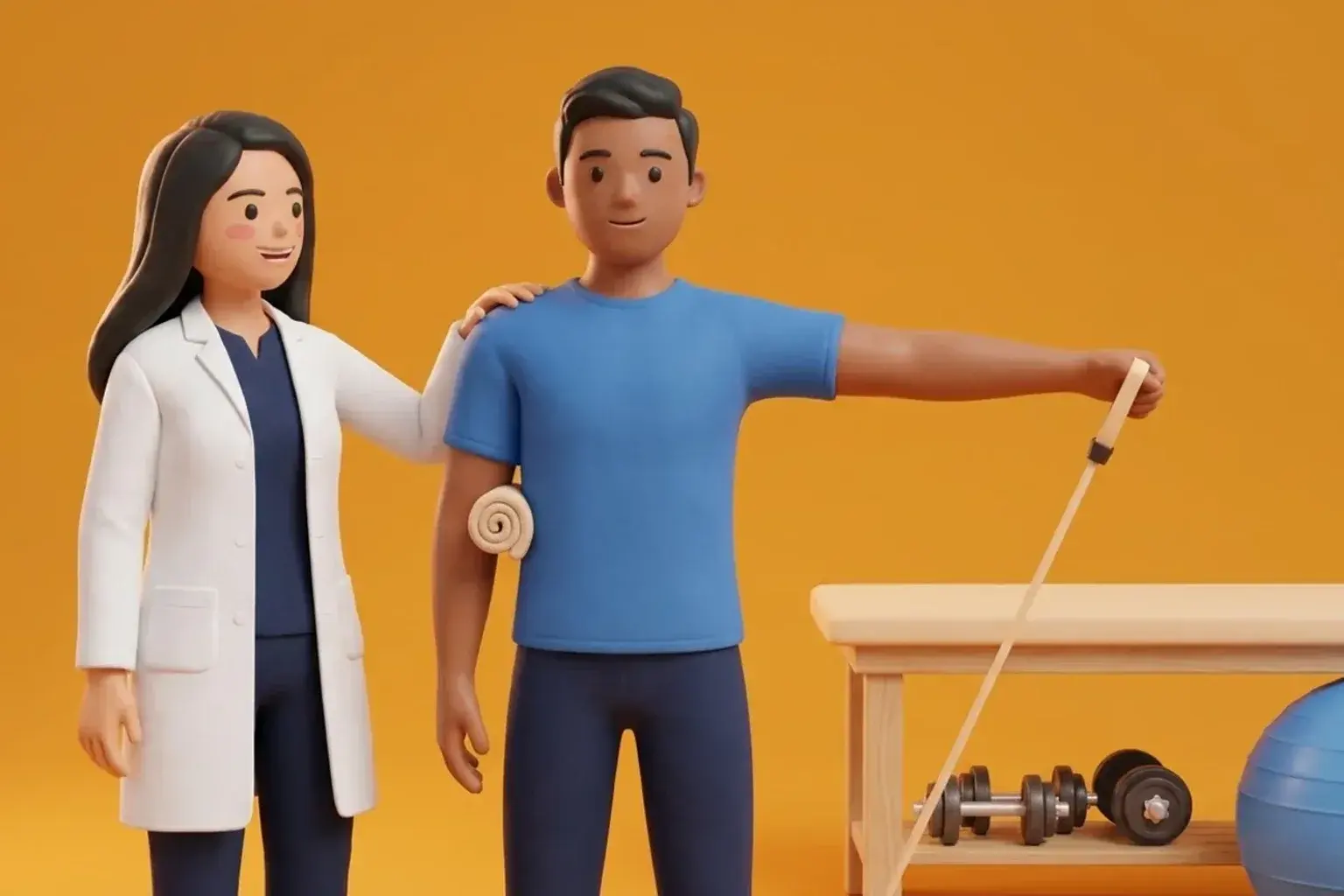
- 1Stand tall with your operative elbow bent to ninety degrees, placing a rolled towel between your elbow and ribcage.
- 2Hold the end of a light yellow or red resistance band anchored securely at waist height on your opposite side.
- 3Engage your core, lengthen your neck, and gently draw your shoulder blades backward toward your spine.
- 4Slowly rotate your operative forearm outward away from your abdomen over a count of 2 seconds.
- 5Pause at your maximum comfortable outward rotation for 2 seconds, then slowly return over a count of 4 seconds.
| Protocol Stage & Timeframe | Biological Tissue State & Movement Permissions | Prescribed Clinical Exercises & Advancement Criteria |
|---|---|---|
| Stage 1: Maximum Protection (Weeks 0-6) | Suture anchor reliance; proliferative healing; sling worn full-time; strictly zero active shoulder motion. | Passive scaption < 120 deg; passive ER < 30 deg; pendulum circles; wrist/hand grip ball squeezes. |
| Stage 2: Active-Assisted Control (Weeks 6-12) | Wean sling; early collagen remodeling; gravity-minimized planes; eliminate shoulder hiking. | Table slides, wand-assisted elevation, supine active arm raises, closed-chain wall slides, postural resets. |
| Stage 3: Progressive Resistance (Weeks 12-18) | Collagen bundle coarsening; tensile strength ~50%; light resistance loading permitted. | Elastic band ER/IR, prone Y-and-T raises, seated cable rows, serratus push-up plus on wall. |
| Stage 4: Advanced Conditioning (Weeks 18-24) | Advanced tissue maturation; multi-planar dynamic loading; eccentric control and endurance. | Dumbbell scaption, cable face pulls, quadruped balance drills, core-to-shoulder kinetic chain exercises. |
| Stage 5: Functional / Sports Return (Month 6+) | Tensile strength ~80%; full biological consolidation; high-velocity deceleration and load capacity. | Plyometric ball rebounds, interval cricket/badminton drills, heavy manual lifting simulation, CKCUEST clearance. |
Never introduce resistance bands or dumbbells if the patient still exhibits compensatory shoulder hiking during active unassisted elevation. Adding resistance to an uncoordinated movement pattern reinforces pathological motor substitution and causes secondary subacromial bursitis; return to Stage 2 motor control drills.
Frequently Asked Questions
Why does full recovery from rotator cuff surgery take six months or longer?
While surgical anchors secure the tendon to the bone immediately, the biological process of weaving strong new collagen fibers and restoring tensile strength takes several months. It takes approximately twelve weeks for the tendon to achieve half its normal strength, and six to nine months for the tissue to mature enough to handle heavy lifting, throwing, or manual work safely.
Do I need a doctor referral to see a rotator cuff physiotherapist on BookPhysio.in?
BookPhysio.in does not require a physician prescription. Under the National Commission for Allied and Healthcare Professions (NCAHP) Act 2021, patients across India enjoy direct access to autonomous registered physiotherapists. Through BookPhysio.in, you connect directly with verified clinicians and pay per session with transparent fees, completely free from advance package commitments, commission markups, or platform subscription charges.
Related recovery guides & articles
BookPhysio.in Editorial Team
The BookPhysio.in editorial team writes and maintains this content, checking it against reliable clinical sources. Content follows our medical review policy: general information only, and no page claims a clinical review until a named registered physiotherapist has signed it off.
Read our medical review policy