
Thoracic Cage Mobility Exercises: Gentle Lateral Trunk Flexion and Expansion
In short
Gentle lateral trunk flexion and thoracic cage mobility exercises to prevent chest wall stiffness and restore rib compliance after trauma.
In this guide (2 sections)
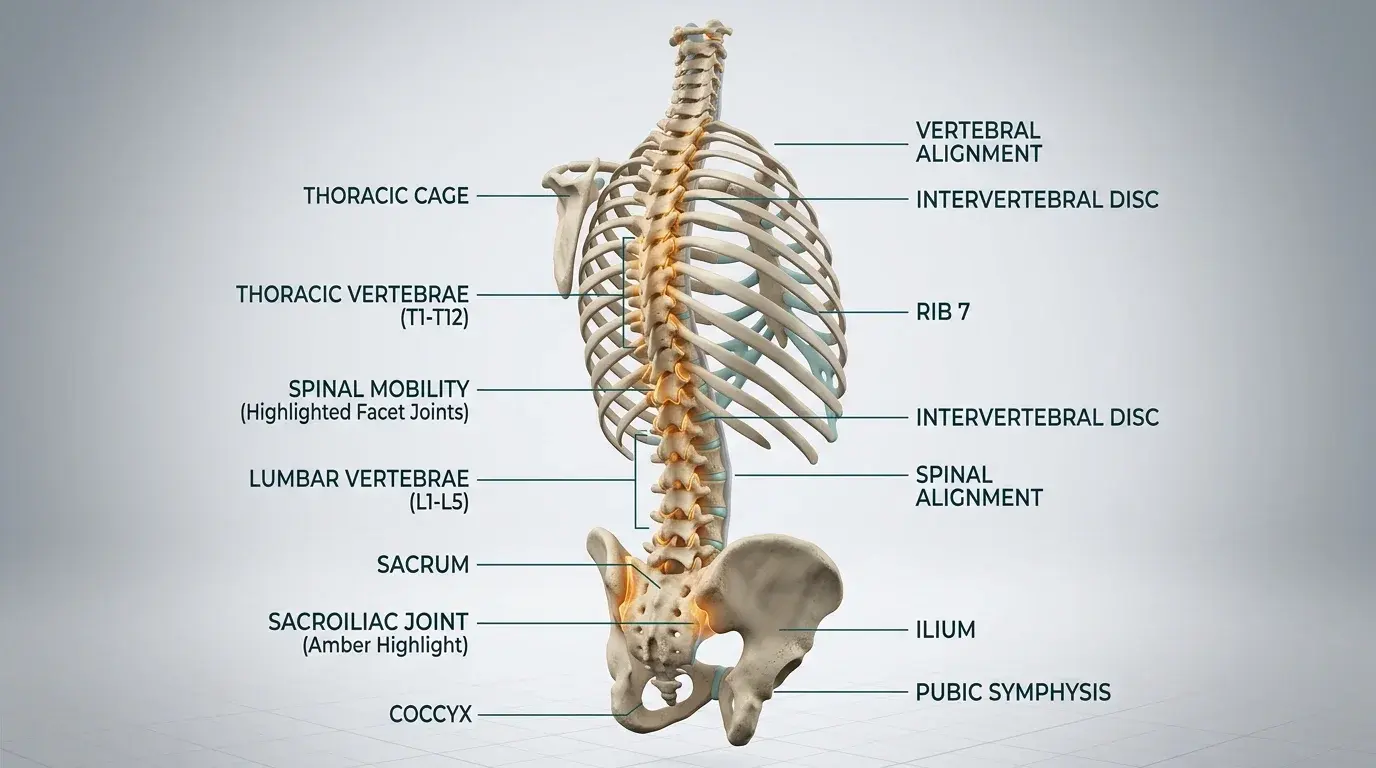
Following multiple rib fractures, patients naturally adopt a rigid, protective posture to guard against pain. While this guarding is beneficial during the initial hyper-acute phase, prolonged thoracic immobilization leads to secondary musculoskeletal complications. Intercostal muscles undergo shortening, costovertebral and costotransverse joints develop fibrotic adhesions, and the chest wall becomes chronically stiff. By weeks three to four post-injury, introducing gentle, controlled thoracic cage mobility exercises, specifically lateral trunk flexion and rotational expansion, is essential to restore physiological rib excursion and prevent permanent restrictive lung defects.
Biomechanics of Costovertebral Articulations and Lateral Flexion
The rib cage functions as a dynamic mechanical bellows, articulating with the thoracic spine through costovertebral and costotransverse synovial joints. Lateral trunk flexion produces asymmetrical mechanical forces: the ribs on the side of flexion approximate and depress, while the ribs on the contralateral side distract and elevate, stretching the intercostal spaces and pleural interfaces. When performed gently within pain-free boundaries, lateral flexion gently mobilizes healing rib callus, breaks early myofascial adhesions in the serratus anterior and latissimus dorsi, and stimulates synovial fluid circulation without imposing hazardous shear stresses.
| Recovery Stage | Healing Phase | Targeted Thoracic Motion | Exercise Prescription | |
|---|---|---|---|---|
| Stage 1 (Weeks 2 to 3) | Early soft callus bridging | Seated active-assisted lateral reach (10-15 degrees) | 5 reps per side, once daily, pain-free range only | |
| Stage 2 (Weeks 4 to 6) | Progressive bony consolidation | Active lateral flexion paired with deep inspiration | 8-10 reps per side, twice daily, gentle stretch sensation | |
| Stage 3 (Weeks 7 to 10) | Solid cortical union on imaging | Multi-planar lateral flexion combined with trunk rotation | 12 reps per side with light resistance band or stick |
Clinical Prescription and Safety Boundaries for Lateral Drills
Thoracic mobility drills must never be performed with aggressive bouncing, ballistic stretching, or heavy external loads. The patient sits tall on an armless chair to stabilize the pelvis and isolate motion to the thoracic spine. Each movement is synchronized with respiration: inhaling deeply during the lateral lengthening phase to maximize intercostal expansion, and exhaling smoothly during the return to neutral. Movement should produce a comfortable muscular stretch sensation without recreating sharp bony fracture pain.
Seated Lateral Trunk Flexion with Rib Expansion
Objective: Restore intercostal elasticity and costovertebral joint gliding without stressing healing rib fractures.
- 1Sit upright in a sturdy armless chair with feet firmly planted on the floor and spine lengthened.
- 2Rest the hand on the uninjured side lightly on the chair seat for balance and stability.
- 3Inhale slowly through the nose while reaching the opposite arm gently upward toward the ceiling.
- 4Gently bend your torso sideways toward the supporting hand, feeling the upper ribs open and expand.
- 5Hold the comfortable stretch for three seconds while taking a gentle breath into the opened side, then return slowly to center while exhaling.
Integrating Thoracic Mobility into Indian Domestic Routines
In Indian households, patients can smoothly weave thoracic mobility into their daily morning routine. Sitting on a firm dining chair or veranda seat following morning tea provides a quiet opportunity for gentle side reaches. Patients must avoid reaching abruptly for high kitchen storage tins (dabbas) or bending sideways to retrieve items from the floor; instead, domestic items should be repositioned to counter height to allow safe, controlled reaching without accidental twisting.
Long-Term Rehabilitation Trajectory and Clinical Follow-Up
Over eight to twelve weeks, symmetrical thoracic excursion is restored. Objective reassessment with tape-measure chest cirtometry tracks progressive gains in thoracic circumference expansion, ensuring that the patient regains full rotational mobility for driving, sports, and active occupational duties.
Immediately stop lateral trunk exercises if the patient experiences a sudden sharp click, palpable bone shifting, or severe localized stabbing pain, which may indicate excessive strain across an incompletely united fracture line.
Is it normal to feel a tight pulling sensation in the chest during side bending?
Yes. A mild pulling or stretching sensation in the chest wall muscles and healing tissues is expected and beneficial. However, it should never feel like a sharp, stabbing bone pain. Keep the movement gentle and within a comfortable range.
Do I need a doctor referral to consult a home physiotherapist in India?
Under the National Commission for Allied and Healthcare Professions (NCAHP) Act 2021, patients in India have direct access to registered physiotherapists without requiring a physician referral. At BookPhysio.in, you connect with verified physiotherapists and pay directly per session, with zero advance fees, zero package lock-ins, and no platform commissions.
Related recovery guides & articles
BookPhysio.in Editorial Team
The BookPhysio.in editorial team writes and maintains this content, checking it against reliable clinical sources. Content follows our medical review policy: general information only, and no page claims a clinical review until a named registered physiotherapist has signed it off.
Read our medical review policy