
Yoga Asana Modifications: Avoiding Aggressive Paschimottanasana Forward Bends
In short
Learn how to modify yoga practice safely during proximal hamstring tendinopathy, avoiding intense seated forward bends while building active strength.
In this guide (4 sections)
Yoga is an integral component of daily health, physical fitness, and spiritual well-being for millions of practitioners across India and worldwide. With its emphasis on mindful movement, breath control, and full-body flexibility, regular asana practice confers substantial physical and psychological benefits. However, in the realm of sports physiotherapy, intense yoga practice is frequently identified as a primary cause or perpetuating factor in chronic proximal hamstring tendinopathy (often colloquially termed yoga butt). Classical forward-bending asanas, most notably Paschimottanasana (Seated Forward Bend) and Uttanasana (Standing Forward Bend), place the hamstring origin into maximal concurrent hip flexion and knee extension, subjecting the insertional enthesis to extreme compressive impingement and tensile shear.
Morning Yoga Shalas, Community Parks, and Aggressive Flexibility Culture
In Indian cities like Rishikesh, Mysuru, Pune, and Bengaluru, as well as community parks where morning yoga groups gather, there is often strong social reinforcement to push deeper into forward bends. Well-meaning yoga teachers sometimes apply manual hands-on adjustments, pressing downward on students backs to force their foreheads onto their shins. When a dedicated practitioner experiences deep buttock aching, they frequently interpret this as a sign of stubborn tightness that must be stretched out through more rigorous practice. This misguided persistence transforms minor, reversible tendon irritation into chronic, severe tendinopathy that can persist for years if movement patterns are not modified.
Enthesis Wrap-Around in Paschimottanasana: Micro-Tearing and Bursal Friction
In Paschimottanasana, the practitioner sits flat on the floor with both legs extended straight and hinges forward from the pelvis, attempting to grasp the feet. Biomechanically, this combines 90 to 110 degrees of hip flexion with 0 degrees of knee extension. For the proximal hamstring tendon complex, this posture represents the ultimate mechanical stress test: the tendon is pulled taut and compressed tightly against the lateral ischial margin with zero muscular slack. The high compressive contact pressure compresses the ischiogluteal bursa and causes cellular tenocyte distress, triggering micro-tears in degenerate collagen fibrils and promoting the release of inflammatory neuropeptides that perpetuate chronic pain.
Modifying Asana Practice: Bending Knees, Utilizing Straps, and Strengthening Bridges
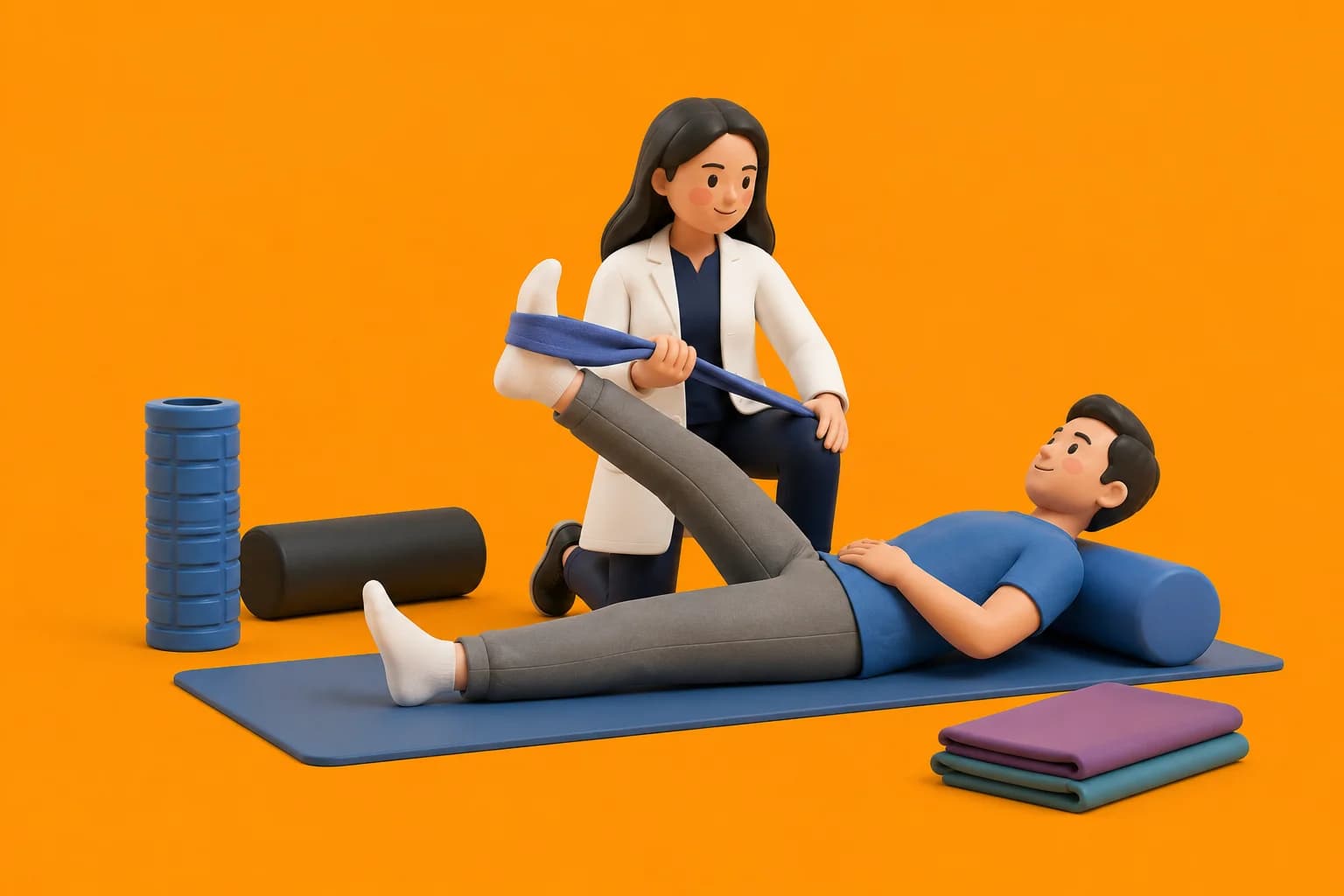
Safeguarding the hamstring tendon does not require abandoning yoga; rather, it requires intelligent biomechanical modifications that replace aggressive passive stretching with active strengthening. Forward bends should be modified by maintaining a generous bend in the knees (at least 20 to 30 degrees) and supporting the pelvis on a folded yoga blanket to maintain an open hip angle. Practitioners are encouraged to substitute passive forward bends with active strengthening postures such as Setu Bandhasana (Bridge Pose), Salabhasana (Locust Pose), and modified Virabhadrasana (Warrior poses), which recruit the gluteals and hamstrings concentrically and isometrically, stimulating healthy collagen remodeling.
Modified Janu Sirsasana with Generous Knee Bend and Strap Support
Objective: Practice mindful spinal hinging without placing compressive wrap-around strain on the proximal hamstring
- 1Sit on the floor with your pelvis elevated on a 2-inch folded yoga blanket or firm cushion to tilt your pelvis forward.
- 2Extend your affected leg forward, placing a rolled-up yoga towel or small foam block beneath your knee so it remains bent at 30 degrees.
- 3Fold your opposite leg, resting the sole of your foot gently against your inner thigh.
- 4Loop a non-elastic yoga strap around the ball of your extended foot, holding one end in each hand with your arms relaxed.
- 5Sit tall, inhale to lengthen your spine, and exhale to hinge gently forward from your hips, keeping your spine straight and chest lifted.
- 6Stop the forward fold the moment you feel a gentle stretch in your mid-thigh, ensuring zero pinching or pulling occurs at your sitting bone.
| Classical Asana | Biomechanical Risk Factor | Recommended Clinical Modification | Alternative Therapeutic Asana |
|---|---|---|---|
| Paschimottanasana (Seated Forward Bend) | Maximum hip flexion with locked knee extension; extreme ischial compression | Place thick bolster beneath knees; sit on folded blanket; use yoga strap | Supta Padangusthasana with knee bent 30 degrees and leg vertical |
| Uttanasana (Standing Forward Bend) | Full forward trunk flexion against gravity; high tensile tendon strain | Bend knees generously (30 degrees); rest hands on yoga blocks or chair seat | Ardha Uttanasana (Half Forward Fold) with hands flat against a wall |
| Hanumanasana (Full Front Splits) | Extreme concurrent hip flexion and extension; catastrophic avulsion risk | Strictly contraindicated during all active and subacute phases | Low lunge (Anjaneyasana) with rear knee down and upright torso |
| Upavistha Konasana (Wide-Angle Fold) | Severe tensile stretch on medial hamstrings (semimembranosus) and adductors | Keep legs closer together; bend knees; maintain strictly upright spine | Baddha Konasana (Bound Angle Pose) with blocks beneath outer knees |
Yoga students with proximal hamstring symptoms must explicitly instruct their teachers to avoid applying manual downward pressure on their lower back or shoulders during forward bends. Sudden external force applied while a tendon is compressed against bone can cause acute structural fiber tearing and set back recovery by several months. Always advocate for your own physical boundaries.
Frequently Asked Questions
Can yoga bridge pose help heal my proximal hamstring tendinopathy?
Yes, absolutely. Setu Bandhasana (Bridge Pose) is an excellent therapeutic posture because it places your hips in extension (the opposite of compressive forward bends) while your hamstrings and gluteals contract isometrically to hold your body up. This builds healthy strength in the tendon without compressing it against the sitting bone.
Do I need a doctor referral to rehabilitate a hamstring strain on BookPhysio.in?
BookPhysio.in does not require a doctor referral. Under the National Commission for Allied and Healthcare Professions (NCAHP) Act 2021, patients across India enjoy direct access to autonomous registered physiotherapists. Through BookPhysio.in, you connect directly with verified clinicians and pay per session with transparent fees, completely free from advance package commitments, commission markups, or platform subscription charges.
Related recovery guides & articles
BookPhysio.in Editorial Team
The BookPhysio.in editorial team writes and maintains this content, checking it against reliable clinical sources. Content follows our medical review policy: general information only, and no page claims a clinical review until a named registered physiotherapist has signed it off.
Read our medical review policy