
Anterior Canal BPPV: Rare Downbeat Nystagmus and the Yacovino Deep Head Hanging Protocol
In short
Anterior semicircular canal BPPV is rare and presents with positional downbeating nystagmus that can mimic central brainstem disorders; the Yacovino manoeuvre provides an effective repositioning pathway.
In this guide (8 sections)
Anterior Semicircular Canal Anatomy and Rarity of Occurrence
Anterior (superior) semicircular canal BPPV is an uncommon clinical entity, accounting for only 1 to 3 percent of all diagnosed canalithiasis cases. Anatomically, the anterior canal sits at the highest vertical point of the vestibular labyrinth. Its apex points upward and its non-ampullated end merges into the common crus with the posterior canal. Because of this superior spatial orientation, natural gravity often facilitates spontaneous particle self-clearing during ordinary head movements.
When otoconia do become trapped in the anterior canal, positional testing triggers an ampullofugal flow that excites the superior canal, producing positional downbeat nystagmus, sometimes accompanied by a minor torsional component beating toward the affected ear. Because downbeat nystagmus is traditionally associated with severe central craniocervical junction anomalies or cerebellar degeneration, distinguishing anterior canal BPPV from central disease requires rigorous positional analysis.
Domestic Context: Provocations in Indian Households
Provocations for anterior canal BPPV in Indian homes typically involve extreme vertical head motions. These include bending down deeply to pick up floor mats or utensils, washing hair over low basins, deep prostration during religious rituals, or leaning backward to dust overhead architectural cornices.
Because positional downbeating nystagmus frequently alarms medical practitioners who fear brainstem ischemia or Chiari malformation, patients often undergo repeated expensive emergency hospitalisations and MRI scans. Understanding the paroxysmal, transient nature of anterior BPPV allows skilled physiotherapists to resolve the issue with straightforward repositioning manoeuvres.
Clinical Testing: Straight Head Hanging and Dix-Hallpike Protocols
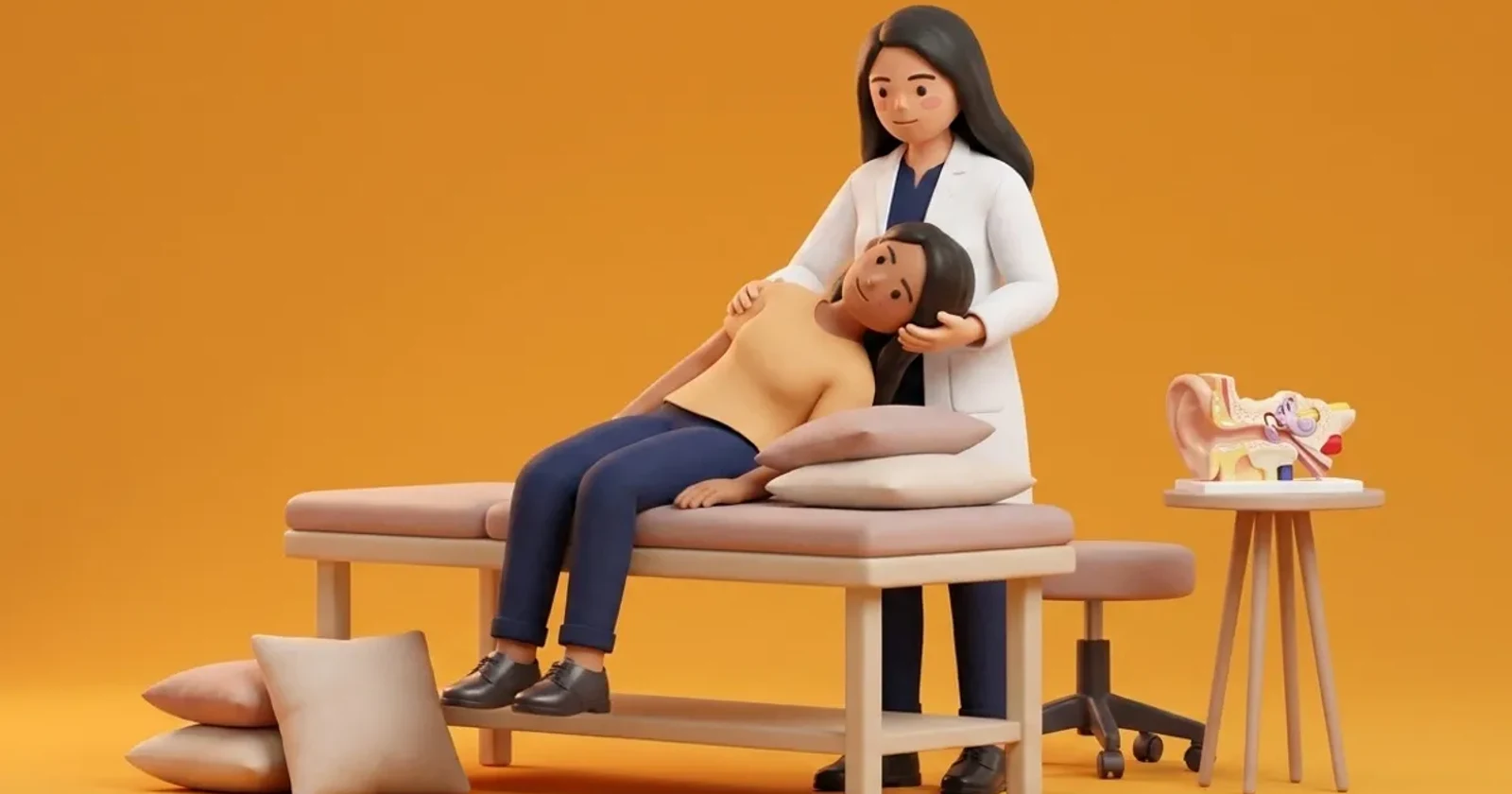
Anterior canal BPPV can be evaluated using either the Straight Head Hanging Test or the standard Dix-Hallpike test. During the straight head hanging test, the patient is brought from a seated position directly into supine with the head extended at least 30 degrees below the horizontal in the sagittal midline.
- Downbeat Nystagmus Vector: A brief latency (1 to 5 seconds) followed by paroxysmal, crescendo-decrescendo downbeating nystagmus that subsides within 30 to 45 seconds.
- Torsional Component: A subtle torsional element beating toward the affected ear may be visible, though pure downbeat nystagmus is frequently observed due to canal geometry.
- Fatigue on Repeat Testing: Re-testing elicits progressively weaker nystagmus and vertigo, confirming the mechanical, peripheral nature of the canalithiasis.
Stage-by-Stage Functional Repositioning Protocol
- Stage 1: The Yacovino Manoeuvre Execution: The Yacovino (Deep Head Hanging) manoeuvre has the unique advantage of treating either anterior canal without requiring definitive lateralisation. Position 1: Head hanging 30 degrees below horizontal for 30 to 60 seconds. Position 2: Chin brought briskly to chest while remaining supine for 30 seconds. Position 3: Return smoothly to upright sitting with chin maintained in flexion.
- Stage 2: Post-Repositioning Verification: Allow the patient to rest quietly in an upright posture for 10 minutes. Repeat the straight head hanging test to confirm complete resolution of the downbeat nystagmus.
- Stage 3: Functional Cervical Protection: Educate the patient on safe hip-hinging techniques during household cleaning and prayer to avoid sudden excessive neck hyperextension during the initial recovery window.
Clinical Exercise Protocol: Controlled Head-Trunk Transition Drill
Controlled Forward Hip-Hinge with Gaze Fixation
Objective: Retrains domestic forward bending mechanics without provoking endolymph turbulence or cervical hyperextension.
- 1Stand upright with feet shoulder-width apart, holding a visual target at eye level 2 metres away.
- 2Hinge forward at the hips while maintaining a neutral spine and keeping your eyes fixed firmly on the visual target.
- 3Bend your knees slightly to reach down without dropping your head below waist level.
- 4Return to the upright standing position smoothly while continuing steady visual fixation on the target.
Clinical Comparison: Anterior Canal BPPV vs Central Downbeat Nystagmus
| Diagnostic Marker | Anterior Canal BPPV | Central Downbeat Nystagmus |
|---|---|---|
| Onset Characteristic | Paroxysmal, with a 1 to 5 second latency period | Immediate, constant, and non-paroxysmal |
| Duration | Self-limiting (resolves within 30 to 60 seconds) | Persistent for as long as gaze or posture is held |
| Effect of Visual Fixation | Suppressed significantly by visual fixation | Fixation fails to suppress, or may even accentuate |
| Associated Symptoms | Isolated positional vertigo without neurological signs | Ataxia, oscillopsia, dysmetria, or lower cranial palsies |
| Structural MRI Findings | Normal posterior fossa anatomy | Chiari malformation, cerebellar atrophy, or infarction |
Red Flags and Neurological Escalation
Any patient presenting with downbeat nystagmus that occurs in the upright position, does not fatigue with repeated testing, or is accompanied by oscillopsia (jumping vision) in neutral gaze must be treated as a central red flag. Craniocervical junction anomalies, multiple system atrophy, spinocerebellar ataxia, and acute cerebellar stroke must be investigated. If downbeating nystagmus persists despite two correctly applied Yacovino manoeuvres, referral for high-resolution contrast MRI of the posterior fossa and cervical spine is mandatory.
Frequently Asked Questions
Why is anterior canal BPPV diagnosed so much less frequently than posterior BPPV?
The anterior canal points upward in the skull, meaning gravity naturally pulls loose particles down into the utricle during normal head movements, leading to a high rate of spontaneous self-resolution.
Can the Yacovino manoeuvre work if we do not know which ear is affected?
Yes. Because the Yacovino manoeuvre operates strictly in the sagittal midline plane, gravity guides particles out of the anterior canal back into the common crus and utricle regardless of whether the right or left anterior canal is involved.
Related recovery guides & articles
BookPhysio.in Editorial Team
The BookPhysio.in editorial team writes and maintains this content, checking it against reliable clinical sources. Content follows our medical review policy: general information only, and no page claims a clinical review until a named registered physiotherapist has signed it off.
Read our medical review policy