
Barefoot Walking Risks for Diabetic Feet on Indian Marble and Stone Floors
In short
Barefoot walking indoors is a deeply ingrained Indian household tradition, yet on cold marble or sun-heated courtyards, insensate diabetic feet face severe mechanical and thermal trauma. Learn essential indoor protection protocols.
In this guide (6 sections)
In Indian residential architecture, flooring materials such as polished Makrana marble, Kota stone, granite, and glazed ceramic tiles are prevalent due to their cooling properties and durability. However, walking barefoot across these rigid, non-yielding surfaces generates intense ground reaction forces directly beneath the metatarsal heads and calcaneus. For people with diabetic sensory neuropathy, the loss of cutaneous nociception eliminates the protective withdrawal reflex that normally protects plantar tissue from excessive mechanical shear and focal pressure. Without protective cushioning, repeated barefoot strides across unyielding domestic flooring initiate sub-dermal capillary thrombosis, autolytic enzymatic breakdown, and deep plantar ulcer development.
Domestic and Cultural Indian Realities
Indian domestic customs treat the home as a sanctuary where outdoor footwear is strictly prohibited at the threshold. Consequently, millions of older adults walk barefoot through kitchens, verandas, and inner courtyards. During Indian summer months, outdoor stone terraces and verandas frequently exceed 55 degrees Celsius under direct sunlight, inflicting full-thickness thermal burns within 30 seconds of barefoot contact on insensate feet. Conversely, during north Indian winter mornings, cold marble floors absorb thermal energy, worsening peripheral vasospasm and reducing microvascular tissue perfusion. Common domestic hazards like dropped fenugreek seeds, safety pins, or broken bangle fragments can penetrate the sole unnoticed. Families must introduce dedicated indoor-only footwear, such as washable microcellular rubber slippers with adjustable velcro straps.
Clinical Biomechanics and Neuropathic Breakdown
The healthy human foot relies on an organised heel fat pad arranged in specialised fibrous chambers designed to dampen shock. In longstanding diabetes, non-enzymatic glycosylation degrades the elastin matrix of this fibro-elastic adipose cushion, reducing its compressive shock attenuation capacity by more than 40 percent. When an individual walks barefoot on rigid marble, peak plantar pressure under the first and second metatarsal heads regularly surpasses 600 kilopascals. This unbuffered pressure exceeds capillary closing pressure, causing localized tissue ischaemia. Concomitant sensory neuropathy prevents the patient from sensing the resulting inflammatory ache, allowing normal walking activity to grind fragile subcutaneous tissue against underlying osseous prominences.
Clinical Assessment and Neuropathy Screening
Assessment begins with thorough bilateral visual inspection of the plantar skin, evaluating for erythema, localized swelling, subungual haemorrhages, and hyperkeratotic callus rims around the heel and metatarsal pads. Sensory evaluation incorporates the 10g Semmes-Weinstein monofilament alongside a 128 Hz tuning fork placed over the bony prominence of the hallux interphalangeal joint to measure vibratory perception. Palpation of the dorsalis pedis and posterior tibial arterial pulses determines if peripheral arterial disease compounds the neuropathic risk. Quantitative infrared dermal thermometry is used to identify pre-ulcerative hot spots, where an asymmetry of more than 2 degrees Celsius between matched sites indicates active subsurface inflammation.
Targeted Offloading and Intrinsic Foot Conditioning
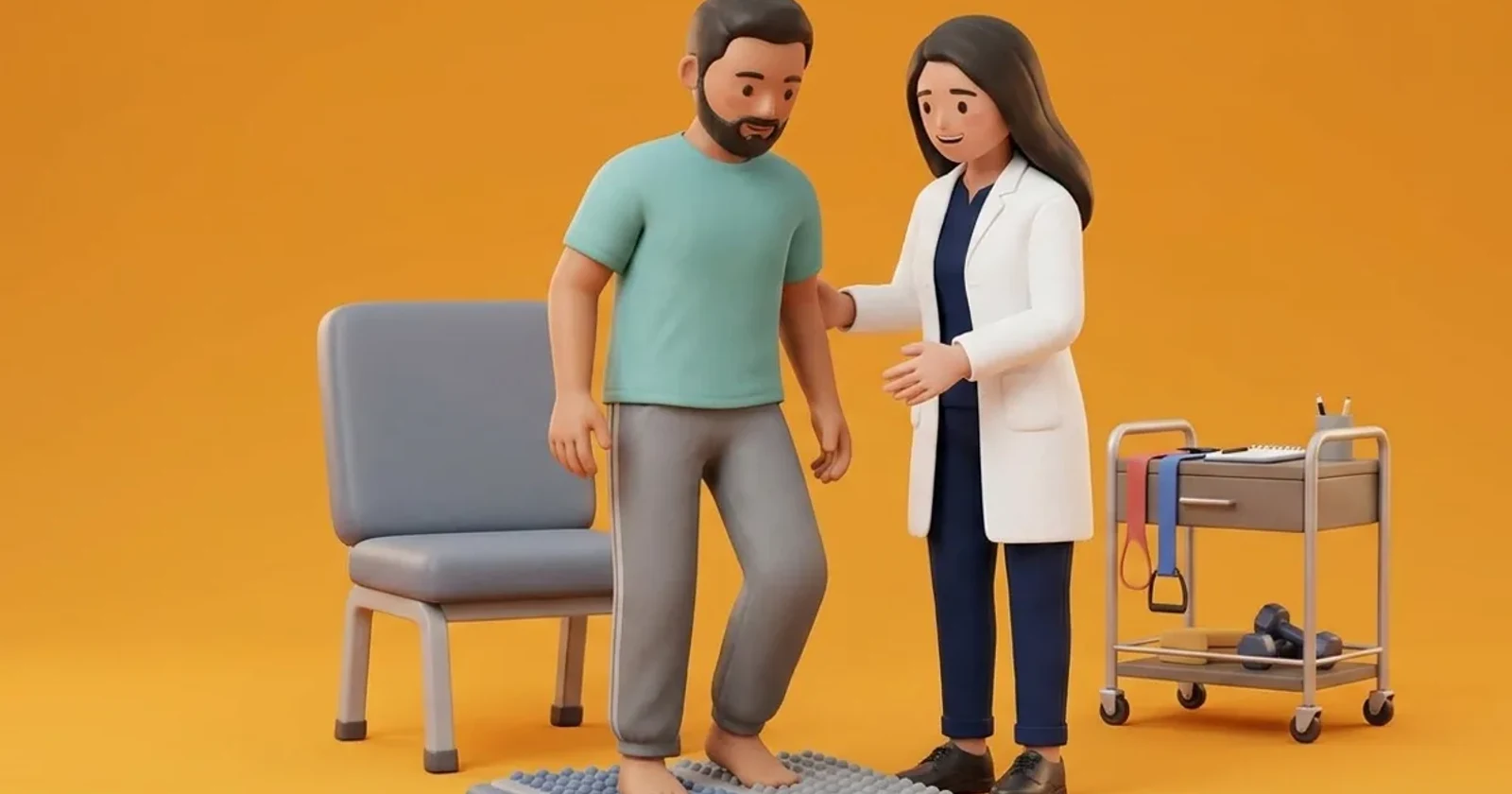
Protecting the neuropathic foot from domestic floor trauma requires strict environmental and behavioural adaptations combined with gentle foot mobilisation. Patients must never step out of bed barefoot; cushioned bedside slippers must be placed within arm reach. Physiotherapy focuses on non-weight bearing range of motion to prevent ankle equinus tightness, alongside seated intrinsic foot exercises that strengthen the arch stabilizers without exposing insensate skin to high impact forces. Balance retraining on non-slip textured surfaces helps maintain postural stability, reducing the risk of sudden slips on freshly mopped floors.
Seated Active Ankle Circumduction and Dorsiflexion
Objective: Maintain ankle mobility and lower limb venous return without floor impact
- 1Sit securely in a firm, arm-supported chair with back straight and thighs supported.
- 2Lift the right leg slightly off the floor, keeping the knee bent at approximately 90 degrees.
- 3Point your toes downward, then slowly pull the foot up toward your shin as far as comfortable.
- 4Gently rotate the ankle in smooth clockwise circles for 5 repetitions, followed by 5 counter-clockwise circles.
- 5Lower the foot gently to the floor and repeat the complete sequence with the left leg.
| Flooring Type | Mechanical and Thermal Hazard | Required Indoor Footwear Adaptation |
|---|---|---|
| Polished Marble / Vitrified Tiles | High stiffness, slippery when wet, cold-induced vasospasm | Indoor MCR footwear with anti-skid rubber tread and 10mm soft base |
| Sun-Heated Stone Veranda / Terrace | Extreme thermal absorption reaching 50 to 60 degrees Celsius | Strictly prohibited barefoot; insulated footwear required outdoors |
| Rough Red Clay Tile / Terracotta | Abrasive texture, surface friction, micro-laceration risk | Smooth cushioned cotton socks paired with structured indoor sandals |
| Traditional Cow-Dung Plastered Earth | Moisture retention, fungal spores, hidden thorn penetration | Closed-toe protective canvas shoes with puncture-resistant soles |
Red Flags and Urgent Diabetic Foot Escalation
Immediate medical evaluation is critical if the patient discovers an open blister, bleeding under a callus, or a painless puncture wound after walking indoors. Warning signs that require urgent emergency attendance include localized heat, rapid swelling of the midfoot, a foul smell emanating from between the toes, spreading purple skin discoloration indicating necrotising infection, or sudden fever accompanied by chills. Delaying assessment for even 24 hours can result in rapid deep-space sepsis.
Frequently Asked Questions
Is it safe to walk barefoot inside the home if the floors are cleaned daily?
No. Clean floors do not prevent mechanical pressure trauma. Even on completely spotless marble or tile, walking barefoot creates excessive ground reaction forces that crush fragile subcutaneous fat pads. Microscopic grit, cold surfaces, and hard flooring will injure insensate diabetic feet regardless of cleanliness. Dedicated indoor footwear is an absolute medical requirement.
What type of indoor footwear is recommended for Indian households?
The recommended indoor footwear consists of microcellular rubber (MCR) sandals with an 8 to 10 millimetre cushioned insole, Shore A hardness of 15 to 20 durometers, a rigid outer non-skid sole, and an adjustable heel strap. Flat rubber flip-flops or hawai chappals should be avoided because their toe-post friction causes blisters between the first and second toes.
Related recovery guides & articles
BookPhysio.in Editorial Team
The BookPhysio.in editorial team writes and maintains this content, checking it against reliable clinical sources. Content follows our medical review policy: general information only, and no page claims a clinical review until a named registered physiotherapist has signed it off.
Read our medical review policy