
BASDAI and BASFI Score Monitoring: Clinical Dosing of Physiotherapy in Spondyloarthritis
In short
Objective dosing in spondyloarthritis requires continuous tracking of disease activity and functional limitation. Learn how to calibrate exercise volume using validated BASDAI and BASFI metrics to avoid provoking inflammatory exacerbations.
In this guide (6 sections)
Exercise therapy is an indispensable pillar in the management of axial spondyloarthritis, yet prescribing an identical generic routine regardless of disease fluctuation risks triggering acute flares. The Bath Ankylosing Spondylitis Disease Activity Index (BASDAI) and the Bath Ankylosing Spondylitis Functional Index (BASFI) provide validated, reproducible metrics that guide clinical exercise dosing. By interpreting changes in these standardized scores, clinicians and patients can calibrate mechanical loading, transitioning safely from gentle active-assisted range of motion during inflammatory surges to progressive postural strengthening during disease quiescence.
Domestic and Cultural Indian Realities
In Indian households, individuals with spondyloarthritis frequently push through severe fatigue and joint pain to fulfil strenuous domestic and professional obligations. Patients often attribute fluctuating morning stiffness to seasonal changes, dietary factors, or minor exertion, delaying objective communication with their care team. When BASDAI scores spike above 4, attempting strenuous domestic chores like washing heavy laundry by hand, squatting to prepare meals on low platforms, or lifting heavy brass pots risks worsening entheseal micro-trauma. Families must establish an adaptive workload distribution where domestic duties are temporarily reallocated during flare states, and high-impact yogasanas like Chakrasana are replaced with passive restorative postures.
Clinical Biomechanics and Inflammatory Pathology
BASDAI measures subjective fatigue, spinal pain, peripheral joint swelling, localized enthesopathy tenderness, and both the duration and severity of morning stiffness on a 0 to 10 visual analog scale. A composite score of 4 or greater signifies active systemic inflammation driven by elevated serum IL-17 and TNF-alpha. At this threshold, excessive mechanical shear across inflamed entheses stimulates local mechanoreceptors and worsens micro-capillary bleeding within subchondral bone marrow. Conversely, the BASFI measures functional competence across ten daily activities, including bending to tie shoelaces, standing unsupported, climbing stairs, and looking over one shoulder. High BASFI scores in the presence of low BASDAI reflect established structural stiffness rather than active inflammation, indicating that mechanical stretching can be dosed more aggressively.
Clinical Assessment and Functional Staging
Routine clinical monitoring should include bi-weekly BASDAI assessments alongside monthly BASFI scoring. A rising BASDAI accompanied by an increase in morning stiffness duration past 60 minutes indicates an impending flare, warranting a reduction in mechanical resistance exercises. Concurrently, physiotherapists evaluate objective mobility markers such as cervical lateral flexion, chest expansion, and lumbar side bending. When both BASDAI and BASFI scores demonstrate concordant improvement following biologic therapy or targeted rehabilitation, patients can be progressed to closed-chain axial loading routines.
Targeted Mobility and Joint Preservation Exercises
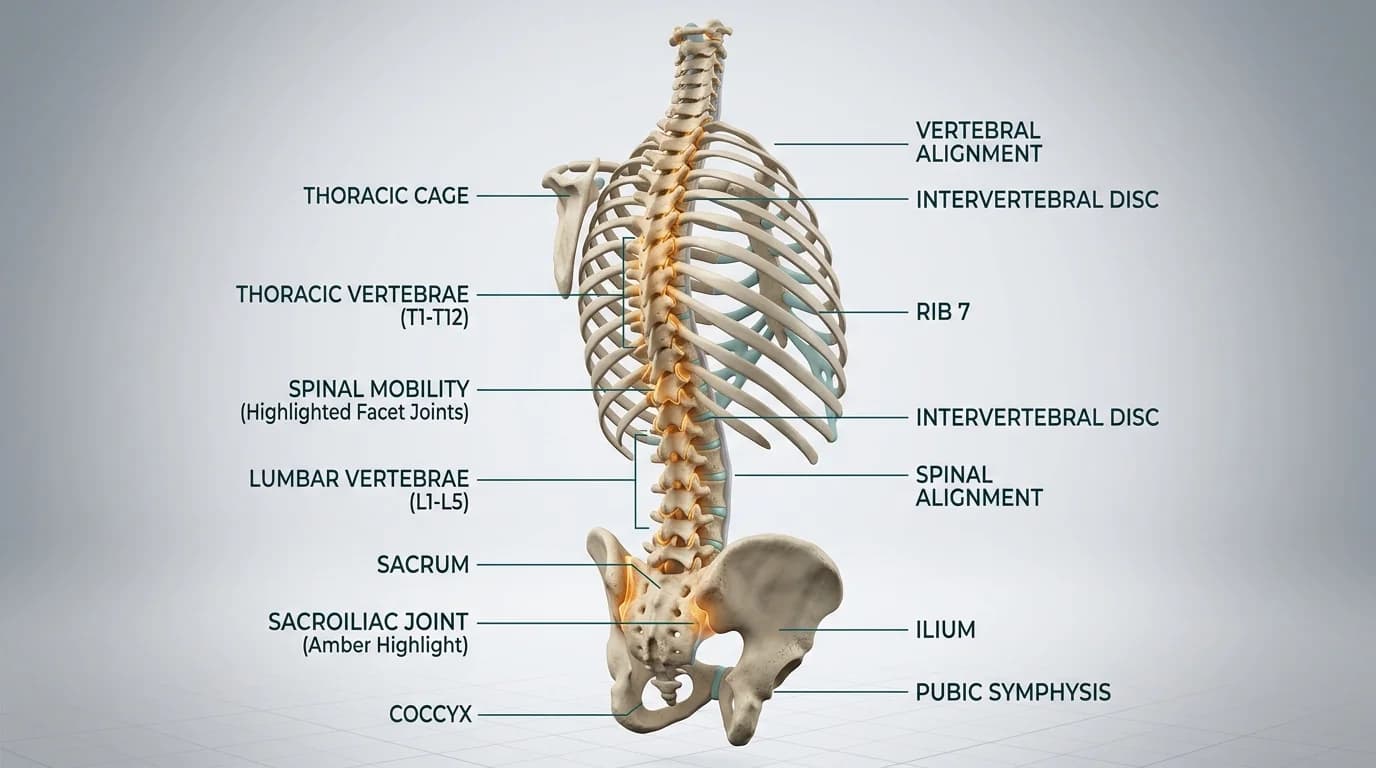
When disease activity is elevated, the primary rehabilitation goal is joint preservation and contracture prevention through low-intensity axial mobility. The following multi-plane movement maintains spinal elongation without overloading inflamed sacroiliac and costovertebral joints.
Seated Axial Spine Lengthening with Diaphragmatic Breath Cycles
Objective: Expand the thoracic cage and decompress the vertebral column within comfortable inflammatory limits
- 1Sit tall on a sturdy, armless chair with your feet flat on the floor and knees bent at 90 degrees.
- 2Place your hands lightly on your lower lateral ribcage with elbows relaxed.
- 3Inhale slowly through your nose for 4 seconds, feeling your ribs expand outward against your palms while imagining lifting the crown of your head upward.
- 4Exhale gently through pursed lips over 6 seconds, maintaining spinal height without slumping backward.
| Clinical Parameter | High Activity: BASDAI 4 or Greater | Low Activity: BASDAI Less Than 4 |
|---|---|---|
| Primary Exercise Goal | Pain relief, joint preservation, and gentle unresisted mobility | Endurance building, deep core strengthening, and spinal extension |
| Exercise Intensity Arc | Sub-maximal active-assisted range of motion within pain-free boundaries | Progressive resistance training and prolonged postural extension holds |
| Stretching Modality | Short-duration gentle static stretches with zero ballistic loading | Sustained myofascial stretching, foam roller mobilization, and prone extension |
| Cardiovascular Work | Gentle indoor level walking or warm water walking for 15 minutes | Upright stationary cycling and brisk walking for 30 to 45 minutes |
Red Flags and Immediate Rheumatology Escalation
If BASDAI scores spike rapidly above 7 despite full medication adherence, immediate medical review is mandatory to rule out concurrent infection or loss of biologic efficacy. Patients exhibiting constitutional symptoms such as unexplained high-grade fever, unintentional weight loss, dactylitis with severe erythema, or acute eye pain with blurred vision must be evaluated by a rheumatologist without delay.
Frequently Asked Questions
Should I completely stop exercising when my BASDAI score is high?
Complete bed rest during a spondyloarthritis flare is counterproductive because immobility accelerates joint stiffness and promotes flexion contractures. Instead of stopping, you should adapt your routine to gentle unresisted active movements, prone positioning, and deep breathing. This helps manage morning stiffness and maintain spinal mobility without aggravating entheseal inflammation.
How do I arrange a home assessment with a qualified physiotherapist through BookPhysio.in?
Under the National Commission for Allied and Healthcare Professions (NCAHP) Act 2021, patients in India can access licensed physiotherapists directly for clinical evaluations. Through BookPhysio.in, you select a verified home-visit clinician in your area. You pay the physiotherapist directly at the end of each session via cash or UPI; BookPhysio.in does not process online payments.
Related recovery guides & articles
BookPhysio.in Editorial Team
The BookPhysio.in editorial team writes and maintains this content, checking it against reliable clinical sources. Content follows our medical review policy: general information only, and no page claims a clinical review until a named registered physiotherapist has signed it off.
Read our medical review policy