
Bifocal and Progressive Glasses: Peripheral Blur and Outdoor Trip Hazards in Seniors
In short
Wearing multifocal glasses outdoors doubles the risk of tripping on kerbs and stairs. Discover how optical distortion blurs stepping zones and how single-vision lenses protect balance.
In this guide (6 sections)
Multifocal eyewear, including traditional bifocals and modern progressive addition lenses (PALs), is prescribed to millions of older adults to correct presbyopia alongside distance refractive errors. While highly convenient for indoor desk work and reading, wearing multifocal lenses during outdoor locomotion significantly impairs postural stability. Clinical trials demonstrate that older adults who wear multifocal glasses outdoors are more than twice as likely to fall on stairs, kerbs, and uneven pavements compared to those wearing single-vision distance glasses.
Domestic and Cultural Indian Realities
Indian outdoor pedestrian environments present unique physical hazards. City footpaths and neighborhood lanes frequently feature broken paver blocks, open drainage covers, loose construction gravel, and erratic concrete kerbs. Older Indians often wear progressive lenses continuously throughout the day, stepping outdoors to visit local vegetable markets (mandis), walk to community parks, or board public transport while wearing multifocals. When glancing downward through the bottom portion of their lenses, the reading addition magnifies and severely blurs the ground, obscuring pothole edges and leading to sudden missteps.
Clinical Biomechanics and Postural Control Decay
Safe human locomotion requires continuous visual feedforward processing to plan foot placement one to two steps ahead. When looking down through bifocal or progressive lenses, the lower visual field passes through the near-vision reading zone. This produces two major optical distortions: optical blur of objects at stepping distance (one to two metres away) and peripheral image jump with prismatic displacement. Furthermore, progressive lenses induce peripheral astigmatic blur. When an older adult steps off a roadside kerb, the optical distortion causes the brain to perceive the kerb as closer or shallower than it is, leading to an awkward foot strike, ankle inversion sprain, or forward tumble.
Functional Assessment and Risk Stratification
Clinical assessment evaluates obstacle-crossing accuracy while comparing the patient's performance wearing multifocal glasses versus single-vision distance glasses. The physiotherapist observes stepping margins, head tilt angle, and gait velocity. Older adults who show excessive chin-down tucking or foot scuffing while wearing progressive lenses outdoors demonstrate high eyewear-related fall vulnerability.
Targeted Strength and Balance Exercises
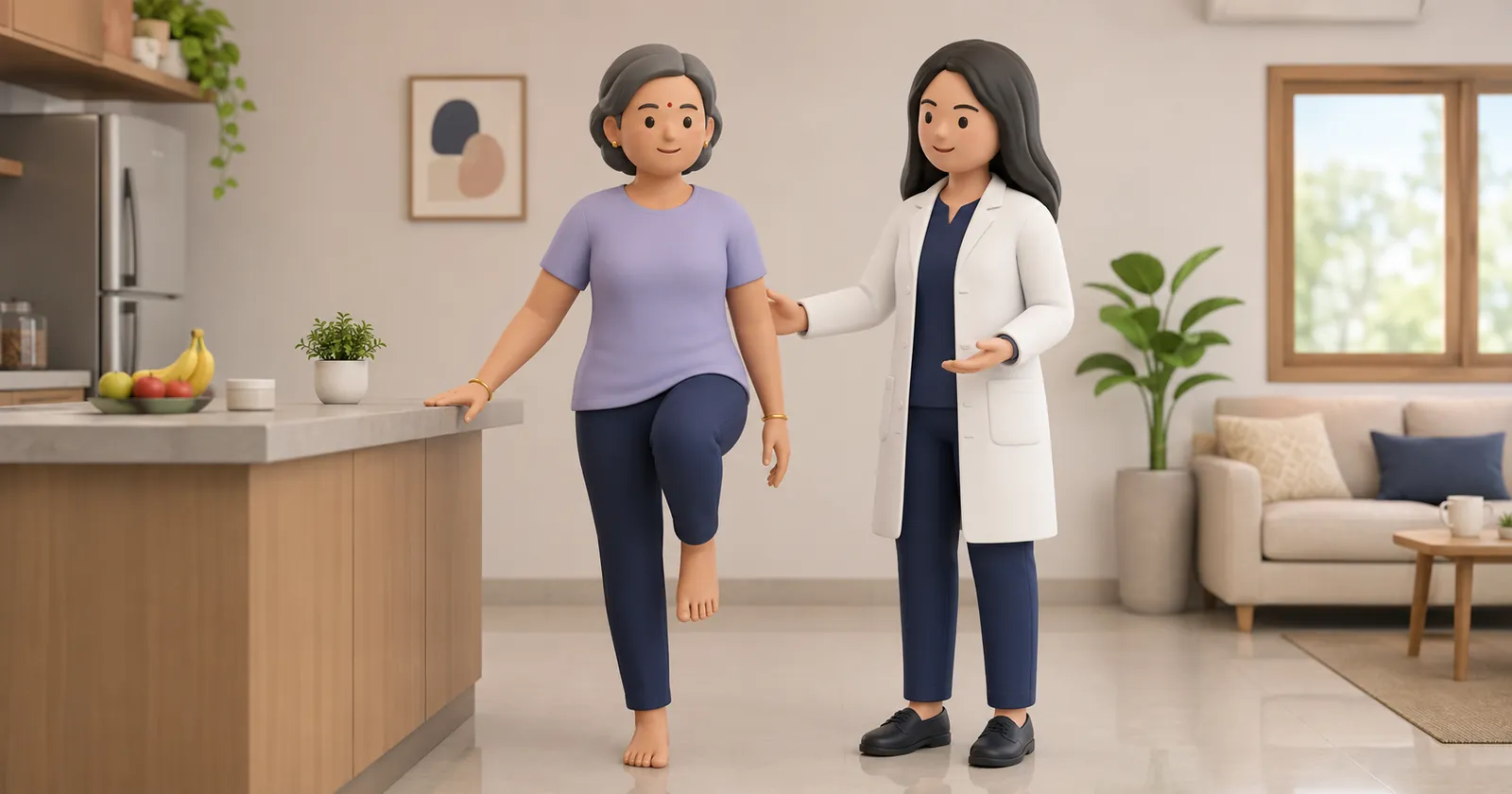
Physiotherapy rehabilitation educates seniors on head positioning mechanics and prescribes single-vision distance glasses for outdoor walking. Training emphasizes conscious head lowering (rather than simple eye lowering) when negotiating stairs, along with ankle stability drills to manage unexpected foot tilts.
Cervical Pitch Lowering and Visual Step Planning Drill
Objective: Train conscious neck flexion to view ground obstacles through the upper distance lens zone
- 1Stand tall at the beginning of an unobstructed hallway, wearing your outdoor walking glasses.
- 2Place five strips of bright tape on the floor at one-metre intervals.
- 3Instead of merely glancing down with your eyes, tilt your entire head forward fifteen degrees at the neck.
- 4Verify that the floor tape lines appear completely sharp and undistorted through the top portion of your glasses.
- 5Walk forward smoothly, maintaining this subtle head pitch, stepping cleanly over each tape line.
| Eyewear Category | Primary Optical Characteristics | Clinical Fall Safety Recommendation |
|---|---|---|
| Bifocal Lenses (Segmented) | Abrupt image jump at dividing line; lower segment blurs ground | Avoid during outdoor walking, gardening, and stair climbing |
| Progressive Addition Lenses (PALs) | Smooth transition but narrow intermediate corridor and peripheral blur | Reserve for indoor seated activities; remove for outdoor pedestrian travel |
| Single-Vision Distance Glasses | Unbroken visual field; zero peripheral distortion; sharp ground vision | Optimal clinical standard for outdoor walking, stairs, and sports |
| Dedicated Reading Glasses | Fixed near-focus lens (30 to 40 cm); extreme distance blur | Strictly for seated reading; never attempt standing or walking while wearing |
Red Flags and Emergency Post-Fall Escalation
Missteps caused by optical distortion frequently lead to lateral ankle ligament ruptures, Jones fractures of the fifth metatarsal, or forward falls resulting in wrist fractures. If an elder trips off a kerb, check for immediate swelling and deformity around the ankle and foot. Inability to bear weight for four steps requires orthopaedic radiography under the Ottawa Ankle Rules. Check for facial lacerations and broken eyeglass glass fragments that could cause corneal trauma.
Frequently Asked Questions
Should an active senior switch from progressive lenses to single-vision glasses for walking?
Clinical trials show that active seniors who switch to single-vision distance glasses for outdoor walking, stairs, and public transport experience a significant reduction in trips and falls compared to those wearing progressives continuously.
Can physiotherapists evaluate how my glasses affect my walking balance in India?
Geriatric physiotherapists assess head-eye coordination, gait speed, and stepping accuracy under different optical conditions. Under the NCAHP Act 2021, Indian patients enjoy direct access to registered physiotherapists. BookPhysio.in connects you with verified physiotherapists for home assessments with direct session pricing.
Related recovery guides & articles
BookPhysio.in Editorial Team
The BookPhysio.in editorial team writes and maintains this content, checking it against reliable clinical sources. Content follows our medical review policy: general information only, and no page claims a clinical review until a named registered physiotherapist has signed it off.
Read our medical review policy