
Brandt-Daroff Habituation Exercises: Resolving Residual Dizziness After BPPV Clearance
In short
Residual dizziness persists in up to 50% of patients after successful BPPV canal repositioning; Brandt-Daroff habituation exercises disperse micro-debris and restore balance.
In this guide (8 sections)
Pathophysiology of Post-Repositioning Residual Dizziness
Following successful canalith repositioning procedures (such as the Epley or Semont manoeuvres) where repeat Dix-Hallpike testing becomes entirely negative, approximately 30 to 50 percent of patients continue to report disabling residual dizziness (RD). Patients describe a vague, floating unsteadiness, lightheadedness, or feeling of walking on foam or wool that persists for days, weeks, or even months after acute rotational vertigo has ceased.
Three primary pathophysiological mechanisms account for residual dizziness. First, microscopic otoconial dust too small to induce visible nystagmus remains dispersed within the semicircular canal lumen, creating subtle fluid turbulence. Second, displaced otoconia that settled back into the utricle disrupt normal macula hair cell firing, producing transient otolith dysfunction. Third, central vestibular recalibration delays occur because the brainstem's predictive models take time to adjust back to symmetrical peripheral inputs.
Domestic Context: Elder Fear and Confinement in Indian Households
In Indian family homes, residual dizziness has profound functional and psychological consequences. Elderly grandparents, traumatized by the terrifying initial attack of spinning vertigo, remain bedbound out of fear that standing up or walking will trigger another violent episode.
Well-meaning family members reinforce this invalidism by insisting that the senior remain completely still in bed, bringing meals to the room and forbidding them from entering the pooja room or kitchen. This prolonged immobilisation accelerates muscle deconditioning, delays central compensation, and fosters chronic anxiety. Prescribing an active home exercise programme like Brandt-Daroff restores confidence and agency.
Clinical Testing: Ruling Out Persistent Canalithiasis
Before initiating Brandt-Daroff habituation, clinicians must verify that active BPPV has truly cleared.
- Negative Repeat Dix-Hallpike Testing: Complete absence of paroxysmal upbeat-torsional nystagmus and rotational spinning in both right and left Dix-Hallpike positions.
- Negative Supine Roll Test: Absence of direction-changing horizontal geotropic or apogeotropic nystagmus, confirming no canal switch to the horizontal canal occurred.
- Dizziness Handicap Inventory (DHI) Scoring: Measures ongoing functional, physical, and emotional handicap, tracking subjective improvement across therapy.
- Static and Dynamic Postural Screening: Assesses Romberg stance, tandem walking, and head turns during gait to isolate residual balance deficits.
Stage-by-Stage Functional Habituation Protocol
- Stage 1: Clinical Reassurance and Education: Reassure the patient and family that the primary spinning problem has resolved; explain that the brain needs movement, not prolonged bed rest, to recalibrate.
- Stage 2: Brandt-Daroff Home Exercise Execution: Perform structured side-lying transitions twice daily, allowing micro-debris to disperse and driving central habituation.
- Stage 3: Resumption of Active Domestic Independence: Gradually resume full domestic routines, including morning walks, pooja bending, and shopping, discontinuing exercises once asymptomatic for three consecutive days.
Clinical Exercise Protocol: The Brandt-Daroff Home Series
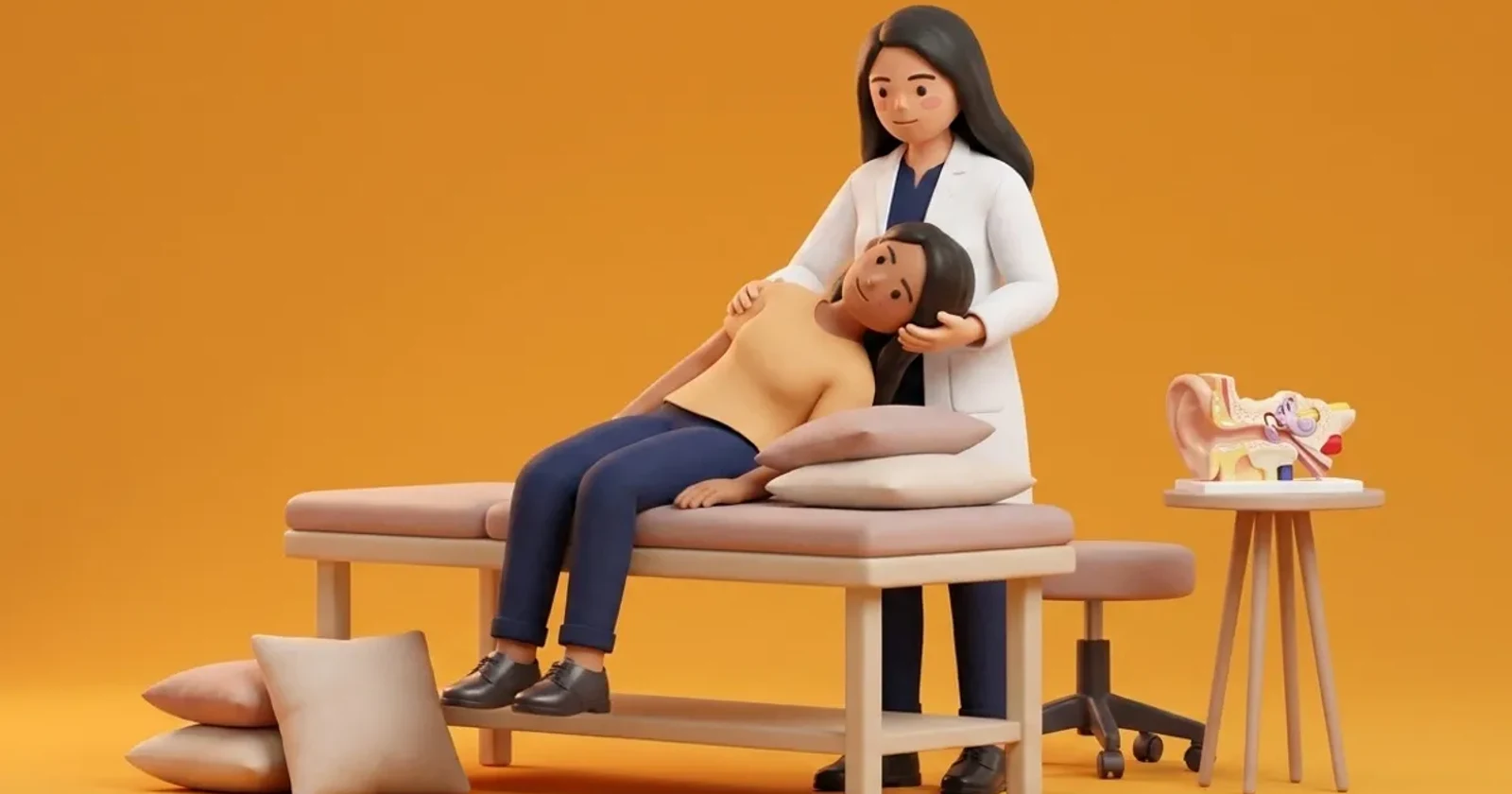
Standard Brandt-Daroff Habituation Series
Objective: Disperses residual microscopic otoconial particles and accelerates central vestibular neuroplastic adaptation.
- 1Sit upright on the edge of a firm bed or plinth with your feet resting flat on the floor.
- 2Turn your head 45 degrees to the left, then lie down briskly on your right side; maintain your head turned 45 degrees upward for 30 seconds or until any dizziness subsides.
- 3Sit up smoothly to the starting position and remain upright for 30 seconds to allow inner ear fluid to settle.
- 4Turn your head 45 degrees to the right, lie down quickly on your left side with head turned upward, hold for 30 seconds, and return to upright sitting for 30 seconds.
Clinical Comparison: Successful Clearing vs Residual Dizziness vs Recurrent BPPV
| Clinical Feature | Fully Resolved BPPV | Residual Dizziness (RD) | Recurrent / Active BPPV |
|---|---|---|---|
| Positional Nystagmus | Completely absent on Dix-Hallpike testing | Completely absent on Dix-Hallpike testing | Paroxysmal upbeat-torsional nystagmus present |
| Nature of Sensation | Zero dizziness; complete spatial stability | Vague floating, unsteadiness, woolly walking | Violent paroxysmal rotational room spinning |
| Duration of Sensation | Asymptomatic | Constant or persistent for hours to weeks | Transient (subsales within 10 to 60 seconds) |
| Primary Underlying Factor | Complete particle clearance into utricle | Micro-debris, otolith lag, delayed adaptation | Free-floating otoconia in canal lumen |
| Targeted Treatment | Discharge with advice on normal activity | Brandt-Daroff habituation and active walking | Repeat Epley or Semont repositioning manoeuvre |
Red Flags: True Canal Switch and Central Evolution
If a patient performing Brandt-Daroff exercises suddenly develops violent rotational spinning and nausea when lying on their side, a true canal switch has occurred - loose particles have migrated into the horizontal semicircular canal. Dix-Hallpike and Supine Roll testing must be re-administered immediately. Furthermore, if unsteadiness is accompanied by focal neurological signs, limb ataxia, or cranial nerve weakness, central neurological disease must be urgently excluded.
Frequently Asked Questions
Why do I feel lightheaded and off-balance even though my Epley test was negative?
Your inner ear crystals are back where they belong, but microscopic dust and temporary balance lag in your brain cause a floating sensation. Brandt-Daroff exercises and normal walking speed up your brain's recalibration.
Can doing Brandt-Daroff exercises make my BPPV come back?
No. Brandt-Daroff exercises disperse tiny residual particles so the inner ear can absorb them. If crystals do move, it reveals an incomplete clearing that can be easily resolved.
Related recovery guides & articles
BookPhysio.in Editorial Team
The BookPhysio.in editorial team writes and maintains this content, checking it against reliable clinical sources. Content follows our medical review policy: general information only, and no page claims a clinical review until a named registered physiotherapist has signed it off.
Read our medical review policy