
C5 Tetraplegia Mobility: Power Wheelchair Setup, Chin Control, and Transfers
In short
Individuals with C5 tetraplegia achieve independent community mobility utilizing specialised power wheelchairs with alternative controls and assisted transfers.
In this guide (6 sections)
A cervical spinal cord injury at the C5 neurological level spares the motor roots innervating the deltoid, biceps brachii, brachialis, and infraspinatus, while all musculature distal to the elbow remains paralyzed. With active shoulder abduction, forward flexion, and elbow flexion preserved, but voluntary wrist extension, triceps extension, and hand grasp absent, functional mobility requires specialised assistive technology. Independent manual wheelchair propulsion is rarely viable for outdoor travel due to absent wrist and triceps function. However, pairing motorized power wheelchairs featuring alternative drive controls (such as micro-joysticks or chin controllers) with structured caregiver transfer protocols enables full domestic and community participation.
Domestic and Cultural Indian Realities
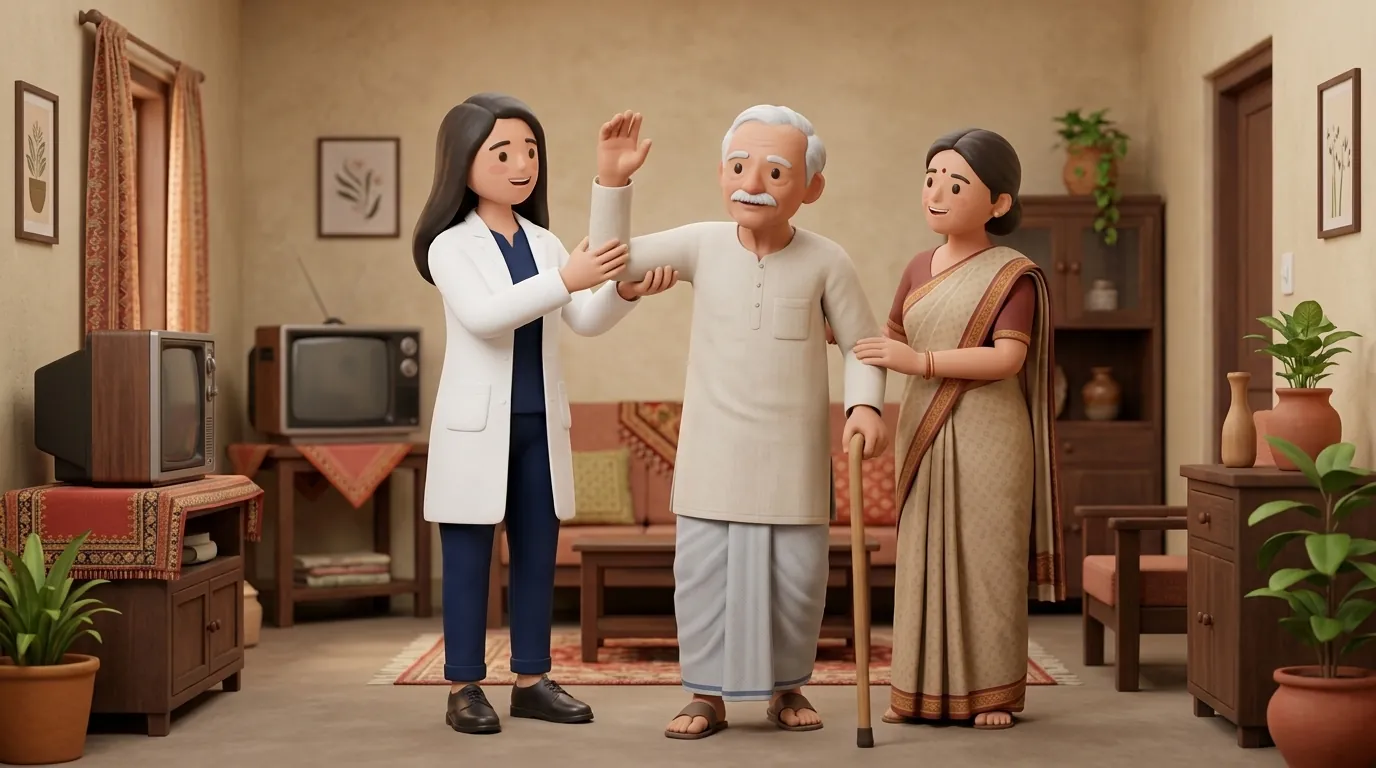
Integrating a motorized power wheelchair within typical Indian apartments requires careful structural and environmental planning. Power wheelchairs are heavy (often weighing 80 to 120 kilograms) and require wide turning clearances of at least 36 to 40 inches. Domestic flat doorways measuring 28 to 30 inches frequently demand door frame widening or replacing swinging doors with pocket sliders. Furthermore, charging heavy lead-acid or lithium-ion batteries requires reliable domestic power sockets with voltage surge protection against regional electrical fluctuations. Caregivers play a continuous role, assisting with morning sliding board transfers between bed and chair while ensuring the patient arms are safely secured in padded arm troughs to prevent shoulder subluxation during transit.
Clinical Biomechanics and Neurological Recovery
In C5 tetraplegia, the deltoid and biceps muscles are active, but their antagonist muscles, the latissimus dorsi, pectoralis major, and triceps, are denervated. This muscular imbalance creates a major clinical vulnerability: without triceps to oppose elbow flexion or rotator cuff stabilizers to anchor the humeral head in the glenoid fossa, gravity exerts severe downward traction on the flaccid shoulder girdle. Subluxation of the glenohumeral joint frequently develops if the arms are allowed to dangle unsupported. Positioning the forearms in contoured, padded arm troughs with the elbows flexed at 70 to 90 degrees supports the shoulder joints and prevents painful traction neuropraxias.
Functional Movement Analysis and Clinical Assessment
Assessment begins by grading strength in the key C5 muscles: the deltoid and biceps must achieve at least grade 3/5 against gravity to permit functional arm positioning. Neck motor control is evaluated thoroughly: operating a chin joystick requires smooth, fatigue-free cervical flexion, extension, and rotation. Seating assessment evaluates trunk stability and skin tolerance: power tilt-in-space seating (providing at least 45 to 55 degrees of posterior tilt) is clinically mandatory because the patient cannot perform independent physical push-up pressure reliefs.
Targeted Rehabilitation and Functional Independence Protocol
Rehabilitation focuses on two core domains: power wheelchair driving mastery and caregiver-assisted transfer training. The patient practices micro-control driving: operating the sensitive proportional chin joystick mounted on an adjustable swing-away cervical collar or chest rig. Transfer training educates family caregivers in safe sliding board technique. The caregiver never pulls on the patient arms; instead, the caregiver grasps the patient trousers at the hips, positions the patient head leaning forward in opposition to the hips, and glides the pelvis across a well-powdered birchwood sliding board.
Supported Deltoid and Biceps Active-Assisted Range Routine
Objective: Strengthen preserved C5 musculature while guarding against shoulder subluxation
- 1Sit securely in your supportive wheelchair with your backrest fully upright.
- 2Rest your forearm on a smooth tabletop supported by an overhead suspension sling or low-friction towel.
- 3Actively bend your elbow, drawing your hand toward your mouth using your biceps.
- 4Hold the flexed position for 3 full seconds without raising your shoulder shrug.
- 5Slowly glide the arm back outward into extension, using gravity to assist the return.
- 6Rest for 5 seconds between movements, maintaining relaxed diaphragmatic breathing.
| Control System | Mechanical Operating Principle | Clinical Suitability in C5 Injury |
|---|---|---|
| Proportional Chin Joystick | Deflection of small joystick mounted under chin via neck movements | Excellent; utilizes preserved C1-C4 cervical rotator musculature |
| Goal-Post Hand Joystick | Forearm positioned in bracket; shoulder deltoid drives movements | Viable if deltoid power is grade 4/5; can cause shoulder fatigue |
| Head Array System | Proximity sensors embedded inside headrest pads detect head tilt | Ideal if cervical movement is strong but jaw or chin fatigue occurs |
| Sip-and-Puff Controller | Pneumatic pressure changes through a mouth straw direct motion | Mainly used for C4 and higher; rarely necessary when C5 deltoid is intact |
Red Flags and Emergency Escalation
Caregivers must strictly avoid pulling the patient arms or axillae during transfers: pulling on an insensate, subluxed shoulder tears the joint capsule and causes severe brachial plexus traction injuries. In addition, individuals with C5 injuries are at high risk of autonomic dysreflexia. Any tight chin-strap pressure, full urinary drainage bag, or unnoticed skin pinch during power chair driving requires immediate vehicle stopping, upright positioning, and systematic trigger inspection. Ensure power wheelchairs feature manual disengagement freewheel levers so the chair can be pushed manually if battery power fails.
Frequently Asked Questions
Can a person with C5 tetraplegia drive a power wheelchair completely independently?
Yes. With a custom-calibrated chin joystick or goal-post hand controller, individuals with C5 tetraplegia can achieve complete independent indoor and outdoor driving autonomy. Modern electronics allow programming speed, acceleration, and sensitivity to match individual cervical motor control.
How do I arrange a home power seating and transfer assessment with a physiotherapist?
Under the NCAHP Act 2021, registered physiotherapists in India provide direct domiciliary evaluations. On BookPhysio.in, book an experienced neuro-physiotherapist who will assess your home accessibility, calibrate seating controls, and train family caregivers in safe transfer protocols. Fees are paid directly to the clinician at your home visit.
Related recovery guides & articles
BookPhysio.in Editorial Team
The BookPhysio.in editorial team writes and maintains this content, checking it against reliable clinical sources. Content follows our medical review policy: general information only, and no page claims a clinical review until a named registered physiotherapist has signed it off.
Read our medical review policy