
Call Centre and BPO Workers: Forward Head and Text Neck Syndrome
In short
Night-shift call centre and BPO workers sit before monitors for 9 hours under artificial lighting. Discover targeted physiotherapy solutions for neck strain.
In this guide (6 sections)
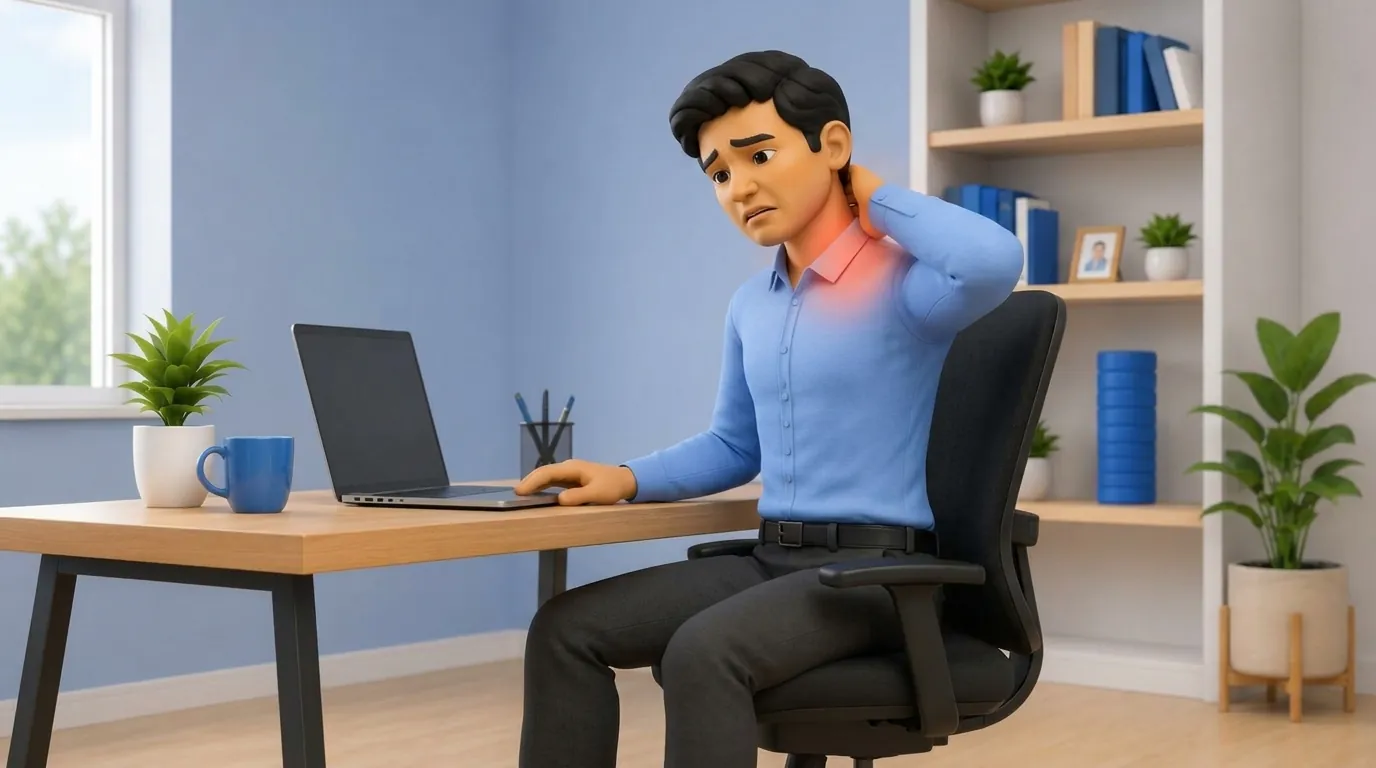
Business Process Outsourcing (BPO) and IT-enabled services across Bengaluru, Gurugram, Pune, and Hyderabad employ millions of young professionals on international night shifts. Workers spend 8 to 10 hours seated at static computer terminals, wearing single-ear telephone headsets and gazing into display monitors. This prolonged posture causes forward head displacement (text neck syndrome), rounded shoulders, thoracic kyphosis, and cervicogenic headaches. Circadian disruption compounds muscular fatigue by impairing tissue repair mechanisms.
Domestic and Cultural Indian Realities
Night-shift schedules invert normal physiological cycles, leading to poor sleep architecture in daytime shared urban flats. Employees often consume high-caffeine beverages to stay awake, increasing sympathetic nervous system tone and myofascial tension. Call-handling metrics mandate strict login times, discouraging away-from-desk breaks. Staff frequently lean forward toward computer monitors to read fine script while tilting the head sideways to cradle phone receivers, creating chronic asymmetrical cervical strain.
Clinical Biomechanics and Occupational Overuse
For every 2.5 centimetres the head moves anterior to the gravitational vertical plumb line, the effective weight supported by the cervical spine increases by approximately 4.5 kilograms. At a typical 45-degree forward neck angle, the cervical motion segments bear an effective load of 22 kilograms. This mechanical stress produces ischemic spasm in the suboccipitals, upper trapezius, and levator scapulae. Simultaneously, the deep cervical flexors (longus capitis and colli) and lower scapular stabilizers become inhibited and lengthened, establishing upper crossed syndrome.
Workplace Ergonomic Assessment and Postural Metrics
Assessment incorporates craniovertebral angle measurement, cervical range of motion testing, and the craniocervical flexion test using a pressure biofeedback unit. Clinicians perform palpation across the upper trapezius, sternocleidomastoid, and temporomandibular joint musculature to identify active trigger points that refer pain into the temples and retro-orbital regions.
Targeted Workplace Conditioning and Stretching Protocols
Ergonomic interventions involve adjusting monitor height so the top third of the screen sits at eye level, using dual-ear noise-cancelling wireless headsets, and positioning the keyboard to maintain 90-degree elbow angles. Conditioning routines emphasize deep neck flexor activation and pectoral stretching.
Craniocervical Flexion and Scapular Retraction at Desk
Objective: Activate the deep cervical flexors and counteract forward head drift during desk work
- 1Sit upright in your office chair with your back supported and feet flat on the floor.
- 2Gently retract your chin straight backward without tilting your head up or down.
- 3Simultaneously draw your shoulder blades backward and downward toward your opposite back pockets.
- 4Hold this aligned position for 5 seconds while breathing smoothly through your nose.
- 5Release gently to neutral without letting your chin poke forward.
| Muscle Group | Functional Status | Physiotherapy Remediation |
|---|---|---|
| Deep Neck Flexors (Longus Colli) | Inhibited and lengthened from forward head posture | Craniocervical flexion training with pressure biofeedback |
| Suboccipitals and Upper Trapezius | Hypertonic and shortened with myofascial trigger points | Suboccipital release, ischemic compression, and active stretches |
| Pectoralis Major and Minor | Contracted, pulling shoulders forward into anterior tilt | Doorway pectoral stretches and thoracic foam rolling |
| Serratus Anterior and Rhomboids | Weakened, allowing scapular winging and downward rotation | Prone scapular retractions and wall slide drills |
Red Flags and Specialist Escalation
Persistent radiating numbness, electric shock sensations down the arm, or progressive thumb and finger grip weakness indicates cervical radiculopathy requiring neurological consultation. Sudden thunderclap headache, visual disturbances, or facial drooping necessitates immediate emergency medical evaluation to exclude vascular emergencies.
Frequently Asked Questions
Can physiotherapy correct text neck syndrome in call centre workers?
Physiotherapy aims to relieve repetitive strain and restore functional capacity through deep neck flexor retraining, ergonomic workstation adjustments, and posture breaks. Retraining cervical muscles relieves nerve pressure and eliminates cervicogenic headaches.
Do I need a doctor referral to see a physiotherapist for neck pain in India?
Under the National Commission for Allied and Healthcare Professions (NCAHP) Act 2021, patients in India enjoy direct access to registered physiotherapists without requiring a mandatory prior medical referral. At BookPhysio.in, you consult verified physiotherapists and pay directly per session without hidden fees or platform commissions.
Related recovery guides & articles
BookPhysio.in Editorial Team
The BookPhysio.in editorial team writes and maintains this content, checking it against reliable clinical sources. Content follows our medical review policy: general information only, and no page claims a clinical review until a named registered physiotherapist has signed it off.
Read our medical review policy