
Casani Manoeuvre: Cupular Release Protocol for Apogeotropic Horizontal Canal BPPV
In short
Apogeotropic horizontal canal BPPV produces violent ceiling-beating nystagmus; the Casani manoeuvre dislodges cupular particles, converting them for final clearance.
In this guide (8 sections)
Pathophysiology of Apogeotropic Lateral Canal Otolith Displacement
Horizontal (lateral) semicircular canal BPPV presents in two distinct clinical variants based on the direction of nystagmus observed during the supine roll test: geotropic (nystagmus beating toward the floor) and apogeotropic (nystagmus beating toward the ceiling). The apogeotropic variant indicates that otoconia are either adhered to the cupula (cupulolithiasis) or free-floating within the anterior arm of the horizontal canal adjacent to the ampulla.
According to Ewald's second law, ampullofugal endolymph flow in the horizontal canal produces hyperpolarization (inhibition), which generates apogeotropic nystagmus. Because the inhibitory response is weaker than the excitatory response, the side with the WEAKER nystagmus represents the affected ear. Standard geotropic Gufoni or Barbecue manoeuvres fail because they move particles deeper into the anterior ampullary recess. The Casani manoeuvre (the modified Gufoni for apogeotropic BPPV) is designed specifically to detach cupular otoconia and reposition them into the posterior arm.
Domestic Context: Debilitating Bedside Turning in Indian Homes
Patients with apogeotropic horizontal BPPV experience violent, nauseating vertigo whenever their head turns left or right while lying flat. In Indian homes, waking up on a traditional cotton mattress or reaching toward the bedside for water triggers acute room spinning, vomiting, and panic.
Because turning in either direction triggers spinning (beating toward the ceiling bilaterally), patients and family members assume both ears are severely damaged or that an acute stroke is in progress. General practitioners frequently prescribe anti-emetics without positional testing, leaving patients bedridden for weeks. Precise execution of the Casani manoeuvre frees the adhered particles and provides dramatic relief.
Clinical Testing: Diagnosing Apogeotropic Horizontal BPPV
Diagnosis requires systematic execution of the supine roll test and confirmatory vertical testing.
- Supine Roll Test (Pagnini-McClure): Brisk 90-degree head turns to either side elicit horizontal nystagmus beating upward toward the ceiling (apogeotropic) in both positions.
- Identification of the Affected Ear: In apogeotropic BPPV, the affected ear is the side with the LESS intense, weaker nystagmus (opposite to the geotropic rule).
- The Bow and Lean Test: Bowing the head forward 90 degrees elicits nystagmus beating away from the affected ear, while leaning the head backward 45 degrees elicits nystagmus beating toward the affected ear.
- Pseudo-Spontaneous Nystagmus: A subtle horizontal nystagmus may be visible in upright sitting due to the 30-degree physiological inclination of the horizontal canal.
Stage-by-Stage Casani Manoeuvre Execution Protocol
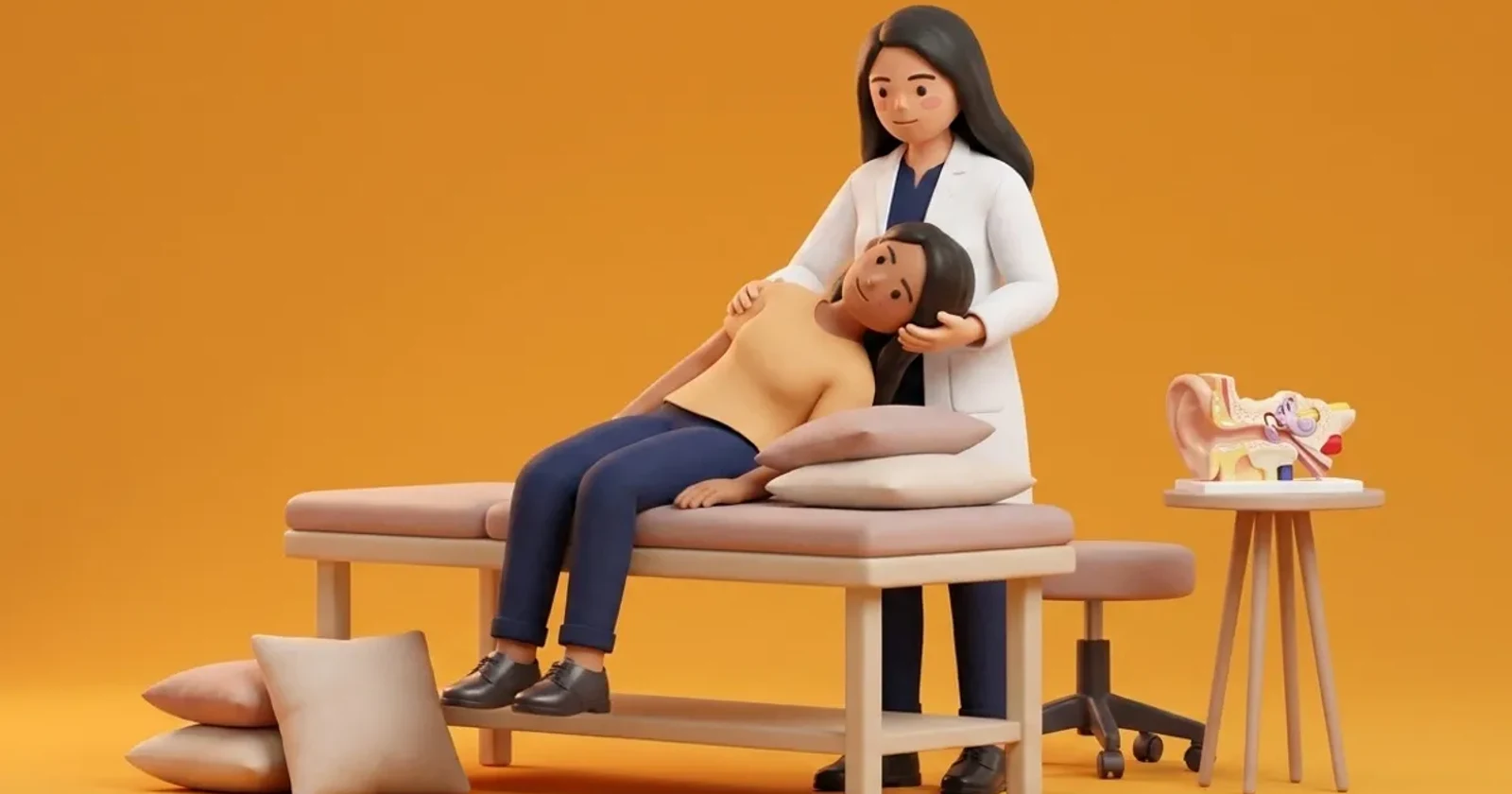
- Step 1: Patient Positioning: Seat the patient upright on the examination plinth with head in neutral alignment; confirm the affected ear using the weaker roll-test rule and bow-and-lean test.
- Step 2: Dropping onto the Affected Side: Briskly drop the patient onto their AFFECTED side, keeping the head in line with the body; hold this position for 2 to 3 minutes.
- Step 3: Rapid 45-Degree Downward Head Rotation: While maintaining side-lying, immediately rotate the patient's head 45 degrees downward toward the bed (nose pointing toward the plinth); hold for 2 to 3 minutes to detach particles from the cupula.
- Step 4: Upright Recovery and Verification: Slowly return the patient to upright sitting with the head kept slightly flexed; repeat the roll test at 15 minutes to confirm conversion to geotropic or complete clearance.
Clinical Exercise Protocol: Forced Prolonged Positioning on Healthy Side
Forced Prolonged Side-Lying Settling Protocol
Objective: Leverages sustained gravity to settle converted horizontal canal otoconia into the utricle overnight.
- 1Following clinical execution of the Casani manoeuvre, prepare a firm bed with a supportive pillow.
- 2Lie down slowly onto your unaffected (healthy) side, keeping your neck in neutral horizontal alignment.
- 3Remain in this side-lying position continuously for at least 8 to 10 hours overnight, avoiding rolling onto your back or the affected side.
- 4Rise slowly in the morning, keeping your head upright and avoiding rapid head shaking.
Clinical Comparison: Geotropic vs Apogeotropic Horizontal Canal Manoeuvres
| Clinical Parameter | Geotropic Lateral BPPV | Apogeotropic Lateral BPPV |
|---|---|---|
| Supine Roll Nystagmus | Beats toward the ground (geotropic) bilaterally | Beats toward the ceiling (apogeotropic) bilaterally |
| Affected Ear Rule | Side with the STRONGER nystagmus (ampullopetal) | Side with the WEAKER nystagmus (ampullofugal) |
| Primary Manoeuvre | Gufoni to UNAFFECTED side or Barbecue roll | Casani manoeuvre (Gufoni to AFFECTED side) |
| Head Turn Direction | Head rotated 45 degrees UPWARD toward ceiling | Head rotated 45 degrees DOWNWARD toward bed |
| Immediate Treatment Goal | Direct clearing into utricle | Detaching cupula to convert to geotropic variant |
Red Flags: Non-Converting Direction-Changing Central Nystagmus
Direction-changing horizontal positional nystagmus can mimic central cerebellar or brainstem pathology. If apogeotropic nystagmus fails to convert to geotropic after three properly applied Casani manoeuvres, or if the nystagmus occurs without symptom latency or fatigue, central positional nystagmus (CPN) must be suspected. Nodulus or uvular lesions, cerebellar stroke, or multiple sclerosis must be excluded via emergency neurological referral and contrast brain MRI.
Frequently Asked Questions
Why did my physiotherapist lie me down on the side that makes me dizzy for the Casani manoeuvre?
In apogeotropic BPPV, lying on the affected side and turning your nose down toward the bed uses gravity to pull stuck crystals off the balance sensor, freeing them to move into the main chamber.
What does it mean if my apogeotropic vertigo converts to geotropic after treatment?
Conversion to geotropic is a sign of success. It proves the crystals have detached from the sensor and are now floating free in the canal arm, where a standard Gufoni manoeuvre can easily clear them.
Related recovery guides & articles
BookPhysio.in Editorial Team
The BookPhysio.in editorial team writes and maintains this content, checking it against reliable clinical sources. Content follows our medical review policy: general information only, and no page claims a clinical review until a named registered physiotherapist has signed it off.
Read our medical review policy