
Central Cord Syndrome Rehabilitation: Cervical Hyperextension and Arm Recovery
In short
Central cord syndrome presents with disproportionate upper limb motor impairment compared to the lower limbs, requiring targeted motor retraining and hand rehabilitation.
In this guide (6 sections)
Central cord syndrome (CCS) is the most frequent form of incomplete cervical spinal cord injury, classically precipitated by acute hyperextension trauma to a pre-spondylotic cervical spine. Its hallmark clinical presentation is a striking dissociation between the extremities: severe motor weakness and sensory impairment in the upper limbs, contrasted with relatively preserved motor function and ambulatory capacity in the lower extremities. Because sacral sensory pathways are typically spared, patients often regain the ability to walk within weeks. However, recovering fine motor control in the hands and coordinated shoulder stability represents a protracted rehabilitation challenge requiring specialised neuro-physiotherapy.
Domestic and Cultural Indian Realities
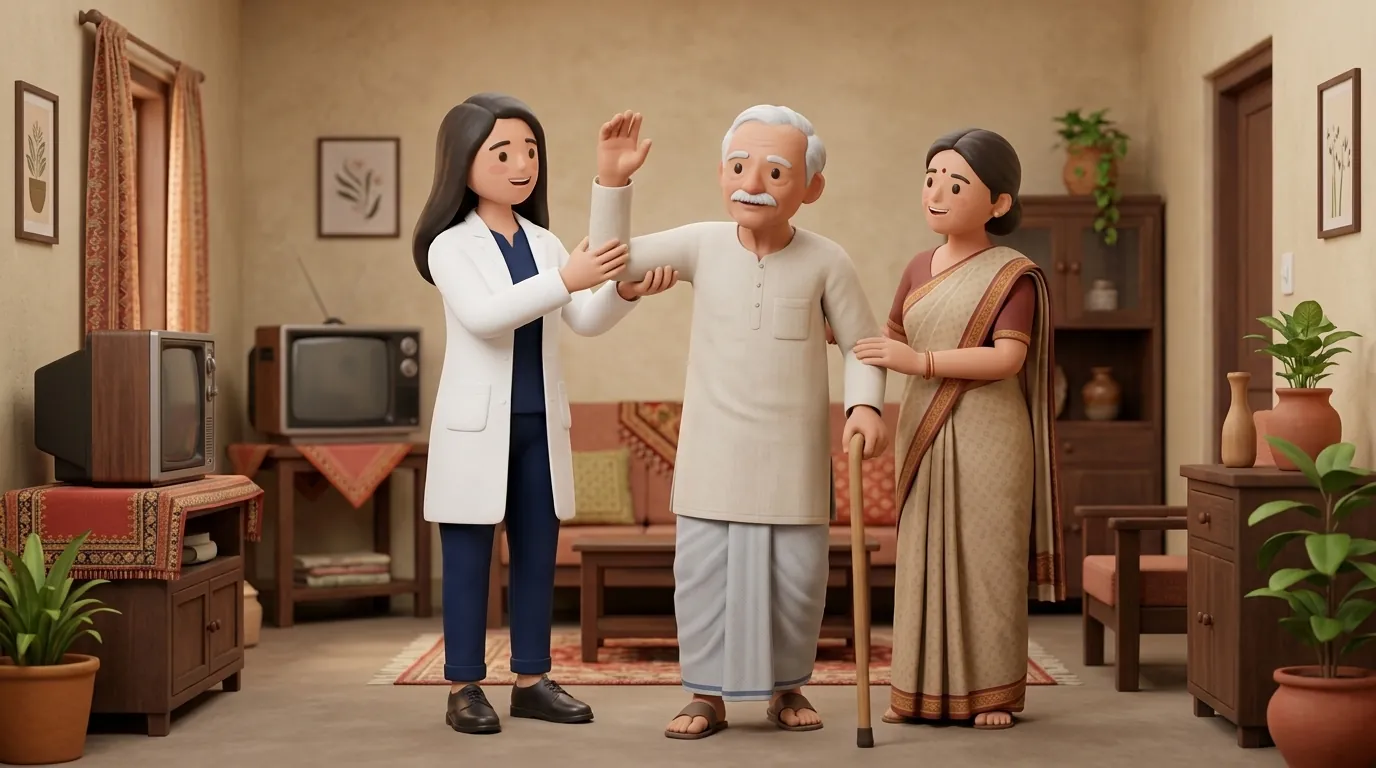
In India, central cord syndrome predominantly strikes older adults who suffer low-energy domestic falls on wet bathroom floors or trip over uneven thresholds. Because the patient may be capable of standing and walking independently around the house, family members frequently misunderstand why they cannot feed themselves dal and rice, open a brass kundi latch, or button a kurta. The severe hand weakness (frequently presenting with intrinsic hand wasting and clawing tendencies) generates high domestic frustration. Home adaptations must include adapted dining utensils with built-up foam handles, slip-on clothing, and lever-action door handles while intensive hand retraining proceeds.
Clinical Biomechanics and Neurological Recovery
The anatomical basis of central cord syndrome lies in the laminated somatotopic arrangement of the lateral corticospinal tracts. Corticospinal fibers destined for the cervical segments and upper extremities are located centrally within the cord, immediately adjacent to the central canal, whereas lumbar and sacral fibers travel peripherally. An acute hyperextension injury pinches the spinal cord between osteophytic vertebral ridges anteriorly and the buckled ligamentum flavum posteriorly, concentrating vascular contusion and edema in the central gray and white matter. While peripheral fibers survive, centrally situated motor neurons governing the hands and arms experience profound axonotmesis.
Functional Movement Analysis and Clinical Assessment
Clinical examination reveals severe asymmetry between upper and lower extremity motor scores on the International Standards for Neurological Classification of Spinal Cord Injury (ISNCSCI). Upper extremity key muscles typically score 1 to 2 out of 5, while lower extremity muscles frequently achieve 4 to 5 out of 5. Hand dexterity is evaluated using standardized assessments like the Nine-Hole Peg Test and Box and Block Test. Sensory mapping documents patchy light touch and pinprick loss across the C5 to T1 dermatomes, while joint position sense in the lower extremities is usually intact.
Targeted Rehabilitation and Functional Independence Protocol
Rehabilitation proceeds along dual parallel tracks. Track 1 focuses on fall prevention and dynamic balance training, ensuring the ambulatory patient has sufficient equilibrium to walk safely despite lacking protective arm extension reactions. Track 2 focuses on high-repetition, task-specific upper extremity motor training. Early resting splints maintain functional hand architecture, preventing clawing contractures of the intrinsic hand muscles. Neuromuscular electrical stimulation (NMES) is applied to the wrist and finger extensors, paired with real-world functional reaching, cylindrical grasping, and pinch manipulation tasks.
Seated Task-Oriented Hand Dexterity and Grasp Progression
Objective: Re-educate intrinsic hand control and wrist stability during functional object manipulation
- 1Sit upright at a sturdy table with forearms supported in pronation on a non-slip mat.
- 2Place five wooden blocks or small cups spread in a semi-circle 6 inches in front of you.
- 3Focus on actively extending your wrist upward to at least 20 degrees before opening your fingers.
- 4Grasp the first block using a three-jaw chuck pinch (thumb, index, and middle finger pads).
- 5Lift the block 2 inches off the table without dropping your wrist into flexion, then transport it 4 inches laterally.
- 6Gently release the block, reset your forearm, and repeat with each consecutive item.
| Clinical Feature | Upper Extremities (Central Fibers) | Lower Extremities (Peripheral Fibers) |
|---|---|---|
| Initial Motor Power Deficit | Severe weakness (Grade 0-2/5); flaccid initial paralysis | Mild to moderate paresis (Grade 3-4/5); tone preserved |
| Rate of Functional Recovery | Slow and protracted over 6 to 18 months; requires fine motor drills | Rapid recovery; independent ambulation often achieved in 4-8 weeks |
| Primary Rehabilitation Goal | Dexterous hand function, grasp-release, self-feeding, grooming | Dynamic balance, gait endurance, stair climbing, fall avoidance |
| Orthotic Requirements | Resting hand splints, tenodesis braces, adapted utensil grips | Rarely requires calipers; light AFO only if mild foot drop exists |
Red Flags and Emergency Escalation
Patients with central cord syndrome who are ambulatory face high fall risks because they lack the rapid upper extremity protective reactions needed to break a fall. Strict supervision and walking aids must be maintained until balance is objectively verified. Any sudden, progressive deterioration in neurological status, such as ascending weakness in the legs or acute loss of bowel or bladder control, warrants immediate neurosurgical evaluation with emergent MRI to rule out an expanding post-traumatic hematoma or progressive spinal cord compression.
Frequently Asked Questions
Why do legs recover so much faster than hands in central cord syndrome?
The nerve fibers controlling the legs travel on the outer perimeter of the spinal cord and largely escape injury, allowing rapid restoration of walking. In contrast, the nerve fibers controlling the arms and delicate hand muscles travel in the centre of the cord, where compressive damage is most severe, requiring many months of intensive nerve regeneration.
Can home neuro-physiotherapists provide specialised hand rehabilitation for central cord syndrome?
Yes. Qualified neuro-physiotherapists utilize task-oriented retraining, electrical stimulation, and adaptive splints directly at home. Under the NCAHP Act 2021, you can consult a licensed physiotherapist directly on BookPhysio.in without a prior prescription, paying the clinician directly at your home consultation.
Related recovery guides & articles
BookPhysio.in Editorial Team
The BookPhysio.in editorial team writes and maintains this content, checking it against reliable clinical sources. Content follows our medical review policy: general information only, and no page claims a clinical review until a named registered physiotherapist has signed it off.
Read our medical review policy