
Deep Sensory Loss and Knee Proprioceptive Drift in Diabetes: Tandem Stance Retraining
In short
Proprioceptive drift causes unnoticed knee hyperextension and joint instability in diabetic neuropathy. Discover clinical tandem stance retraining and balance stabilization.
In this guide (6 sections)
While cutaneous sensory loss in diabetic neuropathy is well documented, deep somatosensory degradation affecting muscle spindle primary afferents and joint mechanoreceptors is equally debilitating. This deep sensory loss results in proprioceptive drift: the gradual, unconscious deviation of a limb or joint position over time in the absence of continuous visual feedback. In the lower extremity, proprioceptive drift frequently manifests as progressive knee hyperextension (genu recurvatum) during the stance phase of gait. Patients unconsciously lock their knees backward against the posterior joint capsule to create a passive, bone-on-bone mechanical stability that substitutes for missing proprioceptive muscular control. Tandem stance retraining and closed-chain sensorimotor drills help re-establish joint position awareness and prevent capsule laxity.
Domestic and Cultural Indian Realities
In Indian daily life, standing in prolonged queues at banks, bus terminals, or religious shrines is common. When an individual with diabetic sensory neuropathy stands for extended periods, proprioceptive drift sets in silently. Unaware of their knee joint angle, the patient locks both knees into extreme hyperextension, resting their body weight entirely on the posterior cruciate ligament and posterior capsule. Over months, this continuous hyperextension stretches the posterior knee restraints, causing joint deformity, instability, and anterior knee pain. At home, walking across smooth marble in low lighting makes it difficult to visually verify knee position, leading to sudden knee buckling and falls. Training patients to maintain a soft knee (slight 5-degree flexion) during standing prevents joint damage.
Clinical Biomechanics and Neuropathic Breakdown
Proprioception relies on group 1a and group 2 sensory afferents originating from intrafusal muscle spindles within the quadriceps, hamstrings, and gastrocnemius, alongside Ruffini endings in joint capsules. Hyperglycaemic microangiopathy and demyelination impair the transmission velocity of these large afferent fibres. When visual cues are removed, the internal mental map of knee position drifts by 5 to 10 degrees within 15 seconds. Locking the knee into hyperextension shifts the ground reaction force vector far anterior to the knee joint centre, generating a continuous passive extension moment. While this prevents the knee from collapsing into flexion, it severely damages the posterior capsule, accelerates patellofemoral osteoarthritis, and creates heavy heel impact forces.
Clinical Assessment and Neuropathy Screening
Assessment begins with joint position reproduction testing: with the patient seated and eyes closed, the clinician moves the knee to a target angle (such as 30 degrees of flexion) and holds it for 5 seconds. The leg is returned to neutral, and the patient is asked to actively reproduce the target angle; an error greater than 5 degrees indicates significant proprioceptive deficit. Static postural control is tested using the tandem stance test (standing heel-to-toe along a line) with eyes open and eyes closed, timing the patient ability to maintain balance for 30 seconds.
Targeted Offloading and Intrinsic Foot Conditioning
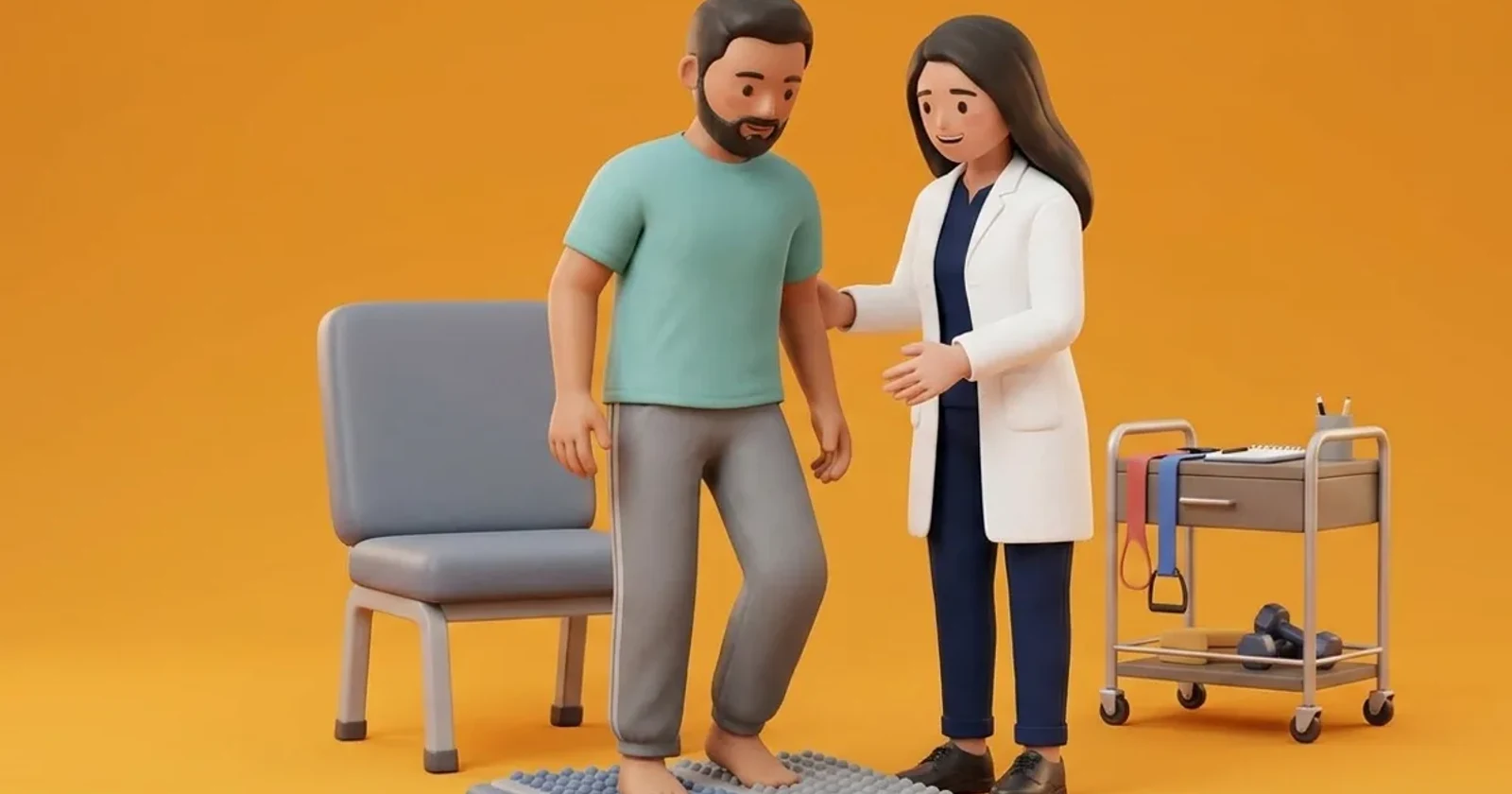
Rehabilitation utilizes visual biofeedback and closed-chain sensorimotor training. Patients practice standing in front of a mirror, learning to visually identify and maintain a neutral knee position without locking backward. Tandem stance exercises are performed inside a room corner with sturdy chair support, challenging lateral hip stabilisers (gluteus medius) and ankle balance mechanisms. Mini-squats performed with a soft ball squeezed between the knees help re-educate quadriceps eccentric control.
Supported Corner Tandem Stance Balance Drill
Objective: Retrain lower limb proprioceptive alignment and lateral stability in a safe environment
- 1Stand inside the corner of a room, facing outward, with a sturdy dining chair directly in front of you.
- 2Place your right foot directly in front of your left foot along a straight line, touching right heel to left toes (tandem position).
- 3Ensure your knees remain soft and slightly bent by 5 degrees, never locked backward.
- 4Rest your fingertips lightly on the chair backrest, looking straight ahead at a fixed eye-level focal point.
- 5When steady, lift your fingers off the chair and hold the balanced tandem stance for 15 to 20 seconds.
- 6Step back, rest for 10 seconds, and repeat the drill with your left foot in front.
| Proprioceptive Deficit Level | Biomechanical Presentation & Gait Tell | Prescribed Physiotherapy Strategy |
|---|---|---|
| Mild Proprioceptive Drift | Slight knee hyperextension during standing; normal walking gait | Visual mirror feedback drills; supported tandem stance; calf stretching |
| Moderate Proprioceptive Loss | Frequent knee locking in stance; heavy heel strikes; positive Romberg | Closed-chain mini-squats; corner balance drills; rocker-sole footwear |
| Severe Deep Sensory Loss | Marked genu recurvatum; frequent knee buckling; severe sway | Hinged knee brace with extension stop; walking frame; sensory retraining |
Red Flags and Urgent Diabetic Foot Escalation
Immediate medical escalation is necessary if a patient experiences sudden knee swelling, localized heat, or joint laxity following a stumble, which may indicate ligamentous rupture or an occult subchondral fracture. Any skin abrasion or blister on the feet resulting from uncoordinated stepping requires immediate podiatric evaluation.
Frequently Asked Questions
Why do I naturally lock my knees backward when standing?
When nerve damage blunts the feeling in your legs, your thigh muscles do not know exactly how much to contract to keep you upright. Locking your knees backward creates a rigid bone-on-bone lock that requires zero muscle effort. However, this damages your knee joint capsule over time. Learning to stand with soft, slightly bent knees protects your joints.
How does tandem stance practice help prevent falls in daily life?
Tandem stance (standing heel-to-toe) narrows your base of support, forcing your brain to use your inner ear and vision to keep your balance. Practicing this in a safe room corner trains your balance reflexes to react quickly if you stumble or step on an uneven surface.
Related recovery guides & articles
BookPhysio.in Editorial Team
The BookPhysio.in editorial team writes and maintains this content, checking it against reliable clinical sources. Content follows our medical review policy: general information only, and no page claims a clinical review until a named registered physiotherapist has signed it off.
Read our medical review policy