
Distal Radius Fracture Volar Plating: Scar and Stiffness Rehab
In short
Volar locking plate fixation for distal radius fractures enables early mobilization. Structured therapy targets forearm rotation and protects flexor tendons.
In this guide (5 sections)
Distal radius fractures: whether presenting as extra-articular dorsally displaced Colles fractures or volarly displaced Smith fractures: are the most frequent fractures of the upper extremity. Open reduction and internal fixation (ORIF) using anatomical volar locking compression plates (LCP) provides rigid osteosynthesis, neutralizing deforming forces and bypassing the prolonged casting that historically resulted in severe joint contractures. Evidence-based physiotherapy capitalizes on stable internal fixation to initiate early motion while protecting vulnerable soft tissues.
Domestic and Cultural Indian Realities
In Indian clinical practice, distal radius fractures peak among active young two-wheeler riders and post-menopausal women following low-energy falls. Following surgery, persistent wrist stiffness severely impairs essential daily tasks: eating food cleanly with hands without spilling, cleaning utensils, rolling dough, pouring water from brass vessels, and completing personal hygiene. Early restored forearm rotation (supination) is vital for culturally specific activities like accepting offerings (prasad) or giving blessings.
Surgical Pathoanatomy and Biomechanical Principles
The volar Henry approach provides access to the distal radius by incising the pronator quadratus muscle. Plate placement relative to the watershed line of the distal radius is critical (Soong grading): plates positioned distal to this landmark risk mechanical attrition or delayed rupture of the flexor pollicis longus (FPL) tendon. Pronation-supination mechanics depend on congruent articulation at both the proximal and distal radioulnar joints (DRUJ) alongside triangular fibrocartilage complex (TFCC) stability.
Postoperative Rehabilitation Phases and Splinting Protocols
A removable thermoplastic volar wrist cock-up splint (15 degrees extension) protects the wrist between exercise sessions for the initial 2 to 3 weeks. Active finger composite fist closure and isolated thumb flexion begin on day 1 to avoid digital edema. Active wrist flexion, extension, and forearm pronation-supination commence within 7 to 10 days post-surgery. Progressive isometric loading begins at week 4, transitioning to dynamic functional grip retraining at week 6.
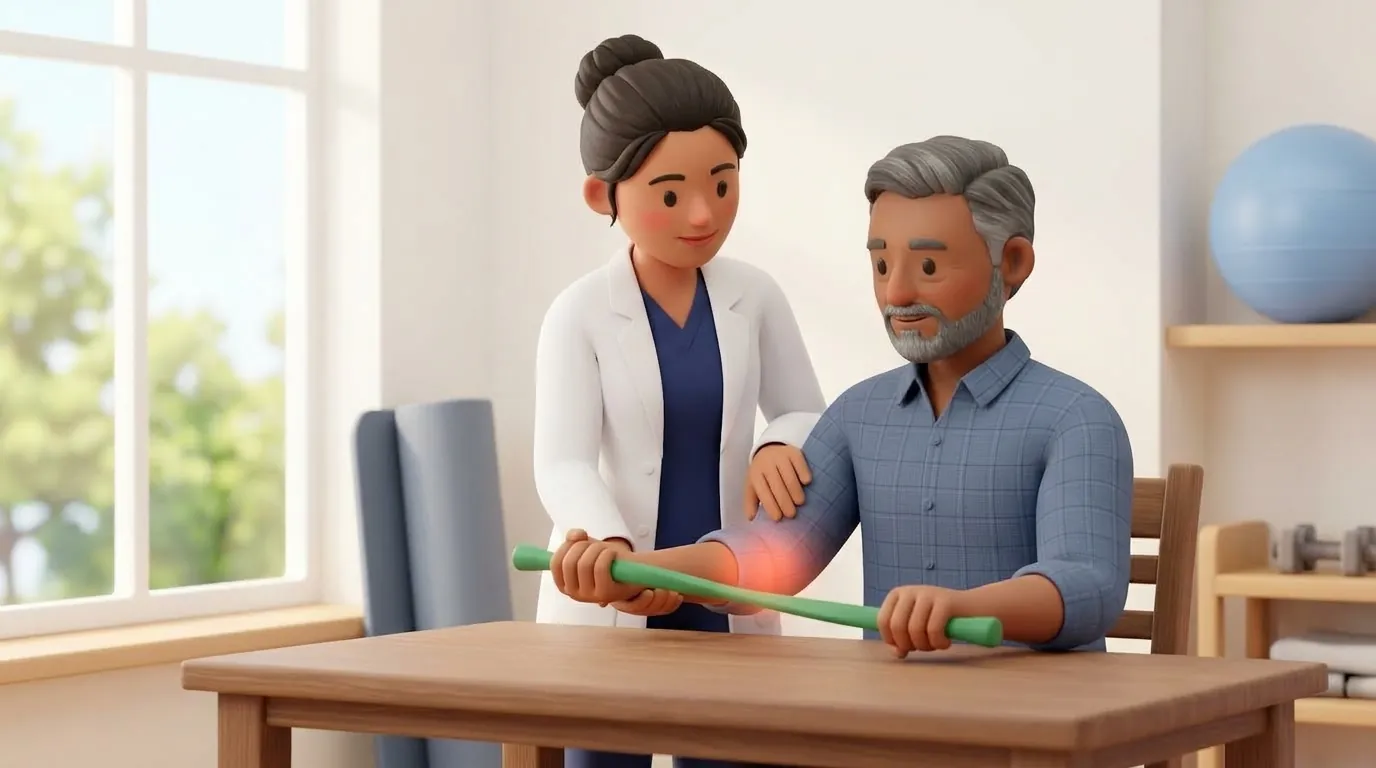
Supported Forearm Pronation and Supination Arc
Objective: Restore distal radioulnar joint rotation while avoiding compressive shear over the volar plate
- 1Sit upright with your elbow tucked comfortably against your ribcage at a clean 90-degree bend.
- 2Hold a light wooden spoon or pen in your hand to provide a clear visual indicator of your forearm angle.
- 3Slowly rotate your forearm so the palm turns completely upward toward the ceiling (supination).
- 4Hold the end supination stretch for 3 seconds, feeling a gentle stretch in the forearm.
- 5Smoothly rotate the forearm downward so the palm faces the floor (pronation), holding for 3 seconds.
| Recovery Phase | Splinting Strategy | Therapeutic Milestones |
|---|---|---|
| Phase 1 (Days 1 to 14) | Volar resting splint; remove for gentle exercise | Immediate finger fist drills, edema control, active wrist flexion-extension |
| Phase 2 (Weeks 3 to 5) | Wean daytime splint; use during crowded travel | Active-assisted supination, scar desensitization, gentle carpal glides |
| Phase 3 (Weeks 6 to 8) | Discharge orthosis for all normal household tasks | Isometric strengthening, therapeutic putty, light domestic chores |
| Phase 4 (Weeks 9+) | No orthotic support required | Full functional loading, progressive resistance, return to sports |
Red Flags and Specialist Escalation
Painful crepitus or loss of active thumb interphalangeal flexion indicates impending or acute rupture of the FPL tendon over a prominent volar plate edge. Severe burning pain, allodynia, or temperature changes in the hand warrant urgent evaluation for early complex regional pain syndrome (CRPS).
Frequently Asked Questions
Why is it difficult to turn my palm up to the ceiling after wrist plating?
Turning your palm up (supination) requires smooth gliding between the two forearm bones. Swelling, tight pronator muscles, and scar tissue after surgery limit this rotation. Targeted exercises help restore this movement safely.
Do I need a doctor referral to start wrist therapy after surgery on BookPhysio.in?
BookPhysio.in does not ask for a doctor referral. Direct access is protected under the NCAHP Act 2021. You book verified physiotherapists and pay directly per session without platform commissions.
Related recovery guides & articles
BookPhysio.in Editorial Team
The BookPhysio.in editorial team writes and maintains this content, checking it against reliable clinical sources. Content follows our medical review policy: general information only, and no page claims a clinical review until a named registered physiotherapist has signed it off.
Read our medical review policy