
Down Syndrome: Generalized Hypotonia and Atlantoaxial Instability Safety
In short
Down syndrome requires specialised physical rehabilitation addressing generalized hypotonia and joint hyperlaxity while maintaining strict atlantoaxial instability safety rails.
In this guide (6 sections)
Down syndrome (Trisomy 21) is the most common genetic chromosomal condition associated with developmental delay and intellectual disability. From a physiotherapy perspective, children with Down syndrome universally exhibit generalized muscular hypotonia (diminished resting muscle tone) combined with ligamentous hyperlaxity throughout all synovial joints. This neuromuscular profile leads to characteristic developmental delays in gross motor milestones such as head holding, independent sitting, crawling, and walking. Moreover, ligamentous laxity at the craniovertebral junction creates a well-documented predisposition to atlantoaxial instability (AAI), where excessive laxity between the atlas (C1) and axis (C2) vertebrae risks spinal cord compression. Physical rehabilitation must carefully balance proactive motor facilitation with strict cervical spine safety precautions.
Domestic and Cultural Indian Realities
In traditional Indian households, children with hypotonia are frequently accommodated by being carried constantly on a parent hip or kept resting in bed for extended periods to protect them from injury. While born of deep familial affection, prolonged carrying deprives the hypotonic child of opportunities to experience active ground reaction forces, engage core trunk stabilisers, and learn dynamic balancing against gravity. Furthermore, traditional gymnastics or playful roughhousing, such as swinging children around by their arms or encouraging vigorous forward somersaults during festive celebrations, pose dangerous risks to hypermobile joints and the vulnerable atlantoaxial joint. Families must be educated on safe, grounded physical play on firm cotton floor mats (dhurries) and guided on sports that promote core strength without compromising cervical stability.
Clinical Biomechanics and Neurological Development
Generalized hypotonia in Down syndrome originates from cerebellar and peripheral nervous system hypo-excitability, accompanied by reduced collagen type VI tensile strength within joint capsules, ligaments, and tendons. Biomechanically, the lack of joint stiffness allows joints to collapse into end-range hypermobility during weight-bearing. In standing and walking, this manifests as extreme genu recurvatum, pes planovalgus with severe midfoot pronation, and an excessively widened base of support. These compensatory strategies help the child balance without expending muscular effort, but they compromise kinetic chain alignment, delay motor milestone acquisition, and cause premature joint degeneration.
Clinical Assessment and Developmental Staging
Assessment utilizes the Gross Motor Function Measure (GMFM-88) specifically modified for Down syndrome, which tracks progression across lying, rolling, crawling, sitting, standing, and walking domains. Hypermobility is scored using the Beighton Scale, where scores of 7 to 9 out of 9 are typical. Clinical screening for atlantoaxial instability (AAI) requires careful neurological examination for signs of cervical myelopathy, including hyperreflexia, Babinski sign, ankle clonus, sudden gait deterioration, neck pain, or changes in bowel or bladder control. Lateral cervical flexion-extension radiographs evaluate the anterior atlantodens interval (ADI); an ADI exceeding 4 to 5 millimetres signifies abnormal instability.
Targeted Rehabilitation and Mobility Exercises
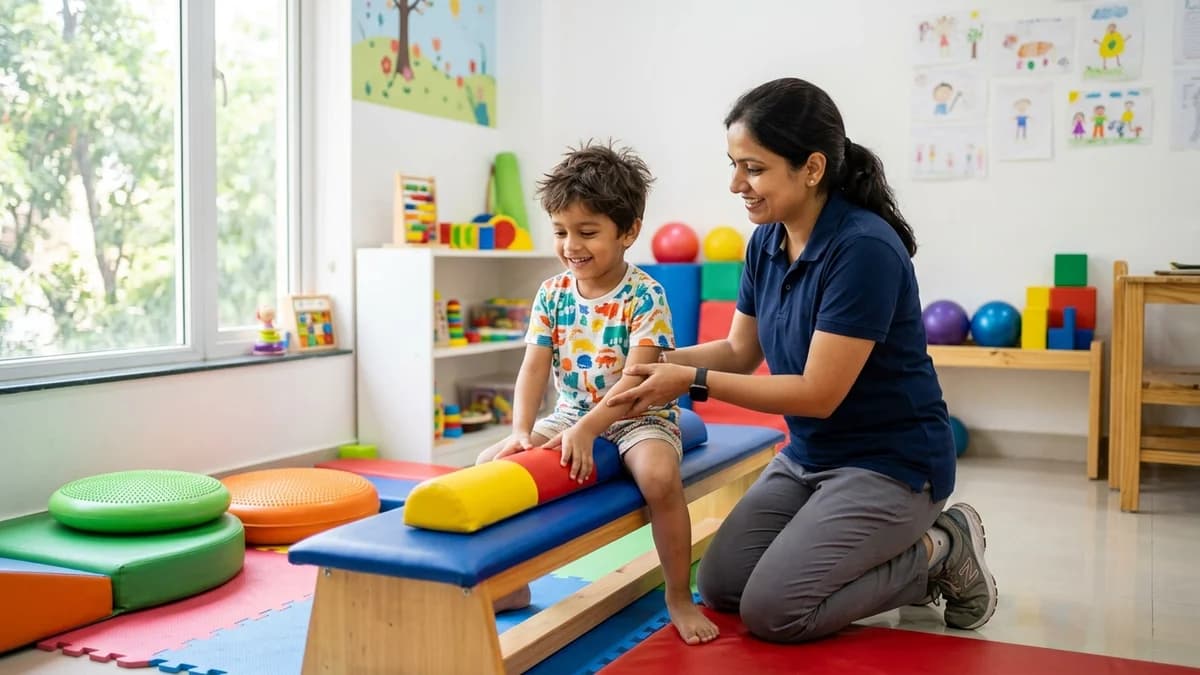
Physiotherapy for Down syndrome emphasizes joint alignment, co-contraction of agonist-antagonist muscle pairs around large joints, and dynamic trunk core strengthening. Treadmill training protocols, initiated as soon as the child can sit independently, have been shown to accelerate the onset of independent walking by several months. Supramalleolar orthoses (SMOs) provide foundational medial-lateral arch support, correcting severe pronation and establishing a stable foot platform.
Bolster Straddle Active Weight-Shift and Core Co-Contraction
Objective: Promote pelvic stability, hip abductor co-activation, and upright trunk posture
- 1Seat the child straddling a firm cylindrical foam bolster with both feet planted flat on the floor.
- 2Ensure the bolster height positions the hips and knees at an approximate 90-degree angle.
- 3Hold a bright interactive toy at eye level directly in front of the child to stimulate active trunk extension.
- 4Gently tilt the bolster slightly from side to side, encouraging the child to engage lateral trunk muscles and maintain balance.
- 5Encourage the child to reach across the midline with one hand while bearing weight firmly through both feet.
| Safety Classification | Recommended Physical Activities | Strictly Contraindicated Activities |
|---|---|---|
| Cervical Spine Safe | Supported treadmill walking, gentle swimming, stationary cycling, low-obstacle crawling courses, and grounded dance | Forward or backward somersaults, tumbling, trampoline jumping, and diving headfirst into pools |
| Joint Alignment Safe | Closed-chain functional squats, bench sit-to-stand transitions, and supramalleolar orthoses (SMOs) for ankle stability | Prolonged W-sitting, extreme passive hamstring overstretching, and pulling forcefully by hands or wrists |
Red Flags and Immediate Specialist Escalation
Immediate escalation to a paediatric spine surgeon or emergency department is mandatory if a child with Down syndrome develops acute neck pain, torticollis, sudden difficulty walking or progressive gait clumsiness, loss of bowel or bladder continence, weakness or numbness in the upper extremities, or hyperactive tendon reflexes. These findings indicate potential atlantoaxial subluxation and spinal cord compression requiring urgent cervical spine immobilisation and MRI imaging.
Frequently Asked Questions
Why should children with Down syndrome avoid trampolines and somersaults?
Due to generalized ligamentous laxity, up to 15 to 20 percent of children with Down syndrome have atlantoaxial instability at the C1-C2 cervical junction. High-impact jarring or axial compression from trampolines and somersaults risks catastrophic spinal cord compression.
How do Supramalleolar Orthoses (SMOs) help children with Down syndrome walk?
SMOs are lightweight, flexible ankle braces that cup the heel and support the arches without restricting forward ankle movement. They stabilize severe foot pronation, providing a solid, stable foundation that accelerates independent standing and walking.
Related recovery guides & articles
BookPhysio.in Editorial Team
The BookPhysio.in editorial team writes and maintains this content, checking it against reliable clinical sources. Content follows our medical review policy: general information only, and no page claims a clinical review until a named registered physiotherapist has signed it off.
Read our medical review policy