
Dynamic Balance and Fall Risk Mitigation in Elderly Rheumatoid Arthritis
In short
Chronic rheumatoid joint destruction, foot deformities, and secondary muscle wasting combine to triple fall risks in older adults. Master multi-sensory balance retraining, reactive stepping strategies, and domestic fall mitigation.
In this guide (6 sections)
In older adults with chronic rheumatoid arthritis, the risk of accidental falls is more than three times higher than in age-matched healthy peers. Articular cartilage destruction, joint instability, hindfoot valgus collapse, and claw toe deformities impair the mechanoreceptive sensory feedback typically provided by capsular Ruffini and Pacinian endings. Compounding this peripheral sensory deficit is disuse muscle atrophy, corticosteroid-induced sarcopenia, and impaired central reactive postural stepping. In an individual with concurrent glucocorticoid-induced osteoporosis, even a minor low-velocity fall from standing height frequently results in catastrophic hip, vertebral, or distal radius fractures. Establishing a structured dynamic balance and fall-mitigation programme is essential to preserve mobility and longevity.
Domestic and Cultural Indian Realities
In Indian residential homes, domestic environments contain multiple unrecognized fall hazards for elderly arthritic individuals. Smooth, polished marble and mosaic tile floors become dangerously slick when wet after morning cleaning. Stepping into wet bathrooms with ground squat commodes, navigating high stone thresholds (dehliz) between rooms, and walking in dimly lit corridors during night-time bathroom visits are major triggers for falls. Furthermore, elderly individuals frequently wear loose, ill-fitting cotton clothing (such as flowing dhotis or saree pleats) that can catch on furniture corners. Families must install non-slip silicone strips in bathrooms, sereverse all loose scatter rugs, mount sturdy grab rails beside toilets, provide motion-sensor night lights, and ensure supportive footwear is worn indoors.
Clinical Biomechanics and Inflammatory Pathology
Postural control relies on the integration of three sensory systems: somatosensory (proprioception), visual, and vestibular inputs, processed by the cerebellum to generate motor responses via the ankle, hip, and stepping strategies. In rheumatoid arthritis, chronic synovial inflammation damages intra-articular mechanoreceptors, blunting joint position sense. When standing sway occurs, the delayed somatosensory signal impairs rapid gastrocnemius-soleus reflex firing (the ankle strategy). The patient must over-rely on the hip strategy or take an emergency reactive step. However, if hip abductor strength (gluteus medius) is degraded by disuse, the reactive step is slow and uncoordinated, leading to a fall. Balance rehabilitation systematically recalibrates visual and vestibular compensation while strengthening lower-limb anti-gravity musculature.
Clinical Assessment and Functional Staging
Structured fall risk assessment utilizes validated functional instruments, including the Berg Balance Scale (BBS), the Timed Up and Go (TUG) test, and the 4-Stage Balance Test (feet together, semi-tandem, full tandem, and single-leg stance). A TUG score of 13.5 seconds or greater indicates high fall risk. Clinicians evaluate sensory reliance using the Clinical Test of Sensory Interaction in Balance (CTSIB) and measure lower extremity strength using the 30-Second Chair Stand test. Joint proprioception is quantified by testing passive joint repositioning accuracy at the knee and ankle.
Targeted Mobility and Joint Preservation Exercises
Balance training must be progressive, conducted in safe environments with sturdy support nearby, moving from static narrow bases of support to dynamic perturbation training.
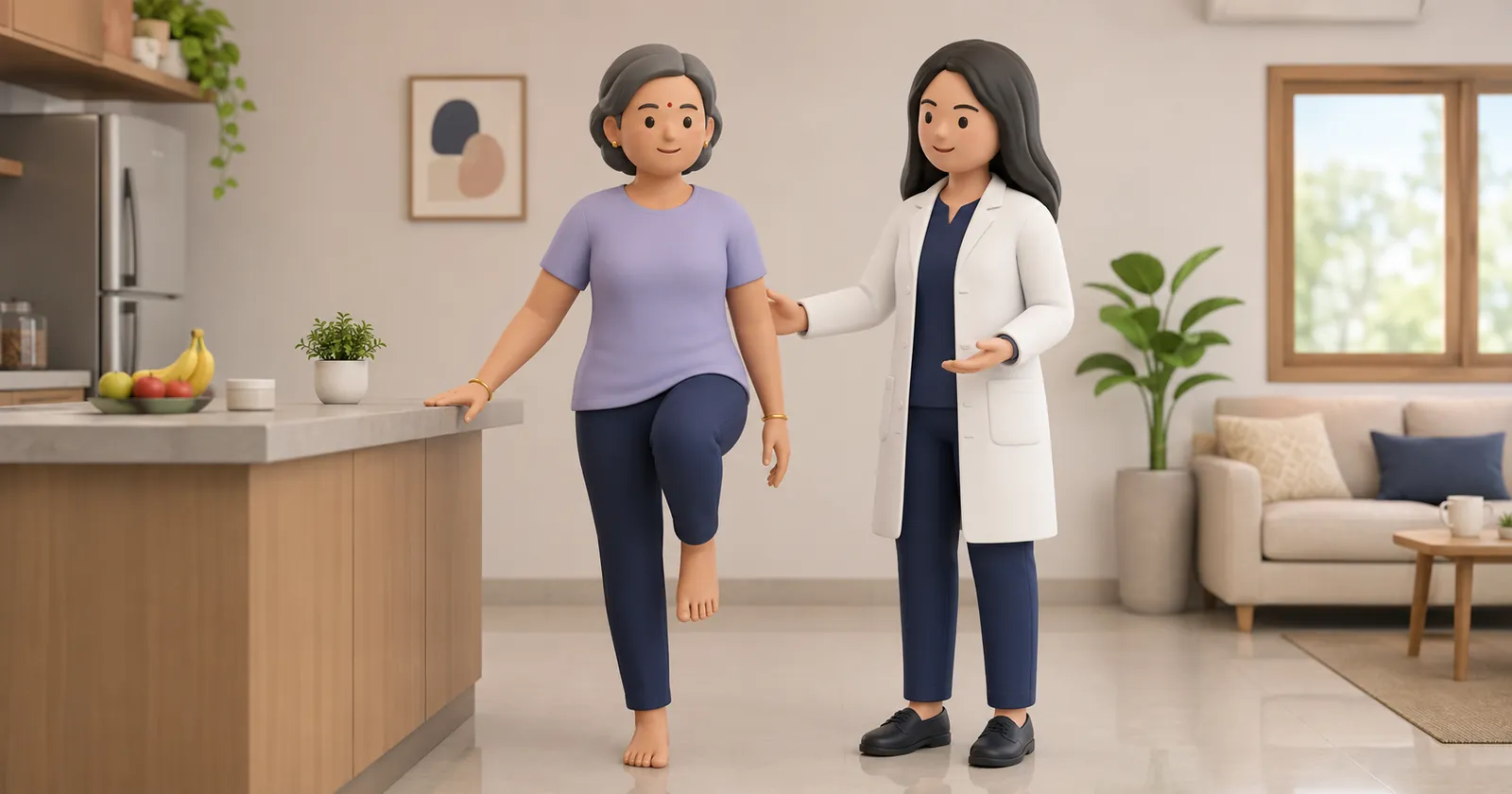
Supported Semi-Tandem Stance with Visual Saccades
Objective: Challenge somatosensory and vestibular balance control safely to reduce fall risk
- 1Stand in a corner of a room or beside a sturdy kitchen counter, resting your fingertips lightly on the surface for safety.
- 2Place the instep of one foot directly against the big toe of the opposite foot (semi-tandem stance).
- 3Distribute your body weight evenly across both feet, standing tall with shoulders relaxed and abdominal muscles engaged.
- 4While maintaining balance, gently turn your head smoothly from left to right across the room for 20 seconds, using hand support if sway occurs.
| Domestic Hazard | Safe Environmental Modification | High-Risk Unmodified Hazard |
|---|---|---|
| Bathroom Flooring | Anti-skid textured tiles with silicone non-slip drainage mats and floor-mounted grab rails | Polished marble or mosaic floor wet from bucket baths with zero wall support |
| Doorway Thresholds | Beveled transition ramps smoothing high stone thresholds (dehliz) between rooms | Raised 2 to 3 inch unpainted stone sills causing catching of shuffling toes |
| Night-Time Lighting | Plug-in automatic motion-sensor LED nightlights illuminating path from bed to bathroom | Navigating dark corridors and unfamiliar spaces in pitch darkness to avoid waking family |
| Indoor Footwear | Supportive indoor slippers with non-slip rubber outsoles and sereverse heel straps | Barefoot walking on cold slick tiles, or wearing loose worn-out backless slip-ons |
Red Flags and Immediate Rheumatology Escalation
If an elderly patient experiences sudden unprovoked falls without slipping or tripping (drop attacks), immediate medical evaluation is mandatory to rule out cardiac arrhythmias, transient ischemic attacks, or severe cervical spine instability with cord compression. Following any fall, acute inability to bear weight, severe groin pain, or external rotation and shortening of a leg indicates an acute femoral neck fracture, requiring emergency hospital transport.
Frequently Asked Questions
Can balance exercises reverse joint deformities in elderly rheumatoid arthritis?
No. Balance exercises cannot reverse established joint subluxation or cartilage loss. However, balance retraining helps manage morning stiffness, strengthens stabilizing muscles, sharpens sensory coordination, and significantly lowers the risk of devastating accidental falls and fractures.
How do I arrange a home fall risk and mobility assessment for my parents via BookPhysio.in?
Under the National Commission for Allied and Healthcare Professions (NCAHP) Act 2021, Indian patients enjoy direct access to registered physiotherapists without an obligatory doctor referral. On BookPhysio.in, you schedule an appointment with a verified home-care clinician in your city. Payment is made directly to the therapist at your home appointment via cash or UPI; BookPhysio.in does not process booking fees online.
Related recovery guides & articles
BookPhysio.in Editorial Team
The BookPhysio.in editorial team writes and maintains this content, checking it against reliable clinical sources. Content follows our medical review policy: general information only, and no page claims a clinical review until a named registered physiotherapist has signed it off.
Read our medical review policy