
Athletic Incontinence: High-Impact Leaks, Intra-Abdominal Pressure in Indian Sportswomen
In short
Leaking urine during badminton smashes, distance running, or box jumps is common among female athletes. Learn why elite core strength does not guarantee continence.
In this guide (6 sections)
Urinary incontinence among competitive female athletes is a widespread, unaddressed challenge across India's sporting community. High-impact sports that involve rapid jumping, sudden deceleration, and overhead lunging, such as badminton, volleyball, kabaddi, gymnastics, and distance running, exhibit urinary leakage prevalence rates between 30 and 60 percent, even among nulliparous teenage and collegiate athletes. Many Indian sportswomen assume that having visible 'six-pack' rectus abdominis muscles means their pelvic floor is equally resilient. In reality, intense superficial core bracing without dynamic pelvic floor compliance creates extreme intra-abdominal pressure spikes that overpower the urethral sphincter. Sports pelvic physiotherapy restores functional elasticity and dynamic continence.
1. Functional Biomechanics: The Pelvic Floor Trampoline and Impact Loading
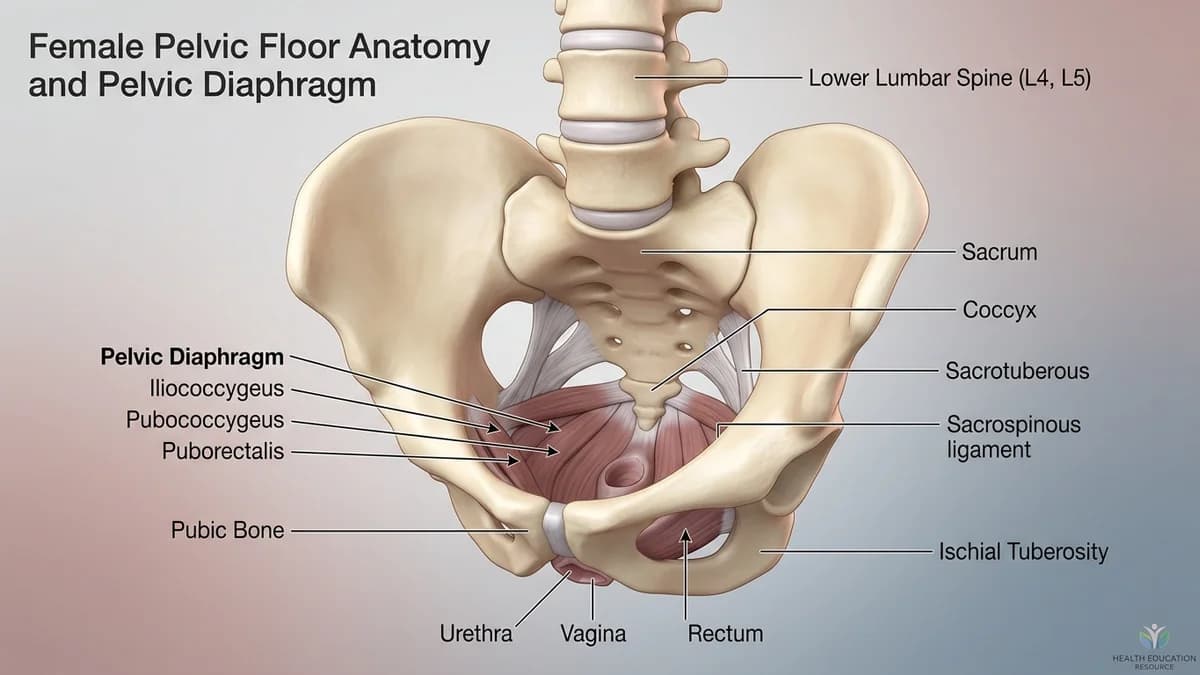
The pelvic floor does not function as an immovable, rigid floor; it operates as a dynamic, elastic trampoline that must stretch eccentrically to absorb impact before recoiling cranially. When an athlete lands from a high badminton jump smash, ground reaction forces combine with sudden abdominal muscle recruitment to generate intra-abdominal pressure spikes exceeding 120 mm Hg. If the levator ani is hypertonic and stiff from constant athletic core bracing, it lacks the elastic compliance needed to absorb shock. Conversely, if it is deconditioned or exhibits delayed reflex timing, intra-vesical pressure instantly exceeds urethral closure pressure, causing involuntary leakage on landing.
2. Domestic Indian Context: Daily Chores, Ergonomics, and Privacy
In Indian sports culture, athletes often train under intense competitive pressure from coaches, sports academies, and families. Discussing urinary leaks during practice matches is considered taboo, leading many young women to wear dark leggings or sanitary pads secretly during tournaments, restrict water intake before matches (causing dehydration and cramping), or quit competitive sports prematurely. In addition, coaching staff rarely receive education regarding pelvic health or energy availability in female athletes (Relative Energy Deficiency in Sport, RED-S). Physiotherapists educate athletes and coaches on pelvic coordination, pre-impact breathing strategies, and pelvic floor periodisation.
3. Clinical Special Tests and Physical Examination
Evaluation includes sport-specific drop-jump testing, assessing whether urinary leakage occurs during repeated single-leg hops or depth landings. Clinical examination evaluates resting pelvic tone, Oxford scale contraction speed, and uses transabdominal real-time ultrasound to assess bladder base displacement during simulated athletic lunges.
| Clinical Feature | Hypertonic / Overactive Pelvic Floor | Hypotonic / Underactive Pelvic Floor | Physiotherapy Target |
|---|---|---|---|
| Athlete Typology | Elite gymnasts, sprinters, crossfitters | Postpartum runners, hypermobile athletes | Differentiation guides exercise choice |
| Muscle Characteristic | Chronically clenched, rigid, non-compliant | Stretched, delayed firing, low peak power | Down-train elasticity vs power training |
| Leakage Trigger | Impact forces hit rigid, unyielding wall | Sphincter overwhelmed by light exertion | Shock absorption vs sphincter hypertrophy |
| Primary Intervention | Eccentric release, diaphragmatic drops | Fast-twitch strengthening, 'The Knack' | Tailored sport-specific motor coordination |
4. Stage-by-Stage Functional Physiotherapy Protocol
Rehabilitation progresses from isolated pelvic floor coordination to high-velocity impact absorption and sport-specific plyometric integration.
Phase 1: Dynamic Squat Landing with Expiratory Pelvic Pre-Activation
Objective: Coordinate anticipatory pelvic floor pre-contraction with knee and hip flexion to dissipate impact forces.
- 1Stand tall with feet shoulder-width apart.
- 2Rise onto the balls of your feet, taking an inhale.
- 3Quickly drop down into a 45-degree athletic quarter-squat as if landing from a jump, exhaling sharply with an open 'shhh' sound.
- 4Simultaneously engage and lift your pelvic floor upward as your heels touch down.
- 5Hold the stable athletic stance for 2 seconds, verifying complete continence, then stand up reset.
Phase 2: Lateral Lunge with Reactive Pelvic Floor Catch
Objective: Build multi-planar pelvic floor stability during rapid change-of-direction movements like badminton court footwork.
- 1Stand with feet together and hands on hips.
- 2Take a wide step to your right, bending your right knee into a deep side lunge while keeping your left leg straight.
- 3As you push off your right foot to return to the centre, exhale and contract your pelvic floor.
- 4Land balanced in the centre without wobbling.
- 5Alternate smoothly between left and right sides.
Phase 3: High-Velocity Depth Jump Landings with Pelvic Elastic Recoil
Objective: Train eccentric muscle compliance under high ground reaction forces.
- 1Stand on a low 15-centimetre gym step or platform.
- 2Step forward off the step with one foot (do not jump up), landing softly on both feet on the floor.
- 3Absorb the landing by flexing your ankles, knees, and hips, exhaling smoothly through open lips.
- 4Focus on the feeling of your pelvic floor catching and absorbing the impact like an elastic trampoline.
- 5Step back onto the platform and rest for 15 seconds before the next repetition.
Seek medical consultation promptly if you experience: visible blood in your urine after endurance training (exercise-induced hematuria), severe unremitting pubic bone pain (suggesting a pubic stress fracture or osteitis pubis), sudden loss of bowel control, or recurrent stress fractures accompanied by amenorrhea (cessation of menstrual periods).
5. Clinic Consultation, Home Visits, and Transparent Fee Benchmarks
Under the National Commission for Allied and Healthcare Professions (NCAHP) Act 2021, patients in India can consult a registered sports and pelvic health physiotherapist directly without an upfront referral, though BookPhysio.in does not ask for one. Sports pelvic physiotherapists utilize high-speed video capture and force plate analysis in modern sports clinics. Consultation fees in Indian metropolitan areas range between ₹500 and ₹1,500, with specialized sports screenings ranging from ₹700 to ₹2,000. Athletes pay their physiotherapist directly at each consultation, with zero platform commission.
6. Frequently Asked Questions
Can an elite female athlete with strong abs have weak pelvic floor muscles?
Yes. Strong abdominal muscles do not automatically mean your pelvic floor is functioning correctly. If your pelvic floor muscles are hypertonic, stiff, or fail to contract with correct timing when you land from a jump, high intra-abdominal pressure will force urine through the urethral sphincter despite strong superficial abs.
Is wearing a tampon or menstrual cup safe to help prevent sports urine leaks?
Some female athletes use a large tampon or silicone pessary as an internal mechanical support against the anterior vaginal wall to support the bladder neck during competition. While helpful as a temporary stopgap, it does not correct the underlying muscle coordination deficit, which requires targeted pelvic physiotherapy.
Related recovery guides & articles
BookPhysio.in Editorial Team
The BookPhysio.in editorial team writes and maintains this content, checking it against reliable clinical sources. Content follows our medical review policy: general information only, and no page claims a clinical review until a named registered physiotherapist has signed it off.
Read our medical review policy