
Safe Floor-to-Standing Transfers in Diabetes: Protecting Insensate Toes and Joints
In short
Rising from the floor can drag and scrape insensate toes against hard tiles, causing severe friction ulcers. Learn structured floor-to-standing transfer techniques.
In this guide (6 sections)
Floor-to-standing transfers represent a complex, high-demand functional mobility task frequently performed in Indian domestic environments. Whether rising after floor-level chores, family gatherings, or spiritual rituals, transitioning from the floor to standing requires coordinated lower-extremity strength, joint mobility, and dynamic balance. In individuals with diabetic peripheral neuropathy, impaired proprioception and quadriceps weakness often lead to unsafe transfer strategies. A common dangerous pattern involves tucking the toes backward and dragging them forcefully across hard, unyielding tile or marble floors, stripping the delicate skin off the dorsal toe apices. Structured half-kneeling transfer protocols using sturdy intermediate furniture protect insensate digits and prevent fall injuries.
Domestic and Cultural Indian Realities
In Indian households, daily activities frequently place individuals on the floor: sorting lentils, rolling chapatis, folding laundry, or performing daily prayers. When an older adult attempts to stand up from the floor, proximal muscle weakness makes pushing directly upward difficult. Consequently, patients often roll onto their knees, curl their insensate toes tightly under their body, and scrape their feet backward across rough marble or mosaic tiles to push upward. Because neuropathy silences pain, the patient does not feel the sharp floor friction sanding off the skin over the first metatarsal head and toe tips. By evening, the toe tips are raw, weeping serous fluid, and primed for deep infection. Patients must be taught the four-point half-kneeling transfer method using a sturdy wooden chair.
Clinical Biomechanics and Neuropathic Breakdown
Rising from the floor requires generating a vertical ground reaction force exceeding 120 percent of body weight while stabilizing three lower limb joint axes simultaneously. When a patient lacks quadriceps eccentric strength and ankle proprioception, they rely on excessive toe dragging to stabilize their base of support. Dragging a curled toe across hard tile generates immense horizontal shear stress (shear vectors exceeding 250 kPa). In diabetic skin compromised by autonomic anhidrosis, the stratum corneum tears easily from underlying papillary dermis, producing large friction blisters and dorsal abrasions. The half-kneeling transfer eliminates toe dragging by keeping the lead foot planted flat on the floor, transmitting vertical forces through the heel and midfoot rather than curled digits.
Clinical Assessment and Neuropathy Screening
Assessment begins with observing the patient natural floor-to-standing transfer strategy in a safe, padded physiotherapy gym. The clinician evaluates lower extremity strength (particularly quadriceps, gluteus maximus, and gastrocnemius), hip extension range, and the presence of knee joint pain or crepitus. Sensation is mapped with 10g monofilaments across all toes and metatarsal heads. The dorsal toe apices are examined carefully for calluses, abrasions, or subungual bleeding caused by past toe dragging.
Targeted Offloading and Intrinsic Foot Conditioning
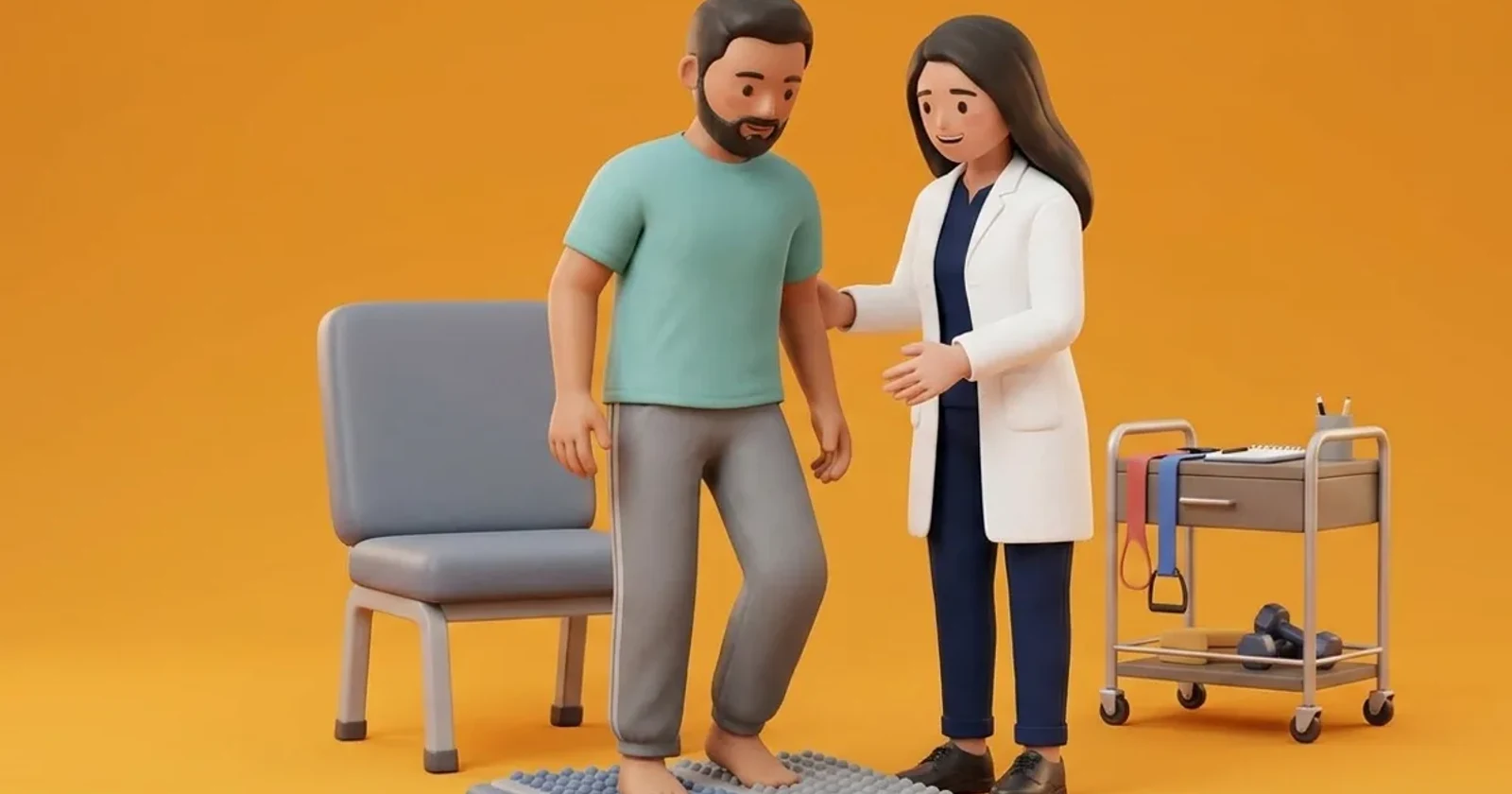
Physiotherapy rehabilitation teaches a structured four-stage transfer: moving from floor sitting to all-fours (hands and knees on a cushioned mat), advancing a strong lead leg forward so the foot rests completely flat on the floor (half-kneeling position), placing both hands securely on a heavy armchair, and pushing smoothly upward through the flat lead heel. Strengthening exercises target the quadriceps, gluteals, and core to build the mechanical power required for clean vertical rising.
Supported Chair-Assisted Half-Kneeling Rise Drill
Objective: Practice vertical rising mechanics while keeping toes flat and protected from floor scrape
- 1Place a thick foam cushion on the floor directly in front of a heavy, stable dining chair.
- 2Kneel on the cushion with both knees, resting both hands firmly on the chair seat.
- 3Bring your stronger foot forward, placing the entire sole flat on the floor ahead of you, knee bent at 90 degrees.
- 4Confirm that your front toes are relaxed and completely flat, not curled or dragging.
- 5Push downward through your hands and your front heel simultaneously, rising smoothly to a standing position.
- 6Stand tall, steady your balance, and breathe calmly.
| Transfer Stage | Safe Clinically Approved Method | Hazardous Habit to Avoid |
|---|---|---|
| Preparation & Equipment | Use sturdy, non-slip armchair as intermediate support; cushioned mat | Attempting to rise in open space without furniture support |
| Transition to Half-Kneeling | Bring lead foot forward with sole completely flat on the ground | Tucking toes backward and curling them tightly under body weight |
| Ascent to Standing | Push through palms on chair and lead heel; vertical trajectory | Scraping and dragging toes backward across hard marble tiles |
| Postural Stabilization | Pause and establish balance holding chair before stepping away | Rushing to walk immediately while dizzy or off-balance |
Red Flags and Urgent Diabetic Foot Escalation
Immediate medical escalation is necessary if a transfer results in an open skin tear, bleeding toe tips, or an inability to bear weight on a joint following a stumble. Signs of deep infection include spreading redness over the toes, throbbing swelling, or fever. Immediate clinical evaluation prevents minor floor scrapes from escalating into deep space infections.
Frequently Asked Questions
Why do my toe tips get raw and red after I get up from the floor?
When you stand up from the floor, you may be curling your toes backward and dragging them across the hard floor to push yourself up. Because diabetic neuropathy numbs your toes, you do not feel the floor scraping your skin off. Learning to push up with your foot flat on the floor protects your toes completely.
What if I am not strong enough to get up from the floor using a chair?
If muscle weakness prevents you from rising safely using a chair, you should minimize floor activities and perform tasks at a table or bed height instead. A physiotherapist can prescribe targeted leg-strengthening exercises to rebuild the necessary strength.
Related recovery guides & articles
BookPhysio.in Editorial Team
The BookPhysio.in editorial team writes and maintains this content, checking it against reliable clinical sources. Content follows our medical review policy: general information only, and no page claims a clinical review until a named registered physiotherapist has signed it off.
Read our medical review policy