
Gross Motor Milestones: Helping Babies Who Are Slow to Roll, Sit, Crawl, or Walk
In short
If your baby is slow to sit, crawl, or walk, early intervention physiotherapy unlocks developmental progress through purposeful play and posture cues.
In this guide (5 sections)
Watching an infant achieve gross motor milestones: lifting the head, rolling, sitting independently, crawling on all fours, and taking those first triumphant steps: is one of the greatest joys of early parenthood. However, when a baby seems slow to meet these milestones, parents often experience profound anxiety. In India, well-meaning family elders frequently dismiss delays with cultural reassurances such as "boys always walk late" or "he is just chubby, he will manage on his own." While every child develops at an individual pace, significant motor delays warrant early evaluation by a paediatric physiotherapist.
The infant brain possesses unprecedented neuroplasticity during the first twelve to eighteen months of life. Gross motor development follows an orderly cephalocaudal (head-to-toe) and proximodistal (core-to-extremities) sequence. Waiting passively for a delayed infant to "catch up" without intervention misses the most fertile window for neurological motor programming. Early intervention physiotherapy uses neurodevelopmental facilitation, sensory enrichment, and purposeful play to help babies master foundational movement patterns.
1. Developmental Windows: Normal Ranges vs Clinically Significant Delays
Motor milestones are not rigid deadlines; they are developmental windows with well-established statistical ranges. When evaluating milestones, clinicians always calculate the infant's adjusted age for babies born preterm (prior to 37 weeks of gestation) by subtracting the number of premature weeks from the chronological age until two years of age.
A child is considered to have a motor delay when they fail to achieve a milestone by the upper limit of the expected window, or when the quality of movement: such as asymmetry, stiffness, or excessive floppiness: is atypical.
| Motor Milestone | Typical Age Range | Clinical Evaluation Threshold | Underlying Neurological Skill |
|---|---|---|---|
| Head Control in Prone | 2 to 4 months of age | Not lifting head 45 degrees by 4 months | Cervical extensor strength, labyrinthine righting reflex |
| Rolling (Back to Tummy) | 4 to 6 months of age | Not rolling in either direction by 7 months | Core rotation, trunk dissociation, asymmetrical tonic reflex integration |
| Independent Sitting | 6 to 8 months of age | Not sitting without hand support by 9 months | Pelvic stability, protective extensor parachute reactions |
| Reciprocal Crawling | 8 to 10 months of age | Not moving or bottom-scooting by 11 months | Cross-lateral coordination, shoulder girdle weight-bearing |
| Independent Walking | 11 to 15 months of age | Not taking independent steps by 18 months | Dynamic equilibrium, ankle balance strategies, upright propulsion |
2. Indian Parenting Practices: Walkers, Swaddling, and Tummy Time Gaps
Certain traditional child-rearing habits in Indian homes inadvertently delay gross motor milestone achievement. The widespread use of circular baby walkers (ghodagadi) is a prime example. Placing an infant in a walker props them up before their trunk and pelvis have developed the muscular strength to support upright posture. Walkers encourage babies to propel themselves forward on tiptoes, which shortens the Achilles tendon and eliminates the critical crawling phase.
Similarly, fear of an infant crying during tummy time leads many parents to keep babies exclusively on their backs in soft mattresses or cradles (jhulas). Tummy time is the foundational gym for an infant: it strengthens the neck, back extensors, shoulder girdles, and abdominal core. Without regular daily tummy time, crawling and independent sitting are almost always delayed.
3. Three-Phase Early Intervention Play Protocol
Paediatric physiotherapy transforms milestone facilitation into enjoyable, bonding play routines that parents can easily practice at home.
Three-Phase Motor Milestone Facilitation Protocol
Objective: Strengthen axial trunk control, facilitate cross-lateral transitional movements, and promote confident standing and walking.
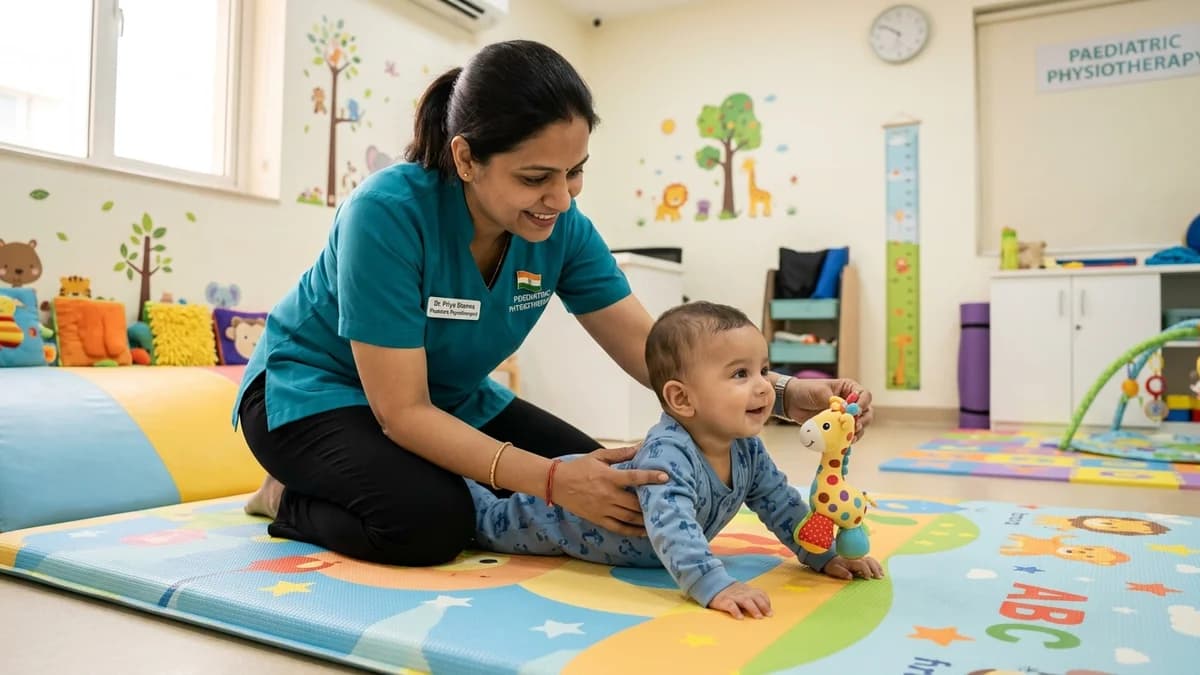
- 1Phase 1 (Tummy Time Mastery and Propped Weight Bearing): If your baby dislikes flat tummy time, start with chest-to-chest positioning while reclining on a sofa. Progress to placing a rolled-up cotton towel or nursing pillow under the baby's chest so their elbows rest on the floor at a 90-degree angle. Place high-contrast toys or a non-breakable mirror at eye level. Aim for 5 to 10 minutes, 3 to 4 times daily.
- 2Phase 2 (Facilitated Rolling and Side-Sitting Transitions): Encourage trunk rotation by placing a favorite toy just out of reach to the side. Gently guide the opposite hip and leg across the midline, allowing the baby's torso to follow naturally into a roll. To facilitate sitting, practice supported side-sitting over your thigh, encouraging the baby to prop weight on one open hand while playing with the other hand.
- 3Phase 3 (Four-Point Kneeling and Cruising Exploration): Encourage four-point creeping by placing the baby on their hands and knees over your outstretched leg. Once pulled to stand, place appealing snacks or musical toys on a low coffee table just beyond arm's reach, encouraging the toddler to cruise sideways along the furniture to build hip abductor strength.
- 4Clinical Cue: Allow babies to explore barefoot on firm floor surfaces (such as clean tiles, wooden floors, or firm foam mats). Bare feet provide rich sensory tactile feedback from the floor that rigid shoes suppress.
4. Red Flags Demanding Prompt Paediatric Neurological Evaluation
While minor milestone variations are common, certain signs indicate possible underlying neurological conditions (such as Cerebral Palsy, Spinal Muscular Atrophy, or congenital muscular disorders) requiring urgent medical evaluation. Red flags include a baby feeling abnormally stiff with legs crossing like scissors when held upright, feeling excessively floppy like a "ragdoll" with poor head control beyond 4 months, early hand preference before 12 months (which suggests weakness in the non-preferred hand), or any loss of previously acquired motor skills.
Frequently Asked Questions
Is it true that baby walkers help infants learn to walk faster?
No. Paediatric associations worldwide strongly discourage baby walkers. Walkers do not teach walking; instead, they delay independent walking by allowing babies to glide across the room without using core balance muscles. Furthermore, walkers promote toe-walking and present significant safety hazards, including tipping over stairs or reaching hot kitchen surfaces.
Does skipping the crawling phase harm a child's development?
While some babies transition directly from bottom-scooting to walking and develop normally, crawling on hands and knees is clinically valuable. Crawling integrates cross-lateral bilateral brain hemisphere communication, strengthens the shoulder girdles and wrist arches needed later for handwriting, and refines binocular visual depth perception.
My 14-month-old stands when holding hands but refuses to let go. What should I do?
This is very common and typically reflects a temporary balance confidence barrier rather than muscle weakness. Encourage the child to hold onto a push-wagon or heavy laundry basket that provides moving support. Practice standing while holding a small toy in each hand: having both hands occupied encourages the child to balance using their feet without realizing they are standing unsupported.
How do I know if my baby is just lazy or genuinely delayed?
Babies are biologically wired to explore their environment and are never simply "lazy." When an infant avoids rolling, crawling, or pulling up, it usually indicates underlying motor challenges such as low muscle tone (hypotonia), weak core stabilizers, joint stiffness, or tactile sensory aversion. A paediatric physiotherapy assessment clarifies the exact reason.
How does BookPhysio.in support families with developmentally delayed toddlers?
BookPhysio.in connects parents across India with certified paediatric physiotherapists specializing in early intervention. Clinicians provide home visits (₹600 to ₹2,000) or clinic sessions (₹400 to ₹1,500), assessing motor development in the child's familiar home environment with transparent per-visit pricing and zero platform commission.
Related condition guides


BookPhysio.in Editorial Team
The BookPhysio.in editorial team writes and maintains this content, checking it against reliable clinical sources. Content follows our medical review policy: general information only, and no page claims a clinical review until a named registered physiotherapist has signed it off.
Read our medical review policy