
Construction Head-Load Carrying: Gamela Cervical Shear Mechanics
In short
Construction labourers carry 25 to 40 kg shallow iron pans (taslas) on their heads daily. Learn clinical rehabilitation to manage cervical disc compression.
In this guide (6 sections)
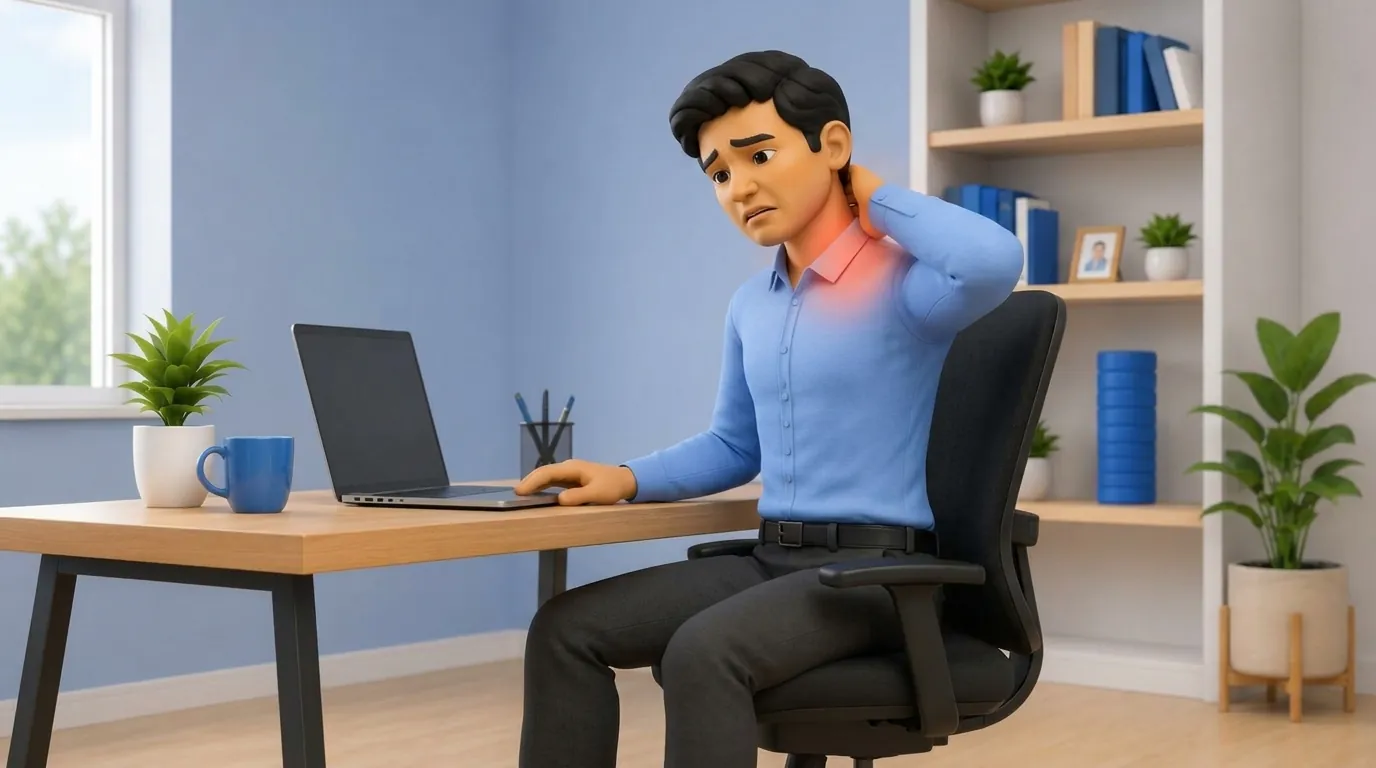
Manual material handling on Indian building sites relies heavily on head-load carrying by male and female construction labourers. Workers hoist shallow iron pans called gamelas or taslas filled with wet mortar, concrete, sand, or bricks weighing between 20 and 40 kilograms directly onto their heads. The load balances on a rolled cloth ring (chunni or bita). This vertical axial loading compresses the cervical intervertebral discs, reverses the natural cervical lordosis, and generates destructive shear stresses that accelerate premature cervical spondylosis and disc herniation.
Domestic and Cultural Indian Realities
Across active construction sites in Delhi NCR, Mumbai, and Bengaluru, head-load transport is considered the fastest method to move wet concrete up temporary bamboo scaffolding and narrow stairways. Workers balance heavy taslas while climbing ladders without handrail support. Hoisting the pan requires a forceful deadlift from ground level onto the head, often performed with a rounded lumbar spine. Labourers endure neck soreness and scalp tenderness daily, relying on evening rest to recover before repeating the process the following morning.
Clinical Biomechanics and Occupational Overuse
Placing a 30-kilogram weight on the skull vertex multiplies physiological compressive forces across the cervical motion segments by five times. To prevent the pan from toppling, the sternocleidomastoid, upper trapezius, and scalene muscles fire in continuous isometric co-contraction. This continuous loading occludes local capillary beds, creating painful ischemic trigger points. Dynamic walking induces vertical oscillatory shear forces that flatten the shock-absorbing cervical lordosis, driving the nucleus pulposus into the spinal canal.
Workplace Ergonomic Assessment and Postural Metrics
Clinical assessment incorporates cervical spine range of motion measurement using an inclinometer, cervical compression and distraction testing, and dermatomal sensory mapping of C5 to T1. Postural analysis identifies loss of cervical lordosis, rounded shoulders, and anterior pelvic tilt. Functional movement screening highlights compensatory thoracic and lumbar hyperextension during load hoisting.
Targeted Workplace Conditioning and Stretching Protocols
Ergonomic interventions advocate the use of dual-handled wheelbarrows, mechanical hoists, and dividing loads into smaller batches not exceeding 15 kilograms. When head loading remains unavoidable, introducing a thick, high-density closed-cell foam pad beneath the cloth ring dampens peak shockwaves. Conditioning routines focus on deep neck flexor strengthening and thoracic spine extension mobilization.
Deep Neck Flexor Isometric Stabilization with Towel Support
Objective: Strengthen the longus colli and stabilize cervical lordosis under axial loading
- 1Stand tall with your back against a flat wall, heels placed 4 inches forward.
- 2Place a small rolled towel behind the natural curve of your neck.
- 3Gently glide your head backward to flatten the towel against the wall without tilting your chin up.
- 4Hold the backward press for 6 seconds while breathing calmly.
- 5Relax smoothly forward to the starting position without poking your chin out.
| Spinal Region | Occupational Mechanical Trauma | Ergonomic and Clinical Solution |
|---|---|---|
| Cervical Spine (C4-C7) | Axial disc flattening and osteophyte compression of nerve roots | Limit unit load to 15 kg and use shock-absorbing foam head pads |
| Trapezius and Scalenes | Ischemic muscle spasm from continuous balancing co-contraction | Deep trigger point release and active upper trapezius stretching |
| Lumbosacral Junction | High compressive load during ground-to-head tasla hoisting | Train squat-lifting mechanics and implement two-person loading |
| Lower Extremity Joints | Knee and ankle shock loading during stair ascent with heavy pans | Use mechanical hoists for vertical floor transport |
Red Flags and Specialist Escalation
Development of electrical shooting pain radiating down both arms, numbness in the fingertips, clumsiness in handling objects, or an unsteady, spastic gait indicates progressive cervical spondylotic myelopathy requiring urgent neurosurgical evaluation and decompressive imaging.
Frequently Asked Questions
Can physiotherapy prevent spinal damage from carrying heavy head loads?
Physiotherapy aims to relieve repetitive strain and restore functional capacity through deep neck flexor conditioning, spinal decompression exercises, and ergonomic load-reduction strategies. Strengthening core and postural muscles provides better support for the cervical spine.
Do I need a doctor referral to see a physiotherapist for neck pain in India?
Under the National Commission for Allied and Healthcare Professions (NCAHP) Act 2021, patients in India enjoy direct access to registered physiotherapists without requiring a mandatory prior medical referral. At BookPhysio.in, you consult verified physiotherapists and pay directly per session without hidden fees or platform commissions.
Related recovery guides & articles
BookPhysio.in Editorial Team
The BookPhysio.in editorial team writes and maintains this content, checking it against reliable clinical sources. Content follows our medical review policy: general information only, and no page claims a clinical review until a named registered physiotherapist has signed it off.
Read our medical review policy