
High-Tone Pelvic Floor and Urinary Hesitancy: Weak Stream and Retention in Indian Working Women
In short
Waiting minutes for urine to start, a slow dribbling stream, and chronic pelvic aching in working women often stem from an overactive pelvic floor. Discover how to relax.
In this guide (6 sections)
In urban India, millions of professional working women, including corporate executives, IT engineers, school teachers, nurses, and retail staff, suffer from an under-discussed bladder dilemma: urinary hesitancy, a slow dribbling stream, and feeling that the bladder never empties completely. Women often sit on the toilet for minutes, waiting for the stream to initiate, or push forcefully with their abdominal muscles to empty. Often misattributed to repeated urinary tract infections (UTIs) or urethral strictures, this syndrome is most frequently driven by an overactive, high-tone pelvic floor. Habitually holding urine for 8 to 10 hours daily due to unhygienic public restrooms or intense work schedules locks the external urethral sphincter in chronic spasm. Pelvic down-training and relaxation physiotherapy restore normal flow.
1. Functional Biomechanics: Non-Relaxing External Urethral Sphincter and Fowler's Syndrome
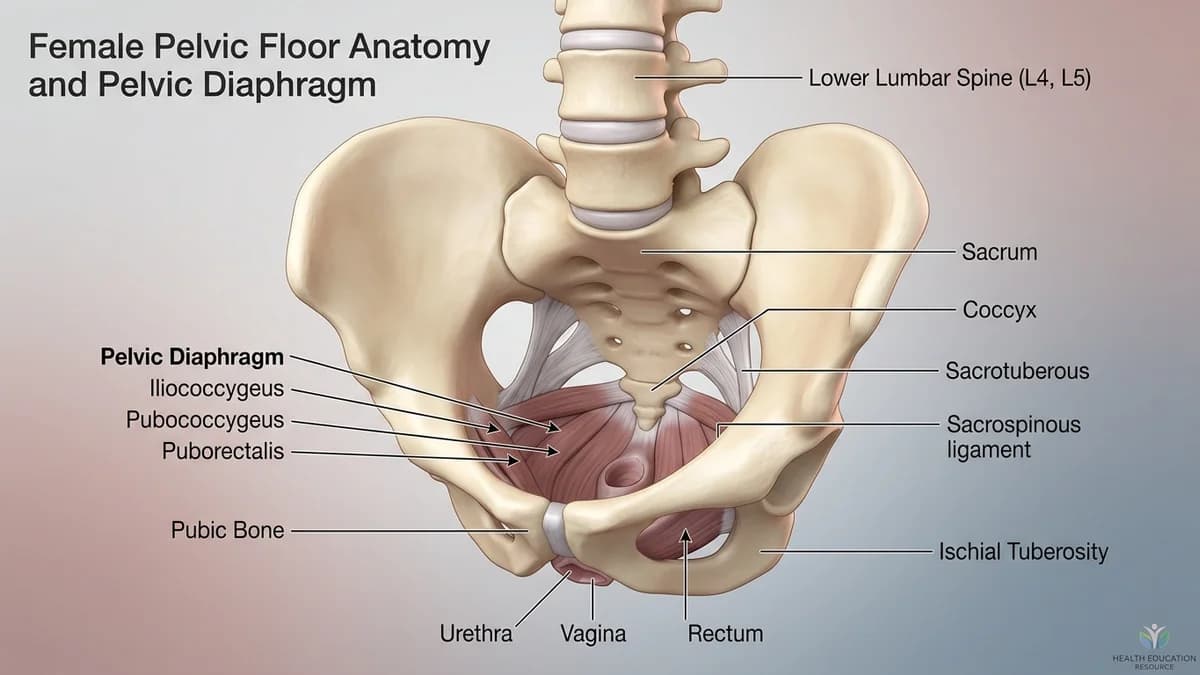
Normal voluntary voiding requires reciprocal inhibition: as the detrusor smooth muscle contracts to expel urine, the striated external urethral sphincter and pubourethral muscle must relax completely to allow unobstructed laminar flow. When a woman habitually holds urine all day (the 'teacher's or nurse's bladder'), she relies on continuous, high-threshold voluntary contraction of the pelvic floor to suppress urgency. Over months and years, these striated muscle fibres undergo neuroplastic remodelling, remaining permanently contracted. When the woman sits down to urinate, the sphincter fails to relax (dysfunctional voiding / high-tone non-relaxing pelvic floor), creating functional bladder outlet obstruction, a weak intermittent stream, and high post-void residuals.
2. Domestic Indian Context: Daily Chores, Ergonomics, and Privacy
The physical realities of Indian workplaces and urban transit heavily drive high-tone bladder disorders. Unhygienic public or office restrooms cause women to hover above toilet seats without touching them ('the hovering posture'). Hovering requires a vigorous 80 percent contraction of the quadriceps, gluteals, and pelvic floor muscles, the exact opposite of the relaxation needed to empty the bladder. Furthermore, long commutes on crowded buses, metros, or auto-rickshaws force women to restrict daytime water intake, drinking large volumes only after returning home, which shocks an unyielding bladder. Physiotherapists teach clean toilet seating ergonomics, hydration pacing, and somatic pelvic drop techniques.
3. Clinical Special Tests and Physical Examination
Assessment begins with non-invasive Uroflowmetry, which reveals a flattened, prolonged, or interrupted 'staccato' urinary flow curve instead of a normal smooth bell-shaped curve. Bladder ultrasound measures post-void residual (PVR) volume. Digital vaginal examination evaluates resting tone in the pubourethral and pubococcygeus muscles, identifying tight, ropy muscle bands.
| Flow Parameter | Normal Bell-Shaped Flow Curve | High-Tone Staccato Voiding | Physiotherapy Target |
|---|---|---|---|
| Peak Flow Rate (Qmax) | Normal >20 to 25 ml/sec | Blunted (<12 to 15 ml/sec) | Increase flow rate via sphincter relaxation |
| Flow Curve Shape | Smooth, continuous, symmetrical bell | Interrupted, prolonged, saw-tooth curve | Restore continuous laminar flow without push |
| Post-Void Residual | Minimal (<20 to 30 ml) | Elevated (>50 to 150 ml residual) | Complete bladder emptying without catheter |
| Pelvic Floor Behavior | Complete electrical silence (sEMG <2 uV) | Spike in electrical activity (hypertonus) | Surface EMG down-training and biofeedback |
4. Stage-by-Stage Functional Physiotherapy Protocol
Rehabilitation centres entirely on somatic down-training, eliminating the hovering posture, and restoring complete voluntary sphincter relaxation.
Phase 1: Full-Contact Toilet Seating Ergonomics
Objective: Eliminate the hovering posture so the pelvic floor can relax completely during voiding.
- 1Never hover over the toilet seat; hovering keeps your pelvic floor locked in a 80 percent contraction.
- 2Wipe the seat clean with tissue or use a paper seat cover, then sit all the way down with your full weight supported.
- 3Place your feet flat on the floor or elevate them on a small footstool.
- 4Rest your forearms on your thighs and lean forward by 20 degrees with a straight spine.
- 5Open your mouth slightly and exhale softly to release your jaw and throat, which reflexively relaxes your pelvic floor.
Phase 2: The 'Open-Glottis Sigh' Flow Initiation Drill
Objective: Overcome urinary hesitancy without pushing or bearing down with abdominal muscles.
- 1Sit fully supported on the toilet and do not push or strain.
- 2Inhale softly through your nose into your lower abdomen.
- 3Exhale slowly with a relaxed, audible sigh like 'haaaaa' through open lips.
- 4As you sigh, visualize your pelvic floor dropping downward like a trapdoor opening.
- 5Allow the urine stream to initiate on its own; once flow begins, maintain the gentle breathing until it finishes naturally.
Phase 3: Deep Asian Squat (Malasana) Pelvic Unclamping
Objective: Lengthen chronically shortened pubourethral and levator ani fibres away from the workplace.
- 1Stand with feet shoulder-width apart, holding onto a sturdy bedframe or doorframe.
- 2Lower into a deep squat, keeping your heels flat or supported on a folded towel.
- 3Allow your pelvis and perineum to soften completely toward the floor.
- 4Take 5 slow diaphragmatic breaths, focusing on the physical sensation of opening and unclenching.
- 5Stand up smoothly, training your nervous system that dropping pelvic tension is safe.
Seek immediate urological care if you experience: complete inability to pass urine for over 6 hours accompanied by severe lower abdominal distension (acute retention), visible blood in your urine, high fever with severe chills and back pain, or progressive lower limb weakness.
5. Clinic Consultation, Home Visits, and Transparent Fee Benchmarks
Under the National Commission for Allied and Healthcare Professions (NCAHP) Act 2021, patients in India can consult a registered pelvic health physiotherapist directly without an upfront referral, though BookPhysio.in does not ask for one. Pelvic health physiotherapists use surface EMG biofeedback and gentle manual down-training in private clinical suites. Clinic consultations in Indian cities range between ₹500 and ₹1,500, with home visits ranging from ₹700 to ₹2,000 where available. Patients pay their physiotherapist directly at each consultation, with zero platform commission.
6. Frequently Asked Questions
Why does hovering over public toilet seats harm my bladder?
Hovering forces your quadriceps, gluteals, and pelvic floor to contract forcefully to keep your body suspended in the air. Because normal urination requires the pelvic floor and sphincter to relax completely, trying to urinate while hovering forces your bladder to push against a closed door, leading to urinary hesitancy, incomplete emptying, and chronic muscle hypertonicity.
Will doing Kegel exercises fix my weak urine stream?
No. Doing Kegels will make your weak stream worse. Your stream is weak because your pelvic floor muscles are already chronically tightened and cannot relax to let urine flow. Performing Kegels adds more tension to an already spastic muscle. You need down-training, relaxation exercises, and postural re-education, not strengthening.
Related recovery guides & articles
BookPhysio.in Editorial Team
The BookPhysio.in editorial team writes and maintains this content, checking it against reliable clinical sources. Content follows our medical review policy: general information only, and no page claims a clinical review until a named registered physiotherapist has signed it off.
Read our medical review policy