
Hip Flexion Contracture Prevention in Spondylitis: Modified Thomas Stretch and Prone Rest
In short
Secondary hip involvement in ankylosing spondylitis produces insidious hip flexion contractures that drive crouch-gait and compound spinal kyphosis. Master modified Thomas stretching, gluteal activation, and therapeutic prone resting.
In this guide (6 sections)
In axial spondyloarthritis and ankylosing spondylitis, secondary hip involvement (coxitis) develops in 30 to 40 percent of patients, predominantly in those with youthful disease onset. Persistent enthesitis and synovial inflammation around the femoral head-neck junction and anterior iliofemoral ligament prompt patients to adopt protective hip flexion to alleviate joint capsule tension. However, prolonged sitting in flexion induces rapid adaptive shortening of the iliopsoas, rectus femoris, and tensor fasciae latae, culminating in fixed hip flexion contractures. Because the hip joints and pelvis dictate sagittal spinal balance, a 15-degree hip contracture forces the pelvis into excessive anterior tilt, which severely compounds thoracic kyphosis and forces the knees into a fatiguing crouch gait. Implementing proactive modified Thomas stretching and daily prone resting is vital to preserve walking efficiency.
Domestic and Cultural Indian Realities
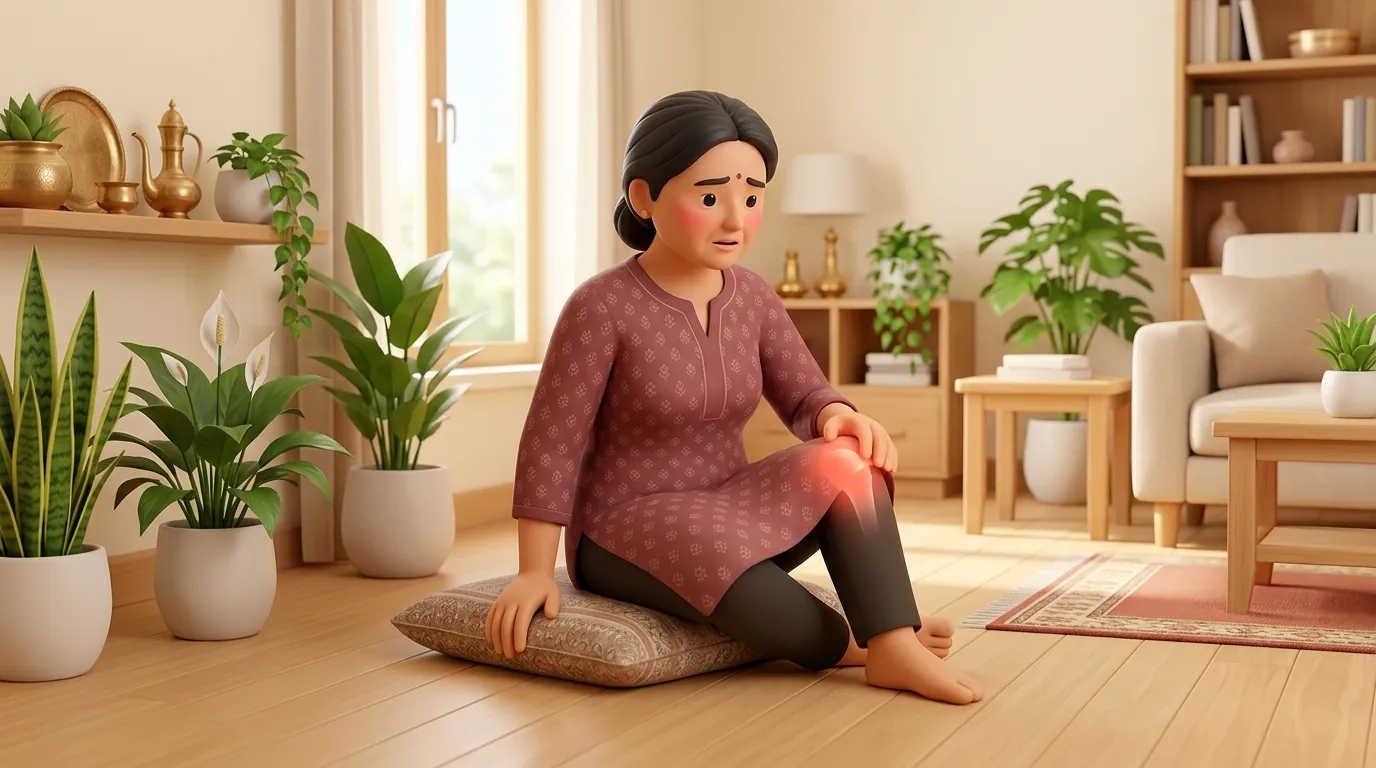
In Indian domestic environments, daily routines frequently encourage sustained hip flexion. Sitting cross-legged on thin floor mats (sukhasana) during prayers, squatting over ground commodes, and curling up in foetal positions on soft mattresses or rope charpoys keep the anterior hip capsule contracted for hours. When attempting to rise to a standing position, patients experience severe groin tightness and must walk with bent knees. Families must assist the patient in transitioning to raised chairs (18 to 20 inches height), utilizing Western commodes, and carving out 20 to 30 minutes of undisturbed daily prone resting on a firm wooden cot to allow gravity to passively stretch the hip flexors.
Clinical Biomechanics and Inflammatory Pathology
The hip joint relies on the massive anterior iliofemoral ligament to provide passive anterior stability during upright bipedal standing. In inflammatory coxitis, persistent pannus and capsular synovitis drive collagen cross-linking and fibrosis of this ligamentous sheet. When a patient with a fixed hip flexion contracture attempts to stand upright, the inability to achieve neutral hip extension prevents the centre of mass from aligning over the femoral heads. To prevent falling forward, the patient must either exaggerate lumbar lordosis (which is impossible if the lumbar spine is ankylosed) or flex the knees and dorsiflex the ankles into a crouched posture. This crouch gait dramatically increases the metabolic energy cost of walking and increases patellofemoral compressive stress. Daily prolonged static stretching is necessary to produce plastic elongation of collagen fibers.
Clinical Assessment and Functional Staging
Evaluation of hip contracture utilizes the standardized Thomas test. The patient lies supine at the end of a firm plinth; the clinician flexes the unaffected hip to the chest to eliminate lumbar lordosis. If the tested thigh fails to lie flat on the plinth surface, a hip flexion contracture is confirmed, and the angle between the thigh and plinth is measured with a goniometer. Hip internal and external rotation are recorded. Functional walking endurance is measured using the 6-Minute Walk Test.
Targeted Mobility and Joint Preservation Exercises
Rehabilitation focuses on low-load prolonged elongation of the anterior hip capsule and iliopsoas, combined with reciprocal gluteus maximus strengthening.
Bed-Edge Modified Thomas Hip Flexor Elongation
Objective: Utilize passive gravity traction to elongate the shortened iliopsoas and anterior hip capsule safely
- 1Lie flat on your back on a firm, raised bed, positioning your body so your affected leg hangs freely off the edge of the mattress.
- 2Gently bend your opposite knee and hold your shin lightly with both hands to keep your lower back flat against the mattress.
- 3Allow your outer, hanging leg to drop down toward the floor under the gentle pull of gravity, keeping your thigh relaxed.
- 4Breathe deeply and maintain this relaxed, passive stretch for 30 seconds without forcing or bouncing.
| Intervention Domain | Evidence-Based Contracture Prevention | High-Risk Contracture-Promoting Pattern |
|---|---|---|
| Nocturnal Posture | Sleeping flat on back with legs extended straight, or prone sleeping for 30 minutes | Curling tightly in a foetal flexion posture with thick pillows under knees |
| Seated Rest | High firm dining chair with 100-degree hip angle; hourly standing extensions | Deep, soft sagging armchairs pulling hips into 120 degrees of acute flexion |
| Active Strengthening | Prone gluteal squeezes and straight-leg backward extensions to activate gluteus maximus | Repetitive sit-ups and abdominal leg raises that over-strengthen the already tight iliopsoas |
| Domestic Sanitation | Raised Western toilet frame with armrests ensuring 90-degree hip transfers | Ground-level Indian squat commodes forcing maximal hip flexion and adduction |
Red Flags and Immediate Rheumatology Escalation
Rapidly progressive groin pain with a severe antalgic limp and inability to bear weight indicates rapid aggressive hip joint destruction or avascular necrosis of the femoral head, requiring immediate orthopaedic consultation for total hip arthroplasty. Acute localized swelling and redness over the groin accompanied by fever demands emergency aspiration to exclude septic coxitis.
Frequently Asked Questions
Can stretching reverse a completely fused hip joint in ankylosing spondylitis?
No. Once complete bony ankylosis of the hip has occurred, exercise and stretching cannot reopen the fused joint space; total hip replacement surgery is required. However, in early and moderate stages, daily modified Thomas stretching and prone resting help manage morning stiffness, prevent soft tissue contractures, and preserve walking tolerance.
How do I book a qualified home physiotherapist to assess hip mobility via BookPhysio.in?
Under the National Commission for Allied and Healthcare Professions (NCAHP) Act 2021, Indian patients enjoy direct access to registered physiotherapists without an obligatory doctor referral. On BookPhysio.in, you schedule an appointment with a verified home-care clinician in your city. Payment is made directly to the therapist at your home appointment via cash or UPI; BookPhysio.in does not process booking fees online.
Related recovery guides & articles
BookPhysio.in Editorial Team
The BookPhysio.in editorial team writes and maintains this content, checking it against reliable clinical sources. Content follows our medical review policy: general information only, and no page claims a clinical review until a named registered physiotherapist has signed it off.
Read our medical review policy