
Independent Living Checklist: Annual Home Environmental Safety and Balance Audit
In short
Conducting an annual home safety audit reduces domestic geriatric falls by over thirty-five percent. Discover the detailed checklist for Indian residences.
In this guide (6 sections)
Ageing in place safely requires a proactive, systematic approach to environmental hazard elimination and neuromuscular capacity tracking. Clinical guidelines recommend that every adult aged sixty-five and older undergo an Annual Home Safety and Balance Audit. Combining objective functional mobility assessments with a room-by-room environmental hazard inspection identifies latent vulnerabilities before a traumatic fall occurs. Systematic home audits reduce domestic fall rates by more than thirty-five percent, preserving long-term independence.
Domestic and Cultural Indian Realities
In Indian apartments and independent homes, domestic hazards accumulate gradually over years. Storage clutter, unsecured electrical wires for room heaters and phone chargers, worn-out coir doormats, dim fluorescent lighting, and slippery marble thresholds often go unnoticed by family members who have grown accustomed to them. Furthermore, older adults experience subtle, progressive declines in sensory and motor reserves that escape casual observation. Conducting an annual formal audit around festival periods (such as Diwali or New Year) provides a structured opportunity to refresh lighting, anchor floor textiles, and reassess physical mobility.
Clinical Biomechanics and Postural Control Decay
Human postural equilibrium is governed by the dynamic interaction between individual intrinsic capacity (vision, proprioception, vestibular function, and muscle torque) and extrinsic environmental demands (floor friction, illumination, step heights, and obstacle clutter). When environmental demands exceed intrinsic physiological capacity, a fall occurs. An annual audit measures intrinsic capacity through validated physical tests, while systematically lowering extrinsic demands through targeted environmental modifications, creating a wide margin of biomechanical safety.
Functional Assessment and Risk Stratification
The annual clinical audit utilizes the Home Safety Self-Assessment Tool (HSSAT) adapted for Indian homes, paired with the CDC STEADI (Stopping Elderly Accidents, Deaths, & Injuries) clinical algorithm. Physical screening includes the Timed Up and Go (TUG), 30-Second Chair Stand, and 4-Stage Balance tests. Seniors scoring in moderate or high-risk categories receive immediate physiotherapy intervention and priority home architectural modifications.
Targeted Strength and Balance Exercises
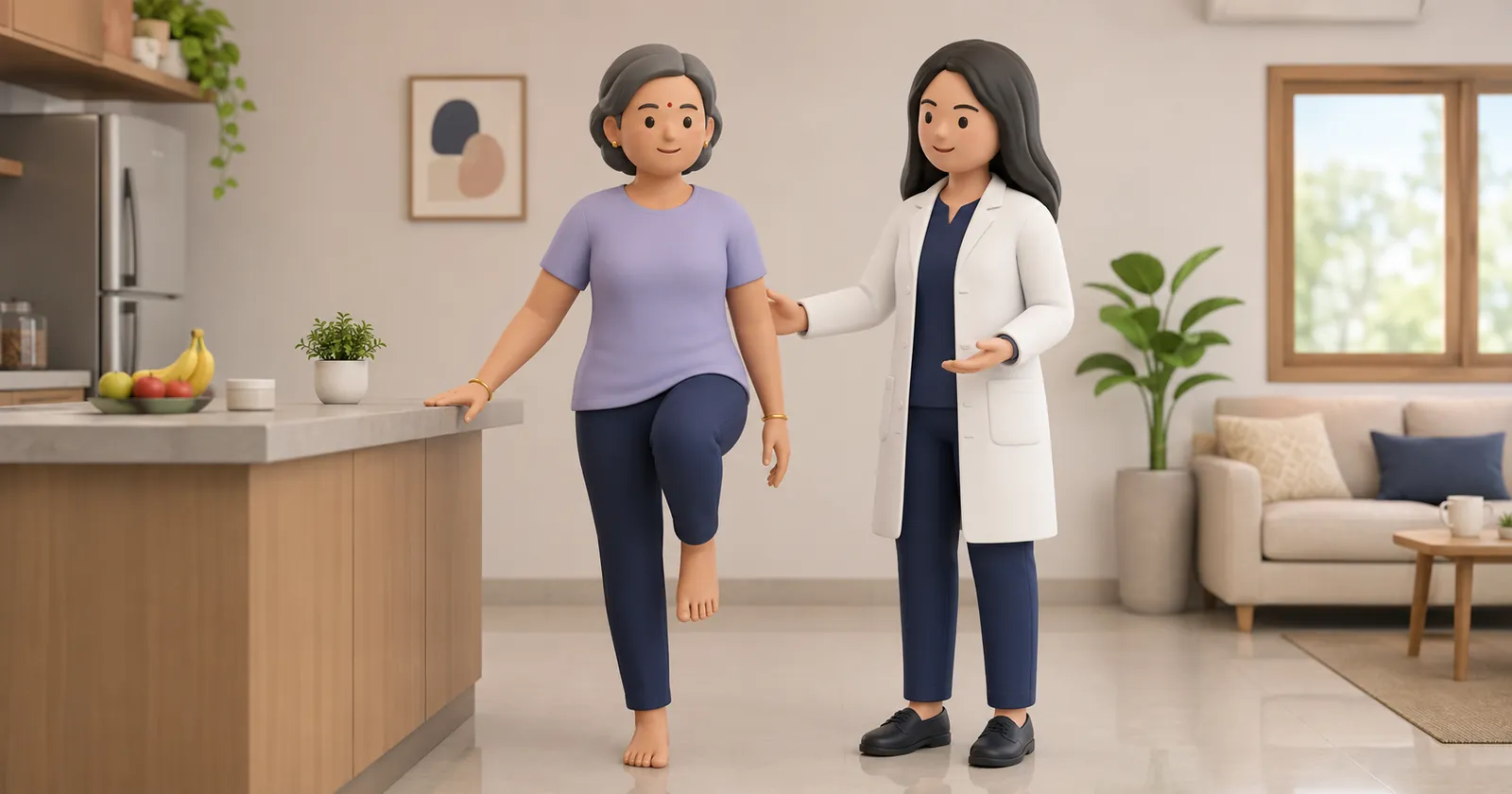
The audit concludes with the prescription of an updated annual balance and strength maintenance programme. Seniors are guided through functional closed-chain exercises that target core stability, quadriceps endurance, and multi-directional stepping.
Annual Functional Balance Re-Calibration Circuit
Objective: Maintain baseline lower-limb strength and static balance benchmarks throughout the ageing continuum
- 1Perform eight unassisted sit-to-stand repetitions from a standard dining chair.
- 2Stand in a secure room corner and maintain a tandem stance (heel-to-toe) for thirty seconds per foot.
- 3Hold onto a sturdy table and perform ten controlled lateral leg lifts per side.
- 4Walk twelve metres in a clear hallway, focusing on tall posture, heel-strike landing, and wide arm swing.
- 5Complete this circuit smoothly, verifying that breathing remains steady and balance feels secure.
| Domestic Living Zone | Environmental Hazard Audit Checklist | Annual Clinical Verification |
|---|---|---|
| Bathrooms and Wet Areas | Anti-skid floor treatment; wall-anchored grab bars; raised commode seat; shower chair | Inspect suction mats for wear; test grab bar structural anchor bolts |
| Corridors and Doorways | Clear of loose chatais and dhurries; bevel ramps on chaukhats; automatic nightlights | Verify 50 lux floor illumination; test motion-sensor battery backups |
| Bedrooms and Transfers | Bed height matched to popliteal height (48-52 cm); firm mattress; clear floor path | Assess sit-to-stand transfer mechanics and nighttime urge management |
| Staircases and Entrances | Bilateral continuous round handrails; high-contrast nosing tape; non-skid treads | Re-evaluate stair ascent and descent mechanics; check footwear sole tread wear |
Red Flags and Emergency Post-Fall Escalation
An annual audit provides an opportunity to review the family emergency post-fall protocol. Verify that emergency contacts, local ambulance numbers, and nearby orthopaedic hospital details are posted clearly near all home telephones. Ensure that medical alert pendants and smartwatch fall detection features are tested and functioning correctly.
Frequently Asked Questions
How often should an older adult have their home safety and balance evaluated in India?
Clinical guidelines recommend an annual audit for all adults aged sixty-five and older. Re-audits should be conducted sooner if an individual experiences a fall, sustains an illness, undergoes surgery, or has a change in medication.
Can physiotherapists conduct detailed home safety and balance audits in India?
Geriatric physiotherapists perform detailed in-home environmental hazard audits and physical balance assessments. Under the NCAHP Act 2021, Indian patients enjoy direct access to registered physiotherapists via BookPhysio.in with direct pay-per-session pricing.
Related recovery guides & articles
BookPhysio.in Editorial Team
The BookPhysio.in editorial team writes and maintains this content, checking it against reliable clinical sources. Content follows our medical review policy: general information only, and no page claims a clinical review until a named registered physiotherapist has signed it off.
Read our medical review policy