
Intrinsic Foot Muscle Strengthening: Short Foot Exercises to Prevent Toe Clawing
In short
Motor neuropathy selectively atrophies the intrinsic muscles of the foot, driving progressive toe clawing and severe metatarsal head pressure. Discover the clinical role of the short foot exercise.
In this guide (6 sections)
Diabetic distal symmetrical polyneuropathy affects both sensory fibres and small motor axons that innervate the intrinsic muscles of the foot, including the lumbricals, interossei, abductor hallucis, and flexor digitorum brevis. Denervation atrophy of these intrinsic stabilisers disrupts the muscular balance between intrinsic and extrinsic foot flexors and extensors. The long extrinsic toe extensors and flexors overpower the weakened intrinsics, pulling the metatarsophalangeal (MTP) joints into hyperextension while flexing the interphalangeal joints, creating claw-toe and hammer-toe deformities. The short foot exercise, developed through Janda sensorimotor principles, activates the intrinsic plantar musculature, elevates the medial longitudinal arch, and helps stabilize the digit alignment.
Domestic and Cultural Indian Realities
In Indian households, the progression of toe clawing presents significant risks during daily barefoot activities and traditional religious practices. As the toes claw upward, the protective plantar fat pad is drawn forward into the sulcus, leaving the prominent metatarsal heads covered only by thin, atrophic skin. When walking barefoot across hard mosaic, marble, or stone floors, these exposed metatarsal heads bear extreme focal impacts, rapidly forming thick hyperkeratotic calluses that breakdown into neuropathic ulcers. Furthermore, clawed dorsal toe knuckles rub against the rigid upper straps of traditional footwear such as Kolhapuri chappals, causing severe dorsal blisters. Practicing seated intrinsic foot exercises daily helps patients maintain muscular tone and protect their feet.
Clinical Biomechanics and Neuropathic Breakdown
The intrinsic plantar muscles act as dynamic stabilizers of the longitudinal and transverse arches during the stance phase of walking. When motor neuropathy induces intrinsic muscle atrophy, intramuscular adipose infiltration and fibrosis occur rapidly. Without active lumbrical opposition, the extensor digitorum longus pulls the proximal phalanx backward onto the metatarsal head, subluxing the MTP joint. Concurrently, the flexor digitorum longus curls the distal phalanges downward into the floor. This structural collapse doubles peak vertical pressure beneath the first and second metatarsal heads while increasing shear stress during terminal stance. The short foot exercise activates the abductor hallucis and plantar intrinsics by actively drawing the first metatarsal head straight back toward the calcaneus without curling the toes, shortening the foot and restoring arch height.
Clinical Assessment and Neuropathy Screening
Assessment begins by grading intrinsic foot muscle wasting through visual inspection, observing guttering between the metatarsal shafts on the dorsal aspect of the foot. The clinician tests passive flexibility of the clawed MTP and interphalangeal joints to determine whether the deformity is flexible, semi-rigid, or rigidly fixed. Motor testing evaluates voluntary abduction and adduction of the toes, alongside paper-grip testing beneath the hallux and lesser digits. Sensory screening with a 10g monofilament confirms the extent of coexisting sensory loss, while plantar palpation evaluates for tender subcutaneous callus formation beneath prominent metatarsal heads.
Targeted Offloading and Intrinsic Foot Conditioning
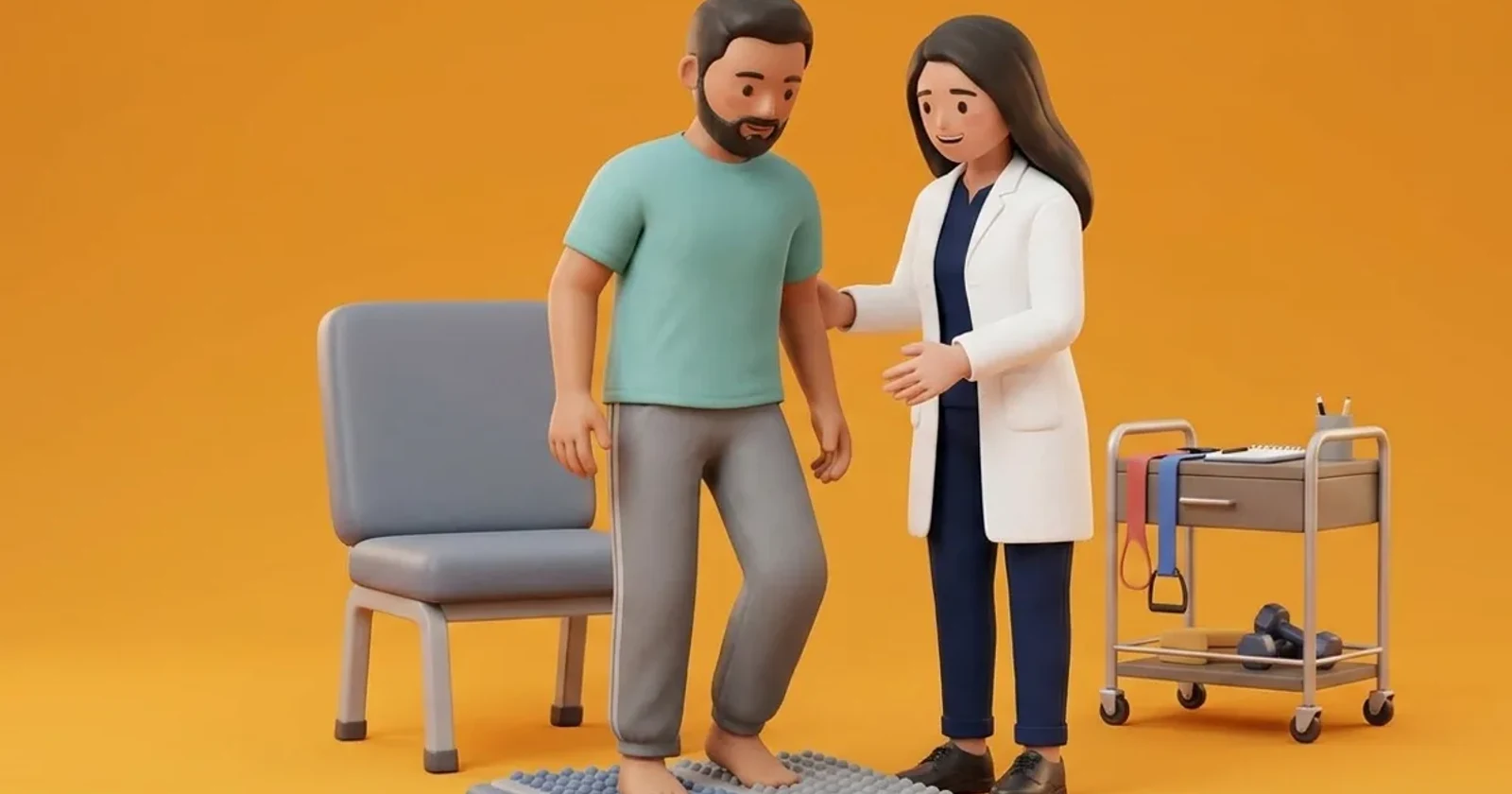
Rehabilitation focuses on conscious neuromotor re-education of the intrinsic plantar muscles, beginning in supported seated postures to eliminate gravitational body weight loads. Patients learn to shorten the foot without curling the toe tips, preventing compensatory recruitment of the long toe flexors. As intrinsic motor control improves, training progresses from seated to bilateral standing, and eventually to dynamic weight shifts. Metatarsal pads and soft silicone gel toe crests are prescribed to cushion prominent metatarsal heads and straighten flexible hammer toes during daily walking.
Seated Janda Short Foot Intrinsic Arch Doming
Objective: Activate abductor hallucis and plantars to raise the medial arch without toe curling
- 1Sit comfortably in a chair with both feet resting flat on the floor, knees bent at 90 degrees.
- 2Keep your heel and the ball of your big toe firmly anchored to the floor at all times.
- 3Without curling or clawing your toes, slide the ball of your big toe straight back toward your heel.
- 4Feel the arch of your foot lift upward as the foot visibly shortens by a few millimetres.
- 5Hold the domed contraction firmly for 5 seconds while keeping toes relaxed and elongated.
- 6Slowly release the arch back to the flat starting position and rest for 3 seconds.
| Deformity Stage | Structural & Biomechanical Characteristics | Physiotherapy & Orthotic Management |
|---|---|---|
| Stage 1: Flexible Toe Clawing | MTP joints easily reduced to neutral passively; mild intrinsic weakness | Active short foot exercises, toe-spreading drills, silicone toe crest pads |
| Stage 2: Semi-Rigid Contracture | Partial passive reduction possible; noticeable dorsal shoe rub | Manual joint mobilisations, extra-depth footwear, metatarsal offloading domes |
| Stage 3: Rigid Fixed Deformity | Fixed contracture; prominent submetatarsal heads; severe callus | Custom total contact orthotics with metatarsal wells; rocker sole footwear |
| Stage 4: Ulcerated Prominence | Skin breakdown over dorsal interphalangeal joints or under metatarsal | Immediate total offloading, wound debridement, surgical orthopaedic consult |
Red Flags and Urgent Diabetic Foot Escalation
Immediate clinical review is required if a patient discovers redness, blisters, or skin breakdown over the dorsal knuckles of clawed toes or beneath the metatarsal heads. Signs of deep infection include purulent discharge staining socks, spreading warmth, localized swelling, or severe tenderness along the plantar fascia. Any open ulceration over an exposed joint capsule represents an urgent risk of septic arthritis and osteomyelitis requiring hospital referral.
Frequently Asked Questions
Can short foot exercises completely reverse severe, longstanding toe clawing?
If claw toe deformities have become completely rigid with fixed joint capsule contractures, exercises alone cannot straighten the toes. However, short foot training strengthens remaining muscle fibres, improves balance control, and helps prevent further joint deterioration, while custom footwear relieves pressure from fixed bony prominences.
Why must I avoid curling my toes during the short foot exercise?
Curling the toes activates the long extrinsic flexor muscles (flexor digitorum longus) instead of the deep intrinsic foot muscles. Overactivating the long flexors actually worsens toe clawing and drives the tips of the toes into the ground, whereas the proper short foot exercise keeps the toes flat while lifting the arch.
Related recovery guides & articles
BookPhysio.in Editorial Team
The BookPhysio.in editorial team writes and maintains this content, checking it against reliable clinical sources. Content follows our medical review policy: general information only, and no page claims a clinical review until a named registered physiotherapist has signed it off.
Read our medical review policy