
Kitchen Reaching Hazards: Plastic Stool Risks and Ergonomic Storage for Seniors
In short
Climbing onto flimsy plastic stools to reach high kitchen spice jars causes severe domestic trauma. Discover how ergonomic shelf reorganisation prevents falls.
In this guide (6 sections)
Domestic kitchens are high-activity zones that combine slick tiled floors, hot liquids, sharp utensils, and vertical reaching demands. Epidemiological surveys show that falls occurring during kitchen tasks account for fifteen to twenty percent of all domestic accidents in older women. Among these, falls resulting from climbing onto unstable domestic furniture to reach elevated storage shelves represent a major cause of catastrophic trauma, including hip fractures, traumatic brain injuries, and rib fractures. Ergonomic reorganisation of storage and balance training eliminate these preventable hazards.
Domestic and Cultural Indian Realities
In Indian households, the kitchen (rasoi) is central to domestic identity. Elderly matriarchs frequently insist on cooking daily meals, preparing traditional snacks, and organising spice containers. However, Indian kitchens often feature high upper lofts and ceiling-height overhead cabinets designed to maximize vertical storage. To reach seasonal spice jars (masala dabbas), large pressure cookers, or festival brass vessels stored in lofts, older women commonly stand on lightweight plastic stools (patlas), dining chairs with wheels, or inverted stainless steel buckets. These lightweight plastic stools buckle or slide easily on smooth granite or tile floors, causing catastrophic falls.
Clinical Biomechanics and Postural Control Decay
Reaching overhead with both arms while standing on a narrow base of support fundamentally challenges postural stability. Raising the arms shifts the body's centre of mass upward and forward. To maintain balance, the body requires ankle plantarflexion and lumbar extensor stabilization. If the senior also extends their neck to look upward, cervical hyperextension can compress the vertebral arteries, temporarily reducing basilar brain perfusion and producing sudden dizziness. Standing on an unstable plastic stool reduces the available base of support; the slightest reach outside the foot boundary tips the stool, precipitating an unrecoverable fall.
Functional Assessment and Risk Stratification
Clinical assessment utilizes the Functional Reach Test (FRT) and the Multi-Directional Reach Test (MDRT). In the FRT, the patient stands next to a wall and reaches forward as far as possible without moving their feet. A forward reach distance of less than fifteen centimetres (six inches) indicates severe balance impairment and a four-fold increase in fall risk. Physiotherapists evaluate functional reaching limits to define the patient's safe 'kitchen working envelope'.
Targeted Strength and Balance Exercises
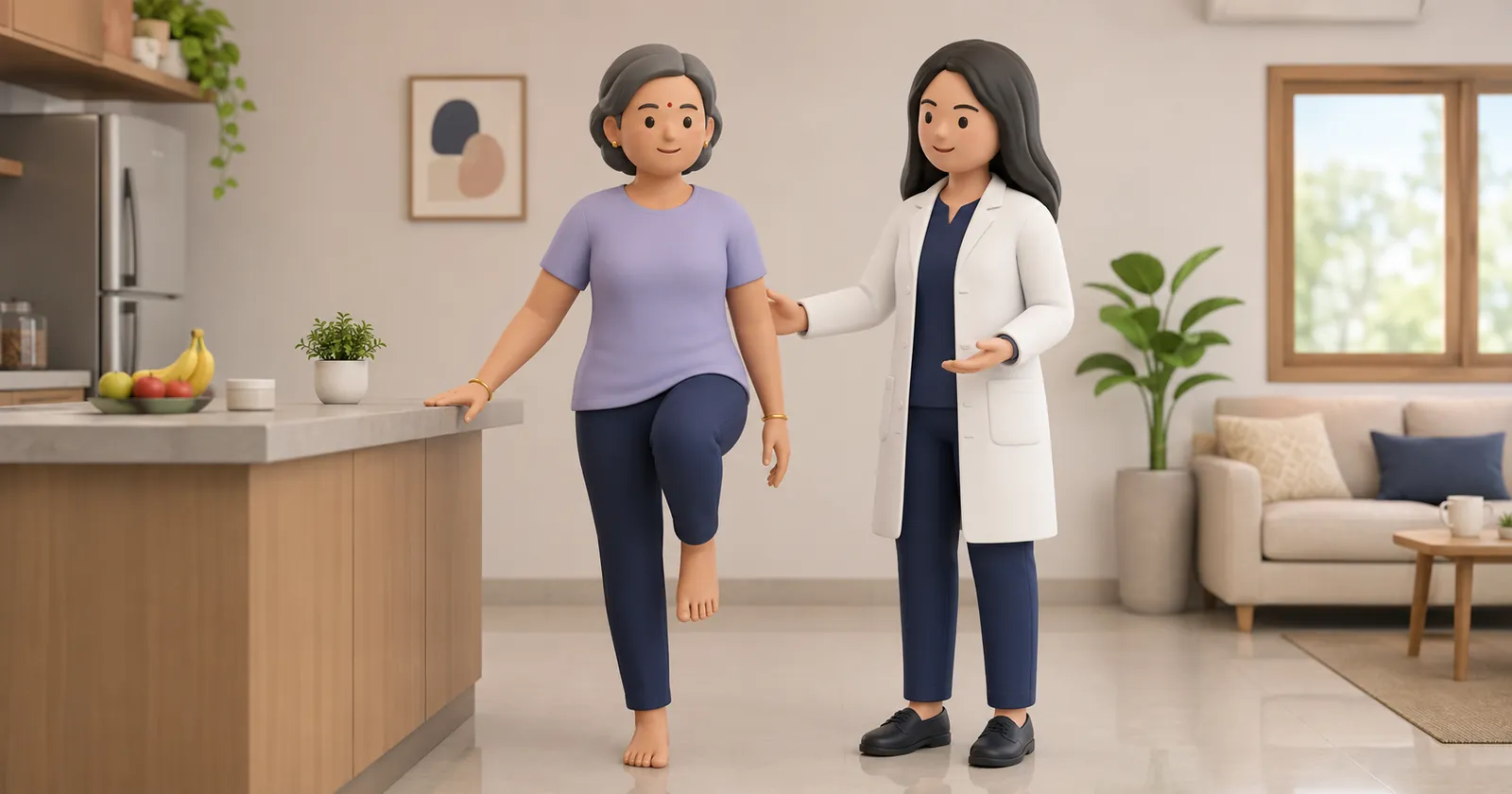
Physiotherapy rehabilitation trains dynamic reaching within functional limits of stability while keeping both feet firmly planted on the floor. Exercises strengthen the core, improve shoulder flexion range of motion, and train seniors to step toward objects rather than stretching past balance margins.
Supported Multi-Directional Functional Reach Training
Objective: Improve dynamic reach margins and centre-of-mass control while maintaining stable foot contact
- 1Stand tall facing a clear wall, positioned thirty centimetres away with feet shoulder-width apart.
- 2Place your left hand lightly on the wall for balance support at shoulder height.
- 3Reach your right hand forward as far as comfortable without lifting your heels off the floor.
- 4Hold the forward reach position for two seconds, feeling your abdominal muscles engage to support your spine.
- 5Return to standing tall, then reach diagonally across to your left; repeat on both sides.
| Storage Zone | Shelf Height and Location | Clinical Ergonomic Recommendation |
|---|---|---|
| Prime Active Zone | Between waist and shoulder height (75 to 130 cm from floor) | Store daily-use spices, cooking oils, lentils, tea, and lightweight pans |
| Lower Storage Zone | Between knee and waist height (45 to 75 cm from floor) | Store medium-weight pots and small appliances; avoid bending to floor |
| Overhead Loft Storage | Above shoulder height (> 140 cm from floor) | Store seasonal festival items; strict rule: only younger relatives access |
| Stepping Equipment Standard | Certified wide-step domestic ladder with high safety handrail | Strictly eliminate lightweight plastic stools (patlas) from kitchen areas |
Red Flags and Emergency Post-Fall Escalation
Falls from elevated stools or chairs involve substantial gravitational kinetic energy, frequently causing complex polytrauma. Inspect the patient for fractured wrists, pelvic fractures, and rib fractures. If the senior fell against a kitchen stove or struck hot cookware, check for scald burns and blunt abdominal trauma. Inability to bear weight or severe hip pain mandates immediate orthopaedic emergency transport.
Frequently Asked Questions
Is it safe for an older adult to use a step stool in the kitchen?
Frail seniors should never climb onto domestic step stools. If an active senior must access upper shelves, they should only use a certified wide-step ladder with slip-resistant rubber feet, locking hinges, and a high waist-level support rail, while another person spots them.
Can physiotherapists help reorganise kitchen ergonomics for elderly parents in India?
Geriatric physiotherapists assess kitchen reaches, floor friction, and transfer pathways during in-home consultations. Under the NCAHP Act 2021, Indian patients enjoy direct access to registered physiotherapists. BookPhysio.in connects you with verified physiotherapists for home care with direct per-session payments.
Related recovery guides & articles
BookPhysio.in Editorial Team
The BookPhysio.in editorial team writes and maintains this content, checking it against reliable clinical sources. Content follows our medical review policy: general information only, and no page claims a clinical review until a named registered physiotherapist has signed it off.
Read our medical review policy