
Traditional Footwear Risks: Kolhapuri Chappals, Embroidered Juttis, and Diabetic Ulcers
In short
Traditional Indian footwear like Kolhapuris and narrow juttis are cultural staples, but their stiff leather and tight toe boxes cause rapid ulceration in diabetic feet. Learn safer alternatives.
In this guide (6 sections)
Traditional handcrafted footwear such as Kolhapuri chappals, Mojaris, and Punjabi juttis hold deep cultural and aesthetic value across India. However, their structural design is fundamentally incompatible with the biomechanical requirements of the diabetic neuropathic foot. Constructed from thick, untanned vegetable-dyed leather and assembled with coarse stitching cords, these shoes lack cushioning and shock absorption. The narrow, tapered toe boxes compress the digits tightly, while rigid leather straps and thick braided toe loops generate intense localized friction. In patients with sensory neuropathy, wearing traditional leather footwear for even a single festive function can inflict deep friction blisters, full-thickness skin sloughing, and rapid limb-threatening infection.
Domestic and Cultural Indian Realities
During Indian weddings, religious festivals, and family celebrations, social customs encourage wearing ethnic attire paired with traditional footwear. Many older adults purchase brand-new juttis or Kolhapuris specifically for these occasions. Traditional juttis have no left or right foot distinction when new; they require weeks of painful break-in wear to mould to the foot. A person with diabetic neuropathy feels no pain during this process, allowing the rigid leather to slice into the dorsal knuckles and heel margins unnoticed. At the end of an evening celebration, removing the shoes reveals blood-soaked socks and exposed subcutaneous tissue. Patients must understand that looking festive should never risk an amputation. Custom diabetic footwear manufacturers now produce ethnic-styled shoes with soft leather uppers, smooth linings, and broad toe boxes that preserve cultural elegance safely.
Clinical Biomechanics and Neuropathic Breakdown
The biomechanical hazard of traditional footwear arises from three primary structural flaws: unyielding material stiffness, absence of sagittal shock absorption, and severe transverse forefoot compression. A typical Kolhapuri chappal incorporates a thick central leather strap and a tight braided loop that encircles the hallux. During walking, this braided loop generates heavy shear forces directly over the medial interphalangeal joint of the big toe. In Punjabi juttis, the sharply pointed toe box squeezes the first and fifth metatarsal heads toward each other, driving the lesser digits into severe clawing and creating dorsal contact with metallic embroidery. Without a resilient midsole, ground reaction forces pass unattenuated into the plantar metatarsal heads, causing rapid blister formation beneath insensate skin.
Clinical Assessment and Neuropathy Screening
Assessment begins with a thorough physical audit of the footwear worn by the patient. The clinician places the insole or outline of the traditional shoe over a tracing of the patient weight-bearing foot; in almost all cases, the shoe width is 15 to 25 millimetres narrower than the foot footprint. Physical examination evaluates the medial hallux, dorsal interphalangeal joints, and posterior calcaneal insertion for redness, calluses, or broken skin. Sensory thresholds are quantified using the 10g monofilament and 128 Hz tuning fork, and the pedal circulation is examined to ensure adequate arterial perfusion.
Targeted Offloading and Intrinsic Foot Conditioning
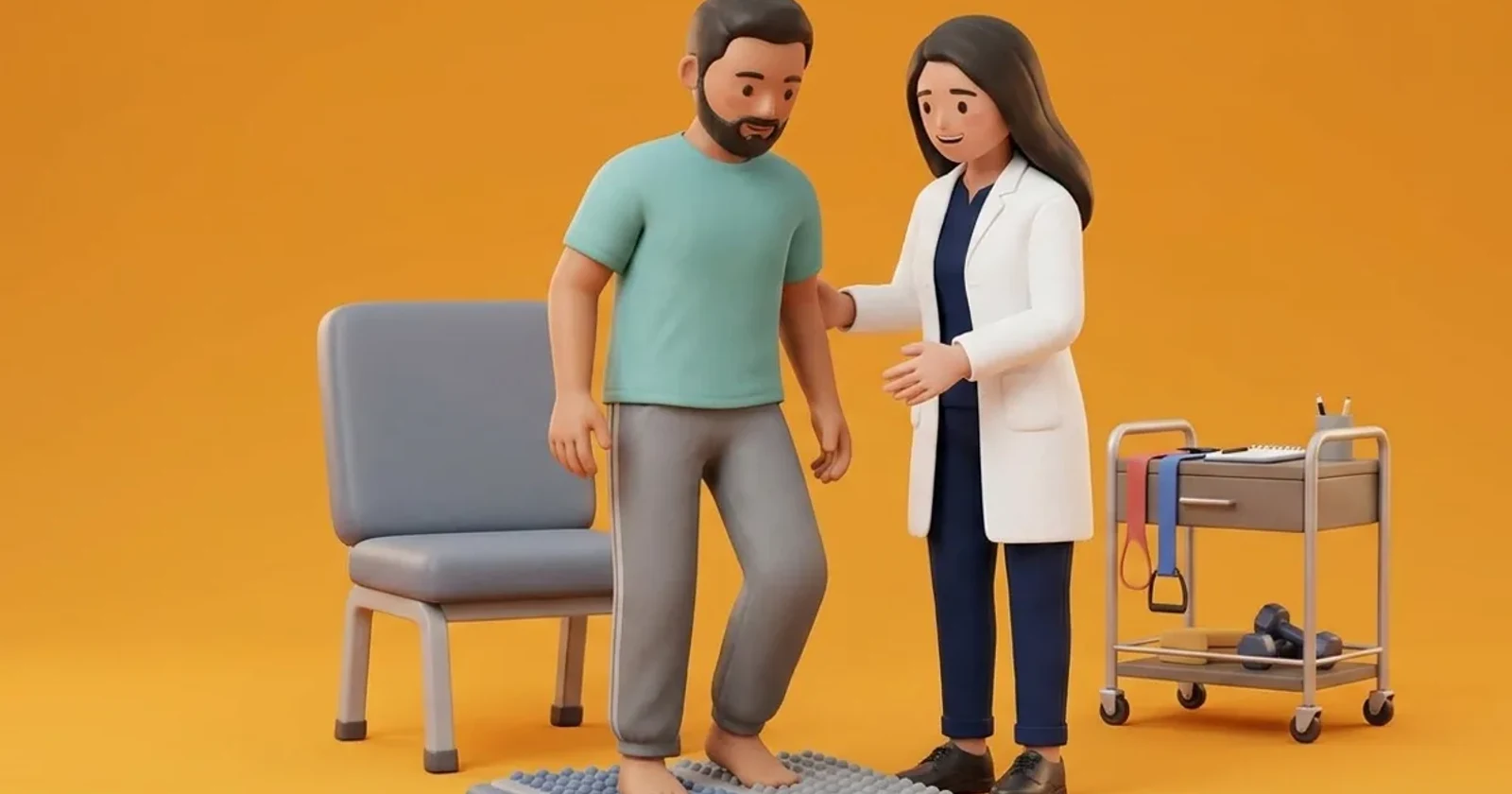
Education focuses on eliminating rigid, narrow footwear from the patient wardrobe. For formal occasions, patients are guided toward certified diabetic formal footwear featuring extra vertical depth, a rounded wide toe box, smooth sheepskin lining, and an internal MCR or plastazote footbed. Physiotherapy incorporates passive toe mobilisation and active toe-spreading drills to maintain metatarsophalangeal mobility and counteract the digital crowding caused by narrow footwear.
Seated Active Toe Splay and Metatarsal Spread
Objective: Relieve digital crowding and activate intrinsic abductor muscles while seated
- 1Sit in a sturdy chair with feet resting flat on a clean surface.
- 2Lift all your toes off the floor while keeping the balls of your feet firmly planted.
- 3Actively spread all your toes as far apart as possible, widening the space between each digit.
- 4Hold the open, spread position for 5 seconds, breathing smoothly.
- 5Relax your toes back to the floor for 3 seconds before the next repetition.
| Design Element | Traditional Jutti / Kolhapuri | Diabetic Prescription Footwear |
|---|---|---|
| Toe Box Shape and Volume | Pointed, narrow, low vertical profile; squeezes digits | Broad, rounded, extra 10 to 12mm vertical depth; zero digital contact |
| Internal Upper Lining | Raw rough leather, coarse stitching threads, metal zari | Soft, smooth, padded microfiber or smooth glove leather |
| Plantar Midsole Cushioning | Single or double layer of dense, unyielding hard leather | Multi-density 8-10mm MCR or EVA with arch contouring |
| Retention Mechanism | Slip-on design or harsh toe-loop; forces toe clawing | Adjustable wide velcro straps across instep and posterior heel |
Red Flags and Urgent Diabetic Foot Escalation
Urgent medical attention is necessary if a patient discovers bleeding, blistering, or black discoloration on the toes or heels after wearing traditional footwear. If redness spreads over the top of the foot, swelling increases, or yellowish pus drains from a blister site, immediate clinical evaluation is required. Infections in the tight interdigital spaces can track into deep plantar fascial compartments within 24 hours.
Frequently Asked Questions
Can I wear traditional juttis for just two hours during a wedding ceremony?
No. In a person with diabetic sensory neuropathy, two hours of standing or walking in rigid, narrow juttis is more than enough time to generate full-thickness skin blisters and deep dermal damage. Because you cannot feel the friction, severe tissue destruction happens silently. Choose modern diabetic formal shoes with wide toe boxes instead.
Can traditional Kolhapuris be made safe by putting a soft rubber pad inside?
Adding an aftermarket gel pad to a Kolhapuri does not fix the fundamental hazards: the harsh braided toe loop that saws into the big toe web space, the lack of an ankle strap, and the completely flat, rigid leather base. Proper protection requires replacing the footwear entirely with certified diabetic sandals.
Related recovery guides & articles
BookPhysio.in Editorial Team
The BookPhysio.in editorial team writes and maintains this content, checking it against reliable clinical sources. Content follows our medical review policy: general information only, and no page claims a clinical review until a named registered physiotherapist has signed it off.
Read our medical review policy