
Lifelong Activity Guidelines and Implant Longevity Education: Preserving Revised Joints
In short
Living successfully with a revised joint requires lifelong joint stewardship and evidence-based activity pacing. Learn how to maintain bone health, recognize early failure signs, and preserve complex reconstructive implants for decades.
In this guide (6 sections)
Revision total hip and knee arthroplasties represent heroic orthopaedic reconstructions that restore pain-free walking and independence in joints previously compromised by infection, fracture, or massive bone destruction. However, a revised joint must be understood as a durable mechanical system with a finite fatigue threshold, not an indestructible biological joint. Because host bone stock is reduced and implants feature modular junctions, long intramedullary stems, and constrained articulation posts, the cumulative physical demands placed upon the limb over decades determine whether the prosthesis will endure for life or progress to premature mechanical failure. Lifelong patient education regarding activity modification, weight control, fall prevention, and routine radiographic surveillance is the foundation of lasting joint preservation.
Domestic and Cultural Indian Realities
In Indian society, managing long-term joint longevity requires maintaining permanent domestic adaptations despite social pressure to conform to traditional habits. Well-meaning relatives may encourage patients who have achieved pain-free function to sit on the floor during weddings, religious kathas, or family festivals. Patients must be empowered with dignified boundaries: explaining that permanent avoidance of cross-legged floor sitting (sukhasana) and squatting is essential medical preservation, not physical inability. Utilizing an elevated pooja chowki at 20 inches height or a sturdy armchair allows full spiritual and social inclusion. Bathrooms must permanently feature an elevated western commode at 20 inches height with secure grab rails. Body weight must be managed through balanced nutrition (reducing processed carbohydrates and saturated fats) to minimize cumulative mechanical load across the revision construct.
Clinical Biomechanics and Reconstructive Fixation
The biomechanics of implant longevity revolve around minimizing wear debris and preventing aseptic interface debonding. Every million steps taken generates microscopic polyethylene wear particles; while modern cross-linked and antioxidant-infused polyethylenes produce dramatically lower volumetric wear than historical materials, excessive high-impact shock or repetitive edge-loading spikes wear debris generation. Furthermore, body weight exerts a compounding biomechanical effect: every additional kilogram of excess body weight translates to three to four kilograms of extra compressive load across the knee during walking, and up to six kilograms during stair climbing. Maintaining a body mass index (BMI) within the healthy range (under 25 kg/m2) significantly dampens interface stress and doubles implant survival probability.
Rehabilitation Assessment and Functional Progression
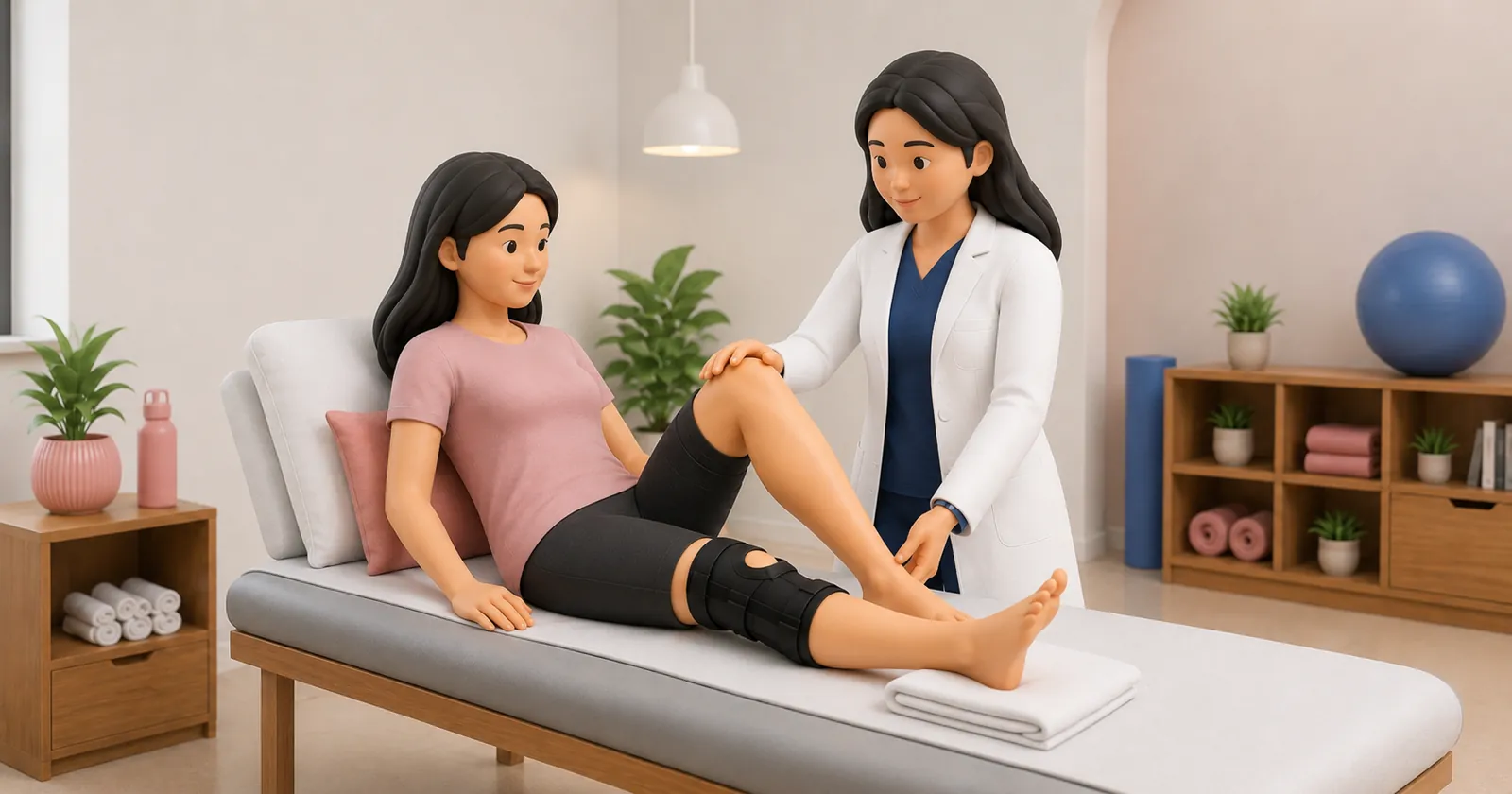
Long-term surveillance mandates annual or biennial clinical reviews with the orthopaedic surgeon and physiotherapist, even when the joint is completely pain-free. A serial anteroposterior and lateral radiograph is obtained every one to two years to screen for silent osteolysis, radiolucent line progression (>2 mm), or stem subsidence before catastrophic bone loss occurs. The physiotherapist assesses walking endurance, balance confidence, and muscular strength, updating home exercise routines to match changes in age and functional capacity.
Targeted Rehabilitation and Joint Preservation Exercises
Lifelong maintenance routines focus on non-impact aerobic conditioning, core postural stability, and daily range of motion preservation within safe boundaries.
Daily Lifelong Joint Preservation Mobility and Core Routine
Objective: Maintain functional joint excursion, periarticular muscle tone, and core stability without joint wear
- 1Sit upright on a firm, 20-inch chair with feet flat on the floor.
- 2Slide the operated heel backward smoothly to your comfortable functional limit (90 to 105 degrees), pause for 3 seconds, and extend fully.
- 3Hold terminal knee extension with a firm 5-second quadriceps squeeze, repeating for 10 smooth cycles.
- 4Stand up using armrests, engage your abdominal wall and gluteal muscles, and perform 10 gentle mini-squats (0 to 30 degrees only).
- 5Finish with 5 minutes of quiet, balanced breathing and gentle ankle pumps.
- 6Incorporate 20 to 30 minutes of low-impact walking or stationary cycling daily.
| Activity Tier | Specific Physical Activities | Clinical Recommendations & Guidelines |
|---|---|---|
| Recommended for Life (Low Impact) | Walking, stationary cycling, swimming (freestyle), golf with cart | Highly encouraged daily; builds bone density and cardiovascular fitness |
| Permitted with Caution (Moderate Impact) | Doubles tennis on clay, gentle hiking on level trails, light bowling | Permitted only with excellent balance, proper shoes, and surgeon clearance |
| Permanently Contraindicated (High Impact) | Running, jogging, singles tennis, soccer, basketball, jumping sports | Strictly banned; shock loading causes rapid loosening and bone fracture |
| Permanently Contraindicated (High Flexion) | Sitting cross-legged on floor (sukhasana), squatting, low floor stools | Strictly banned; deep torsion causes dislocation and cone shear debonding |
Red Flags and Immediate Surgical Escalation
Any new onset of start-up pain upon standing that fails to resolve, progressive deep bone aching in the thigh or shin, audible joint squeaking or clicking, or recurrent joint swelling warrants immediate orthopaedic radiography to evaluate for late aseptic loosening or wear before catastrophic failure occurs.
Frequently Asked Questions
How long can I expect my revision joint replacement to last?
Modern revision joint implants utilizing trabecular metal cones and cross-linked polyethylene have demonstrated 10-to-15-year survival rates exceeding 85 to 90%. By adhering to low-impact exercise guidelines, maintaining healthy body weight, avoiding floor sitting, and attending annual checkups, your revised joint can serve you well for the rest of your life.
How do I access annual physiotherapy reviews for revision joint surveillance in India?
Patients across India can book qualified orthopaedic physiotherapists via BookPhysio.in under the NCAHP Act 2021. Our registered clinicians provide lifelong joint preservation guidance and periodic physical assessments with transparent pay-direct session fees.
Related recovery guides & articles
BookPhysio.in Editorial Team
The BookPhysio.in editorial team writes and maintains this content, checking it against reliable clinical sources. Content follows our medical review policy: general information only, and no page claims a clinical review until a named registered physiotherapist has signed it off.
Read our medical review policy