
Multidisciplinary Diabetic Foot Clinics: Podiatry, Physiotherapy, and Surgical Care
In short
Preventing diabetic amputations requires a coordinated multidisciplinary clinical team. Discover how physiotherapists, podiatrists, and surgeons synchronize care.
In this guide (6 sections)
Diabetic foot disease is a complex, multifactorial pathology involving simultaneous interactions between peripheral sensory neuropathy, peripheral arterial disease, biomechanical foot deformities, infection, and poor glycaemic control. Clinical evidence from international health bodies confirms that establishing a coordinated multidisciplinary diabetic foot clinic (MDT) reduces lower extremity amputation rates by up to 85 percent. When individual medical specialties operate in isolation, vital pre-ulcerative warning signs are easily missed, and treatment delays allow minor abrasions to progress to deep limb-threatening sepsis. A synchronized team comprising diabetologists, vascular surgeons, orthopaedic surgeons, wound care specialists, physiotherapists, and certified orthotists provides continuous triage, rapid surgical intervention, targeted offloading, and lifetime recurrence prevention.
Domestic and Cultural Indian Realities
In the Indian healthcare landscape, patient care is frequently fragmented. A diabetic patient often visits an endocrinologist for blood sugar management, a general physician for fever, and an independent surgeon only when a foot wound has become gangrenous. Podiatry and biomechanical offloading are rarely integrated into standard primary care. Consequently, patients receive prescriptions for expensive antibiotics while continuing to walk barefoot or in flat hawai chappals across hard domestic floors, preventing wound closure. Establishing integrated diabetic foot clinics brings all specialists together. Under the National Commission for Allied and Healthcare Professions (NCAHP) Act 2021, registered physiotherapists in India operate with direct clinical access, allowing patients to consult directly for biomechanical assessments and offloading prescriptions without needing tertiary hospital delays.
Clinical Biomechanics and Neuropathic Breakdown
The clinical pathway of diabetic foot management requires synchronous timing across three distinct biological phases. First, metabolic and vascular optimization: the endocrinologist controls glycaemia while the vascular surgeon restores macrovascular inflow via bypass or angioplasty. Second, surgical debridement and infection control: necrotic tissue and infected bone are resected while preserving viable weight-bearing architecture. Third, biomechanical offloading and gait rehabilitation: the physiotherapist and orthotist prescribe total contact casts or custom orthoses to shield newly granulating tissue from ground reaction forces. If any single component is neglected (such as providing surgery without post-operative offloading footwear), ulcer recurrence occurs within months.
Clinical Assessment and Neuropathy Screening
Within an integrated MDT clinic, every patient undergoes a standardized multi-station assessment. Station 1 evaluates metabolic and renal status (HbA1c, eGFR). Station 2 conducts vascular screening via pedal pulse palpation, Doppler ABI, and toe pressures. Station 3 performs neurological mapping using 10g Semmes-Weinstein monofilaments and biothesiometry. Station 4 evaluates joint mobility, digital deformities, and dynamic in-shoe baropodometry. This synchronized assessment establishes the patient risk tier and determines immediate clinical pathways.
Targeted Offloading and Intrinsic Foot Conditioning
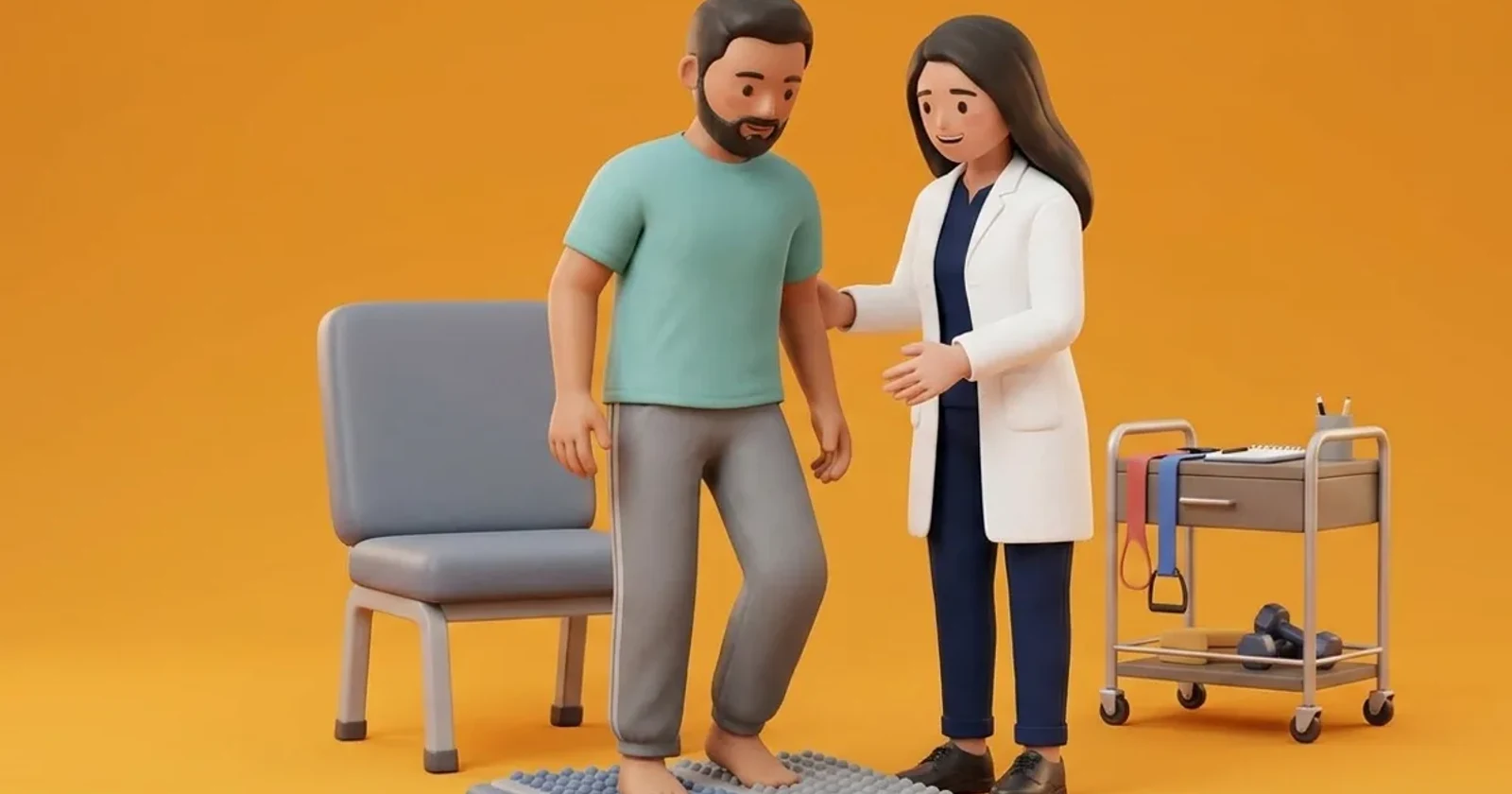
The physiotherapist role in the MDT clinic focuses on functional preservation and pressure redistribution. Therapists fabricate or fit total contact casts (TCC), train patients in crutch or walker non-weight bearing gait, and provide exercise prescriptions that maintain cardiovascular fitness without loading vulnerable feet. Once an ulcer heals, the physiotherapist coordinates with the orthotist to design long-term prescription footwear with rigid rocker soles and multi-density MCR insoles.
Seated Post-Clinic Multi-Joint Mobilisation Sequence
Objective: Reinforce lower limb circulation and joint mobility following clinical foot evaluation
- 1Sit upright in a chair with feet resting flat on a clean floor mat.
- 2Point and flex your ankles smoothly through available range for 15 repetitions.
- 3Gently rotate both ankles in full circles for 10 clockwise and 10 counter-clockwise cycles.
- 4Straighten one knee fully, hold for 5 seconds to engage your quadriceps, then lower gently.
- 5Repeat the knee extension with the opposite leg.
- 6Breathe deeply and relax in neutral posture.
| Clinical Specialist | Primary Clinical Responsibility | Key Diagnostic & Therapeutic Action |
|---|---|---|
| Diabetologist / Endocrinologist | Systemic metabolic & glycaemic control | Regulate HbA1c, manage renal and cardiovascular comorbidities |
| Vascular Surgeon | Macrovascular assessment & revascularisation | Doppler ABI, angiography, surgical bypass, endovascular stenting |
| Orthopaedic / General Surgeon | Surgical debridement & bone resection | Drainage of abscesses, partial ray amputations, Charcot reconstruction |
| Physiotherapist (NCAHP Act 2021) | Biomechanical offloading & gait rehabilitation | TCC application, crutch gait training, sensorimotor balance drills |
| Certified Orthotist / Prosthetist | Custom orthotic & footwear fabrication | CAD/CAM total contact insoles, MCR footwear, shoe fillers |
Red Flags and Urgent Diabetic Foot Escalation
Immediate emergency escalation within the MDT clinic pathway is required if a patient presents with an acute wet gangrene, spreading erythema with crepitus (gas in tissues), systemic signs of sepsis (fever, tachycardia, altered mental state), or sudden unilateral foot warmth and swelling indicating acute Charcot arthropathy. These conditions demand immediate hospital admission and emergency surgical consultation.
Frequently Asked Questions
Do I need a doctor referral to see a physiotherapist for diabetic foot offloading in India?
Under the National Commission for Allied and Healthcare Professions (NCAHP) Act 2021, registered physiotherapists in India are recognized as independent healthcare practitioners with direct access. You can consult a qualified physiotherapist directly for foot biomechanical screening, balance retraining, and offloading footwear prescription.
How do appointment bookings and payments work for physiotherapy consultations?
On BookPhysio.in, booking a home visit or clinic consultation is simple and transparent. Bookings are confirmed via secure email OTP without online payment collection. Patients pay the treating physiotherapist directly at the appointment. This ensures clear, professional care.
Related recovery guides & articles
BookPhysio.in Editorial Team
The BookPhysio.in editorial team writes and maintains this content, checking it against reliable clinical sources. Content follows our medical review policy: general information only, and no page claims a clinical review until a named registered physiotherapist has signed it off.
Read our medical review policy