
Uneven Paver Blocks and Broken Footpaths: Outdoor Stepping Mechanics for Seniors
In short
Cracked paver blocks, open drain slabs, and roadside potholes create hazardous pedestrian environments. Discover how adaptive gait mechanics protect senior balance.
In this guide (6 sections)
Outdoor community ambulation exposes older adults to unpredictable surface irregularities that challenge dynamic equilibrium. While indoor environments present predictable, level flooring, outdoor pedestrian paths demand constant neuromuscular adjustments. Epidemiological surveys indicate that over fifty percent of community falls occur in outdoor settings, with uneven pavements, broken concrete, and roadside potholes identified as the primary environmental triggers. Training seniors in adaptive stepping mechanics, gaze planning, and protective ankle stabilization preserves community mobility.
Domestic and Cultural Indian Realities
Pedestrian infrastructure in Indian residential colonies, municipal markets, and temple precincts presents distinct physical challenges. Sidewalks are frequently constructed from interlocking concrete paver blocks that sink or heave under monsoon rains and tree root growth, creating jagged height discrepancies of three to eight centimetres. In many neighbourhoods, footpaths are interrupted by open utility trenches, protruding water pipes, and broken stone drain slabs. Older Indians walking to local grocery stores, community parks, or neighborhood satsangs must negotiate these obstacles while sharing road margins with passing two-wheelers. Attempting to step around a pothole while wearing traditional footwear frequently leads to severe trip falls.
Clinical Biomechanics and Postural Control Decay
Walking across irregular terrain requires continuous anticipatory postural adjustments and rapid ankle joint corrections. When a foot lands on an uneven paver block, the ankle is forced into sudden inversion or eversion. In healthy young adults, fast-acting peroneal mechanoreceptors detect this angular displacement within thirty milliseconds, triggering an eccentric peroneal muscle contraction that prevents ligamentous failure. In older adults with delayed motor latency and reduced ankle subtalar joint range of motion, the lateral stabilizers react too slowly. The ankle rolls inward (inversion injury), shifting the body's base of support abruptly and causing the senior to fall sideways onto the road.
Functional Assessment and Risk Stratification
Clinical assessment evaluates uneven terrain walking using the Dynamic Gait Index (DGI) and the Emory Functional Ambulation Profile. The physiotherapist assesses the patient's step-width variability, gait speed modulation over irregular surfaces, and visual scanning habits. Older adults who fix their gaze strictly on their toes rather than scanning two metres ahead, or who display marked lateral trunk sway when stepping over five-centimetre obstacles, demonstrate high outdoor fall vulnerability.
Targeted Strength and Balance Exercises
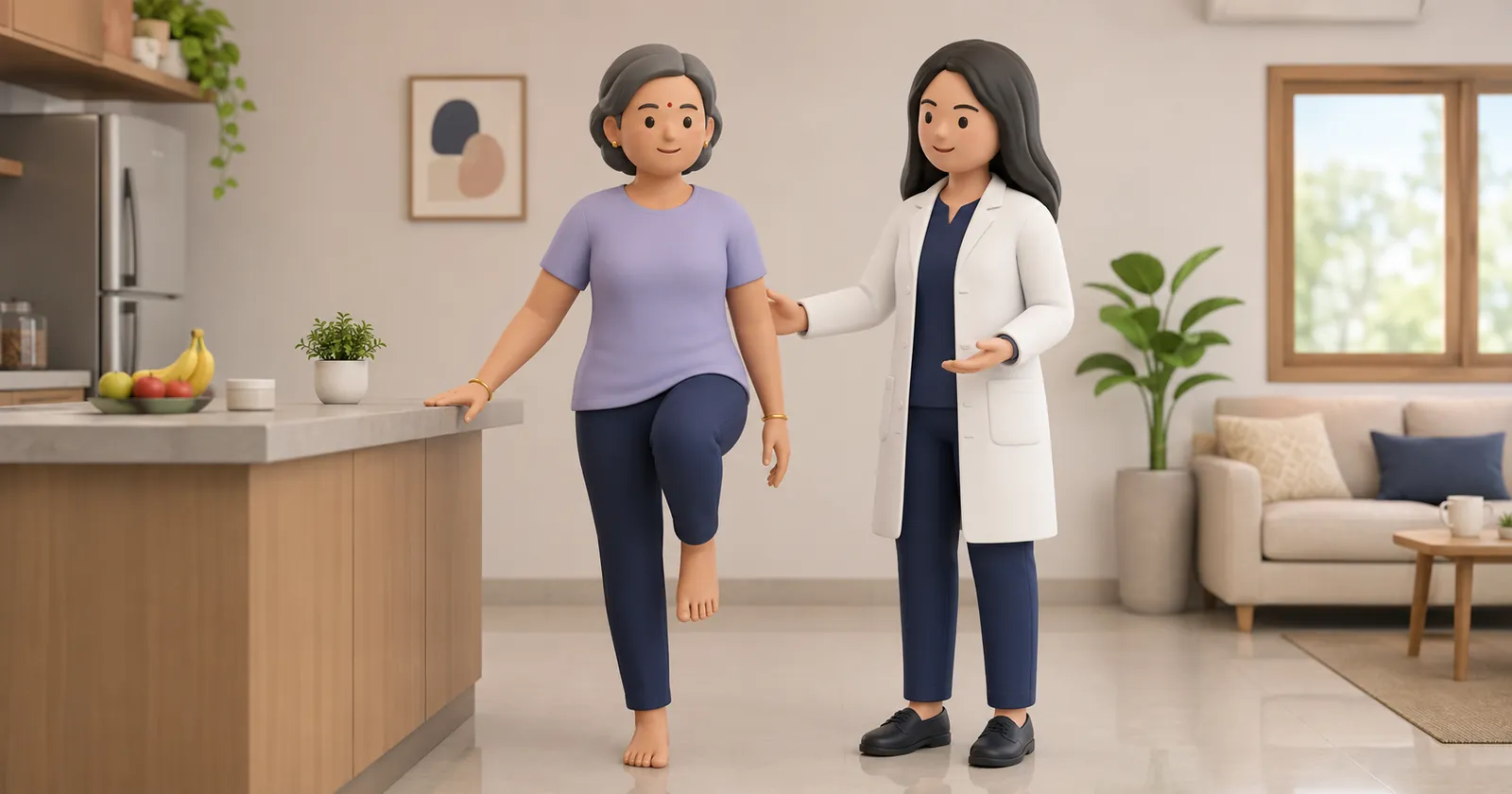
Physiotherapy rehabilitation focuses on dynamic ankle stability, high-stepping knee clearance, and visual look-ahead training. Training utilizes compliant foam pads, tandem walking drills, and obstacle courses that simulate outdoor neighborhood terrain under safe, supervised conditions.
Compliant Foam Ankle Proprioception and Stepping Drill
Objective: Recondition ankle subtalar reactive stabilization on uneven and shifting surfaces
- 1Place a high-density balance foam pad on a firm floor adjacent to a sturdy wall or parallel rail.
- 2Step onto the foam pad with both feet, keeping your hands hovering three centimetres above the rail.
- 3Maintain an upright, steady posture on the compliant foam for twenty seconds, feeling your ankles make micro-adjustments.
- 4Slowly march your knees in place on the foam, lifting each foot three centimetres off the pad.
- 5Step off the pad forward onto firm ground, pause, and step backward onto the foam with control.
| Road Hazard Scenario | Biomechanical Fall Mechanism | Clinical Stepping Strategy |
|---|---|---|
| Heaved or Sunk Paver Blocks | Toe clips vertical lip during swing phase; sudden forward trip | Adopt high-marching gait; lift knees 5 cm higher than normal stride |
| Loose Gravel on Tarmac Margins | Zero friction shear failure at heel strike; foot slides forward | Shorten stride length; plant foot flat with full-sole contact |
| Roadside Potholes and Gaps | Ankle inversion sprain upon landing in depression; lateral collapse | Perform visual path scanning 2 metres ahead; step around rather than across |
| Open Drain Slab Transitions | Wide stride over gap causes centre-of-mass overextension | Use a single-point walking cane planted ahead before stepping across |
Red Flags and Emergency Post-Fall Escalation
Outdoor falls on concrete or tarmac carry high risks of severe abrasions, head trauma, and compound fractures. If a senior falls on an outdoor road, inspect the limbs for visible bone deformity, severe localized joint pain, or bleeding wounds before moving them. Do not allow the patient to attempt weight bearing if the ankle or hip is deformed. Keep the patient warm, protect them from passing vehicular traffic, and contact emergency ambulance services immediately.
Frequently Asked Questions
Should an older adult stop outdoor walks if neighborhood footpaths are uneven?
Stopping outdoor walks accelerates physical deconditioning and worsens balance. Instead, seniors should use a properly measured walking cane, wear supportive rubber-tread shoes, and practice gait retraining with a physiotherapist to safely manage outdoor surfaces.
How do physiotherapists evaluate outdoor walking safety for seniors in India?
Geriatric physiotherapists conduct real-world outdoor gait evaluations, assessing kerb stepping, obstacle crossing, and cane mechanics in the patient's neighborhood. Under the NCAHP Act 2021, Indian patients access registered physiotherapists directly via BookPhysio.in with direct pay-per-session pricing.
Related recovery guides & articles
BookPhysio.in Editorial Team
The BookPhysio.in editorial team writes and maintains this content, checking it against reliable clinical sources. Content follows our medical review policy: general information only, and no page claims a clinical review until a named registered physiotherapist has signed it off.
Read our medical review policy