
Neuropathic Postural Instability in Diabetes: Romberg Testing and Balance Retraining
In short
Loss of somatosensory feedback leaves diabetic patients vulnerable to sudden balance loss and falls. Discover how Romberg testing evaluates sensory balance and learn structured retraining protocols.
In this guide (6 sections)
Postural stability relies on the central integration of three sensory inputs: somatosensory (proprioceptive and cutaneous mechanoreceptors), visual, and vestibular systems. In diabetic peripheral neuropathy, the somatosensory pathway is severely damaged, removing essential real-time feedback regarding joint position, ankle angle, and ground reaction forces. Patients become heavily reliant on visual input to maintain upright balance. When visual cues are removed or diminished (such as in dimly lit hallways or when closing the eyes to wash the face), rapid postural sway and falls occur. The Romberg test provides a validated clinical assessment to quantify somatosensory loss, guiding targeted balance rehabilitation that trains vestibular compensation and safe movement strategies.
Domestic and Cultural Indian Realities
In Indian residences, common architectural and environmental conditions heighten the risk of fall injuries for balance-impaired individuals. Smooth polished tile floors, high door thresholds (chaukhat), and loose cloth rugs (dhurries) create frequent tripping hazards. Traditional night routines often involve navigating dark corridors from bedroom to bathroom without turning on lights to avoid disturbing sleeping family members. Furthermore, closed-eye activities, such as washing the face over a sink or closing the eyes during spiritual prayer (pooja) while standing, precipitate sudden, severe disorientation. Patients must be taught to never stand with eyes closed without holding a firm support, to install night-lights along bathroom hallways, and to eliminate all loose floor rugs throughout the home.
Clinical Biomechanics and Neuropathic Breakdown
Maintaining upright posture requires rapid muscular corrections known as ankle and hip strategies. The ankle strategy relies on instant mechanoreceptive feedback from plantar cutaneous receptors and muscle spindles within the gastrocnemius and tibialis anterior to correct small centre-of-mass displacements. In diabetic neuropathy, delayed nerve conduction velocity and loss of large myelinated 1a afferent fibres abolishes this rapid ankle strategy. Patients are forced to rely on a clumsy hip strategy, producing larger, jerky trunk movements that increase dynamic instability. When the eyes are closed during testing, postural sway velocity and sway area increase by more than 200 percent compared to healthy individuals.
Clinical Assessment and Neuropathy Screening
Clinical evaluation utilizes the standard Romberg and Sharpened (Tandem) Romberg tests. In the standard test, the patient stands with feet together and arms crossed over the chest. The clinician observes postural sway for 30 seconds with eyes open, then instructs the patient to close their eyes. A positive Romberg sign is confirmed if the patient exhibits significant sway, takes a compensatory step, or begins to fall upon eye closure, demonstrating marked somatosensory deficit. Additional assessments include the Timed Up and Go (TUG) test, functional reach, and cutaneous sensation mapping with 10g monofilaments.
Targeted Offloading and Intrinsic Foot Conditioning
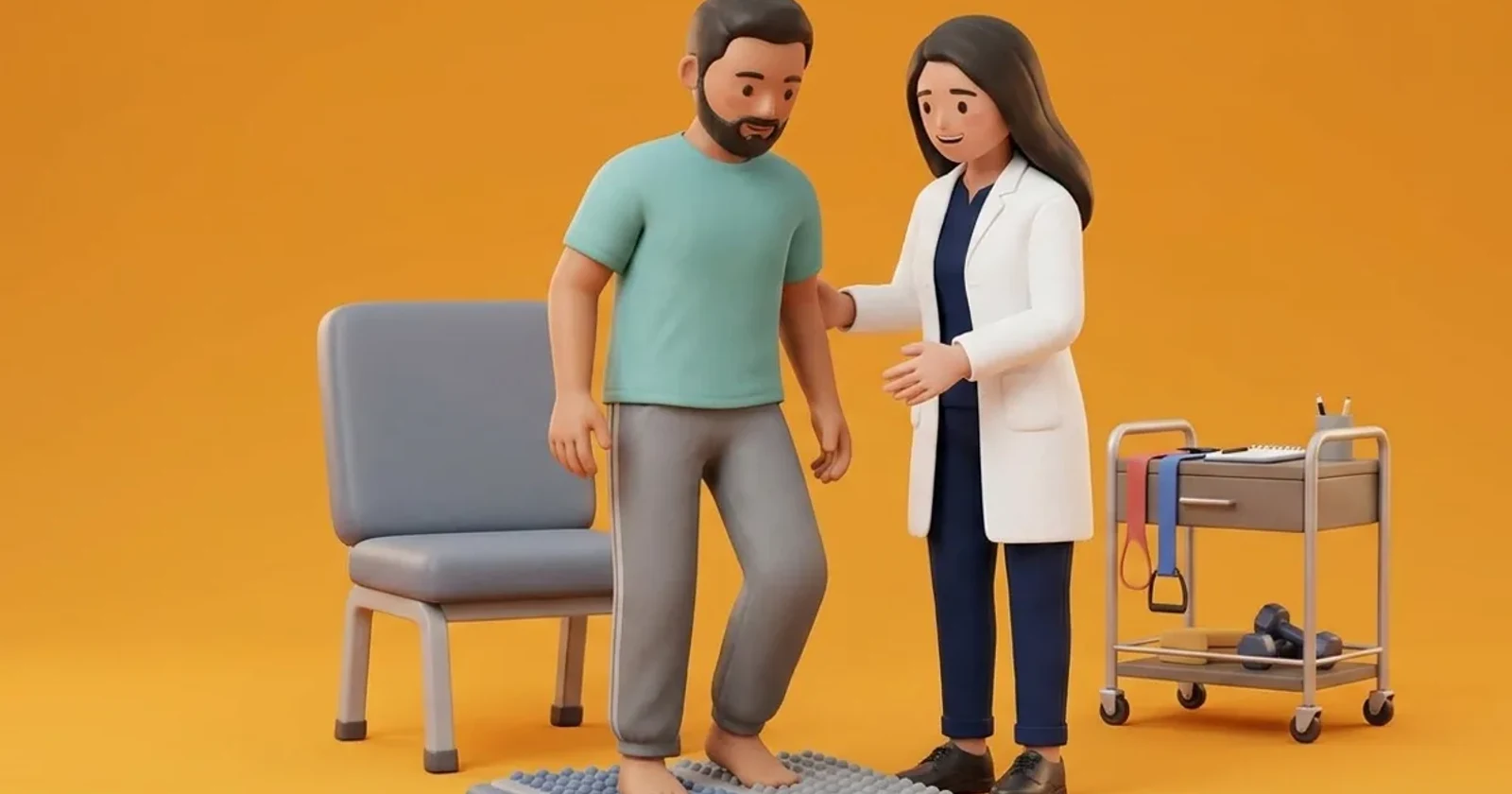
Physiotherapy rehabilitation utilizes sensory re-weighting protocols that strengthen remaining vestibular and visual systems while building lower extremity motor strength. Balance exercises must always be conducted in a safe environment, such as standing inside a room corner with a sturdy chair positioned directly in front. Progression moves from wide-base standing with eyes open to narrow-base tandem standing, weight-shifting drills, and incorporating head turns to challenge the vestibular apparatus.
Supported Corner Stance Balance Retraining
Objective: Train postural balance safely using room walls to eliminate fear of falling
- 1Stand facing outward in the corner of a room, with your back approximately 6 inches from the corner walls.
- 2Place a heavy, stable dining chair directly in front of you so your hands can touch the backrest.
- 3Stand tall with feet placed close together, keeping hands lightly resting on the chair back.
- 4Focus your eyes on a stationary visual target on the opposite wall at eye level.
- 5When steady, lift your fingers slightly off the chair back and maintain balanced upright posture for 20 seconds.
- 6If you feel unsteady, immediately place your hands back onto the chair or lean gently against the corner wall behind you.
| Sensory Balance Input | Neuropathic Status in Diabetes | Rehabilitation Strategy |
|---|---|---|
| Somatosensory (Proprioception) | Severe axonal loss; delayed conduction; absent ankle strategy | Prescribe structured footwear with firm heel counters; textured insoles |
| Visual System | Primary compensatory system; vulnerable to diabetic retinopathy | Improve ambient home lighting; clean eyeglasses; visual focal fixation drills |
| Vestibular System | Typically preserved; underutilized in static standing | Head-rotation balance exercises; vestibular adaptation and gaze stability training |
| Motor Effectors (Lower Limb) | Distal muscle weakness; slowed motor unit recruitment | Closed-chain quadriceps strengthening; calf stretching; core stabilization |
Red Flags and Urgent Diabetic Foot Escalation
Immediate medical escalation is necessary if a patient experiences sudden onset of true vertigo, spinning sensations, double vision, slurred speech, or unilateral facial weakness, which indicates a central neurological event such as a transient ischaemic attack or posterior circulation stroke. Any fall resulting in localized bone tenderness, inability to bear weight, or sudden deformity demands emergency radiographic imaging.
Frequently Asked Questions
Why do I lose my balance whenever I wash my face in the morning?
When you bend over a washbasin and close your eyes to splash water on your face, you simultaneously remove your visual reference and shift your centre of gravity forward. Because diabetic neuropathy has reduced the feeling in your feet, your brain receives zero feedback about your balance, causing immediate swaying. Always keep one hand resting firmly on the counter edge while washing your face.
Can balance exercises prevent falls if my nerve feeling does not come back?
Yes. Even if sensory feeling in the soles does not return, structured balance exercises teach your brain to rely more effectively on your inner ear (vestibular system) and vision. Training also strengthens the leg and hip muscles needed to catch yourself quickly if you stumble, substantially reducing your overall fall risk.
Related recovery guides & articles
BookPhysio.in Editorial Team
The BookPhysio.in editorial team writes and maintains this content, checking it against reliable clinical sources. Content follows our medical review policy: general information only, and no page claims a clinical review until a named registered physiotherapist has signed it off.
Read our medical review policy