
Osteoporotic Vertebral Compression Fractures: Spine-Sparing Movement in Seniors
In short
Over twenty percent of older women sustain osteoporotic vertebral fractures. Learn how spine-sparing movement mechanics and extensor strengthening prevent collapses.
In this guide (6 sections)
Osteoporotic vertebral compression fractures (OVCFs) represent the most common fragility fractures in older adults, affecting up to twenty-five percent of postmenopausal women and ten percent of older men. Unlike traumatic fractures that result from high-energy impacts, osteoporotic vertebrae collapse under routine physiological loads, such as bending forward to tie shoelaces, lifting a bucket, or sustaining a minor jar from a misstep. Once a vertebral fracture occurs, the altered spinal biomechanics quadruple the risk of subsequent adjacent vertebral collapses, causing progressive thoracic hyperkyphosis, balance impairment, and debilitating pain.
Domestic and Cultural Indian Realities
Indian domestic customs involve multiple daily activities that place severe compressive loads on the anterior spinal column. Traditional household cleaning frequently utilizes short brooms (jhadu), forcing women into sustained, deep forward spinal flexion while sweeping floor tiles. Similarly, manual clothes washing, bending forward to pick up heavy water buckets (baltis), and performing deep floor-bowing prayers (pranamas) in pooja rooms require extreme trunk flexion. Older Indian women who attribute height loss and curving spines to natural ageing often continue these flexion-heavy domestic routines, unknowingly triggering repeated wedge compression fractures in the mid-thoracic and thoracolumbar spine.
Clinical Biomechanics and Postural Control Decay
The vertebral body consists of an outer cortical shell surrounding an internal network of trabecular bone. In osteoporosis, trabecular plates thin and disconnect, drastically reducing compressive strength. Biomechanical testing reveals that forward trunk flexion increases anterior vertebral body compressive force by up to three hundred percent compared to standing upright. When an osteoporotic senior bends forward with a rounded spine, the anterior vertebral cortex collapses, creating a wedge-shaped deformity. Multiple wedge fractures produce hyperkyphosis (dowager's hump), shifting the body's centre of mass anteriorly. To prevent falling forward, the individual must hyperextend the neck and flex the knees, resulting in a fatigue-prone, unstable posture that dramatically increases fall risk.
Functional Assessment and Risk Stratification
Clinical evaluation includes the Occiput-to-Wall Distance (OWD) and Rib-to-Pelvis Distance measurements. An OWD greater than zero centimetres indicates abnormal thoracic kyphosis and suspected thoracic fracture, while a rib-to-pelvis distance of less than two finger-breadths signals lumbar compression fractures. The physiotherapist assesses functional lifting mechanics, spine-sparing awareness, and balance control using the Berg Balance Scale.
Targeted Strength and Balance Exercises
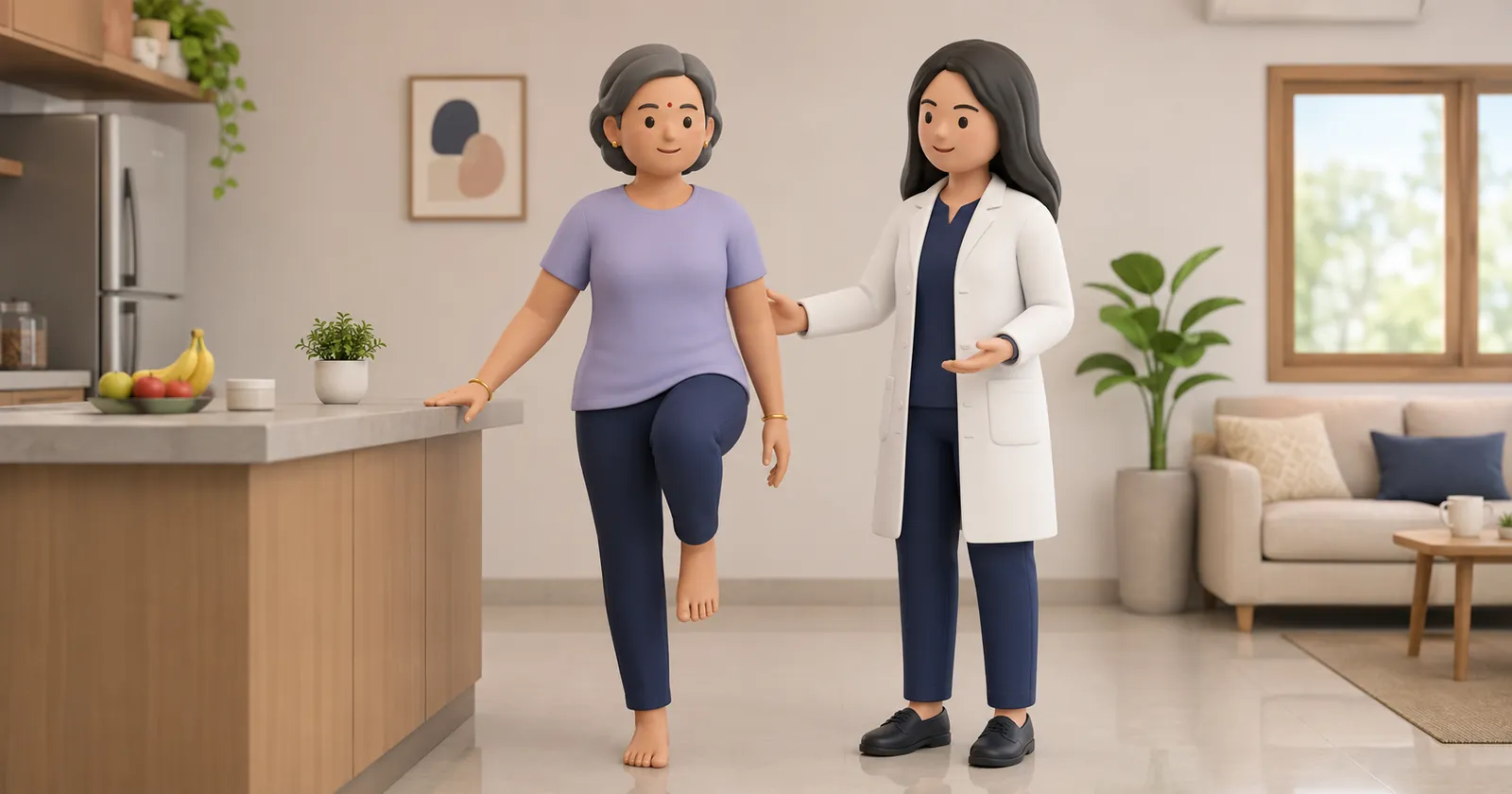
Physiotherapy rehabilitation for osteoporosis strictly contraindicates spinal flexion exercises (such as traditional sit-ups, toe touches, or deep forward yoga bends). Instead, therapy focuses on spine-sparing biomechanics, teaching the 'hip hinge' movement pattern, and strengthening the thoracic and lumbar extensor musculature to counteract progressive forward kyphotic collapse.
Prone Scapular Retraction and Thoracic Extension
Objective: Strengthen thoracic erector spinae and scapular retractors to reduce anterior vertebral body loading
- 1Lie face down on a firm bed or exercise mat with a small pillow placed under your lower abdomen for lumbar comfort.
- 2Rest your arms alongside your body with your palms facing inward toward your thighs.
- 3Gently draw your shoulder blades backward and downward toward your spine.
- 4Slowly raise your head, shoulders, and upper chest three to five centimetres off the mattress without straining your neck.
- 5Hold this gentle extension position for three seconds while breathing steadily, then lower smoothly back down.
| Daily Activity | High-Risk Flexion Habit | Spine-Sparing Ergonomic Modification |
|---|---|---|
| Floor Cleaning and Sweeping | Bending forward with short-handled jhadu | Use long-handled mop or broom; maintain erect spine and step forward |
| Lifting Household Objects | Rounding the lumbar spine to lift from floor | Perform hip-hinge technique; bend knees and hips while keeping spine neutral |
| Coughing or Sneezing | Unchecked rapid forward spinal flexion | Brace one hand against thigh or wall to support upper body; maintain neutral spine |
| Morning Bed Transfers | Curling spine forward directly into sit-up | Log-roll onto side, swing legs off bed edge, and push up using arm strength |
Red Flags and Emergency Post-Fall Escalation
Acute, severe, localized midline spinal pain following a minor slip or jar strongly suggests an acute vertebral compression fracture. Emergency red flags requiring immediate hospital neurosurgical evaluation include new-onset urinary or fecal incontinence, progressive lower-limb weakness, numbness in the saddle distribution (perineum), or electric-shock sensations radiating down the legs, indicating acute spinal cord or cauda equina compression.
Frequently Asked Questions
Should an older person with osteoporosis avoid all forward-bending yoga poses?
Older adults with diagnosed osteoporosis should strictly avoid spinal flexion postures such as Paschimottanasana (seated forward bend) and Halasana (plow pose). Safe yoga modifications focus on gentle spinal extension, hip opening, and standing balance while keeping the spine in neutral alignment.
How do physiotherapists help older patients with established vertebral compression fractures?
Physiotherapists provide spine-sparing movement education, prescribe postural extensor strengthening, and fit supportive spinal orthoses to relieve pain and prevent falls. Under the NCAHP Act 2021, Indian patients access registered physiotherapists directly via BookPhysio.in, paying directly per session without platform commissions.
Related recovery guides & articles
BookPhysio.in Editorial Team
The BookPhysio.in editorial team writes and maintains this content, checking it against reliable clinical sources. Content follows our medical review policy: general information only, and no page claims a clinical review until a named registered physiotherapist has signed it off.
Read our medical review policy